
Guide
The silver nitrate test for phosphine in acetylene: sensitivity interferences and the silver acetylide hazard
The silver nitrate test exposes paper wetted with silver nitrate solution to acetylene; phosphine blackens it as silver phosphide. About 5 vpm PH₃ stains instantly and under 1 vpm within minutes, so a stain on purified gas is a 10 to 50 fold excursion. IS 308:2024 specifies 0.1 % solution for 30 seconds.
- Sensitivity
- About 5 vpm phosphine discolours the paper almost immediately; under 1 vpm produces a stain in a few minutes
- IS 308 procedure
- 0.1 %
- Limits tested against
- 0.01 % v/v phosphorus compounds as PH₃ and 0.02 % v/v sulphur compounds as H₂S
- Interference
- Arsine and hydrogen sulphide also stain the paper; the test shows a hydride
- Hazard
- Silver acetylide formed in silver nitrate solution is explosive when dry; decompose with dilute hydrochloric acid
The silver nitrate test is the oldest, cheapest and still the most useful check an acetylene plant has on its purifier. A strip of filter paper wetted with silver nitrate solution, held in a stream of acetylene, stays white if the gas is clean and turns brown or black within seconds if phosphine is present. Its sensitivity is far better than most operators realise, and it has one real hazard that most plants forget.
What the paper is reacting with
Crude acetylene from a carbide-to-water generator carries phosphine, hydrogen sulphide, arsine and ammonia in small quantities, all of them hydrolysis products of impurities in the carbide. Phosphine is the one that matters, because the lime slurry in the generator holds back most of the sulphur but almost none of the phosphorus. A British survey compiled by Miller found 150 to 310 vpm of phosphine in gas from most commercial carbides and 800 to 1,000 vpm from Indian carbide in the 1950s and 1960s, so an Indian plant's purifier is working hard, and the test that proves it is working matters more here than almost anywhere.
Phosphine reduces silver nitrate, depositing black silver and silver phosphide. Hydrogen sulphide gives black silver sulphide. Arsine darkens the paper in the same way. The reaction is fast and the stain is permanent, so the test is binary: white means the hydride content is below the paper's threshold, any colour means it is not.
How sensitive is it?
The sensitivity figures are published in the analytical literature on acetylene and were compiled by Miller in 1965. Silver nitrate paper discolours virtually immediately at about 5 vpm of phosphine, and produces a stain in a very few minutes at less than 1 vpm. A tube packed with silver nitrate on silica gel, read by the length of the stain, measures phosphine down to units of 0.001 vpm, but only in the absence of arsine and hydrogen sulphide, which also stain. The primary sources are French Standard NF T 22-001 of October 1954, Strizhevskii and Zaitseva in Zavodskaya Laboratoriya (1956) and Nelson in Analytical Chemistry (1957).
Those numbers put the test in perspective. A ferric chloride purifier in good order delivers gas at about 0.1 vpm of phosphine. IS 308:2024 allows 0.01 % by volume, which is 100 vpm. The paper responds at 5 vpm. So a stain on gas leaving the purifier is not a marginal result; it is a 10 to 50 fold excursion above what the bed should be giving, and the gas is still within the standard. That is exactly what a breakthrough detector should be: it fires long before the product is out of specification.
| Level | Phosphine as PH₃ | What it means |
|---|---|---|
| Purifier in good order | about 0.1 vpm | No stain at any exposure |
| Paper responds | about 5 vpm instantly; under 1 vpm in minutes | Bed is breaking through; withdraw it |
| IS 308:2024 limit | 100 vpm (0.01 % v/v) | Product no longer conforms |
| Raw gas, normal carbide | 150 to 310 vpm | Unpurified |
| Raw gas, Indian carbide (historic survey) | 800 to 1,000 vpm | Unpurified |
How IS 308:2024 runs the test
Annex B of IS 308:2024 gives the acceptance procedure for dissolved acetylene. The cylinder or rack sample is purged through a pressure regulator at a discharge pressure of 0.2 kg/cm², venting roughly one-sixth of the cylinder's contents before the test. Filter paper is wetted with silver nitrate solution of 0.1 % mass per volume. With the regulator gauge at not more than 0.2 kgf/cm², the needle valve is opened and the gas allowed to play on the paper for 30 seconds. A brown or black paper is a fail. Clause 6.2 requires two separate samples from the filling rack, and clause 7 makes conformity conditional on both passing every requirement in Table 1, which also caps total impurities insoluble in acetone at 4 % by volume and moisture at 0.25 % by mass. Samples may instead be drawn from 5 % of the cylinders after blowing off about 15 % of the gas.
The same annex gives the quantitative methods behind the limits. Sulphur compounds are absorbed in sodium hypochlorite and weighed as barium sulphate, 1 g of which is equivalent to 0.096 litre of H₂S at NTP; phosphorus compounds are oxidised, precipitated as ammonium phosphomolybdate and titrated with 0.1 N sodium hydroxide. These are laboratory determinations. The silver nitrate paper is the plant's shift-by-shift screen that makes them rarely necessary.
How a KIGL plant uses it
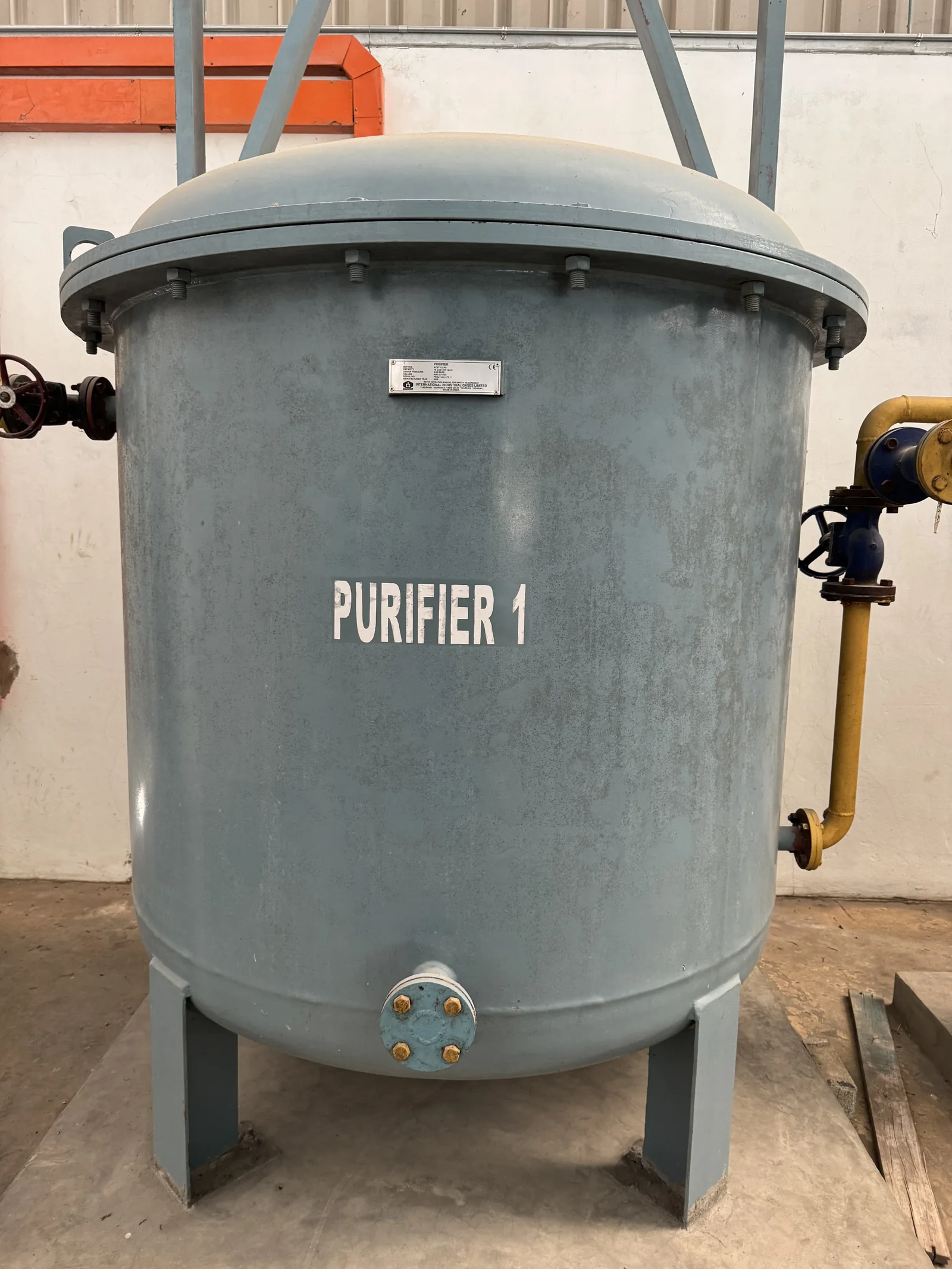
The plant test is simpler and harsher than the standard's. KIGL's operation manual takes gas leaving the top tray of the purifier in service and exposes test paper saturated with a 5 % silver nitrate solution. The result is recorded once per shift as pass or fail in the shift log, with the purity figure from the acetone absorption test beside it. A stain withdraws the purifier immediately and brings the standby unit on line; the fail is entered in the purifier record, which must show every purity result, every date out of and back into service, and the hours and maximum air temperature of every regeneration.
The manual's reasoning is that purification is a rotation, not a single bed. Two purifiers alternate, and the test decides when they swap. Regeneration is never later than 3 weeks, but on high-phosphorus carbide the paper may call it first. As general engineering practice rather than a manual instruction, a bed that stains early after regeneration is worth checking for water in the mass or channelling before it is written off as spent.
The interferences, honestly stated
The test shows a hydride, not phosphine specifically. For wet generation that distinction rarely matters: hydrogen sulphide in crude gas is usually below 10 vpm and arsine around 3 vpm, so the paper is effectively a phosphine test. It stops being one after a bad carbide lot with high sulphur, or in a water-to-carbide generator where, with no lime slurry to scrub it, hydrogen sulphide can rise to 500 vpm or more.
Where it matters, hydrogen sulphide is separated by lead acetate paper, which responds to H₂S at 1 to 20 vpm and not to phosphine (Detection of Toxic Gases in Industry, DSIR Leaflet No. 2, 1955). Arsine is determined by the Gutzeit method. In practice a plant can run lead acetate paper alongside silver nitrate whenever a silver nitrate stain is unexplained, or when the carbide supplier changes.
The hazard in the used paper
Acetylene in contact with silver nitrate solution forms silver acetylide, usually as the double salt with silver nitrate. The compound is explosive when dry and sensitive to friction, impact and heat. KIGL's manual states it plainly: paper saturated with silver nitrate solution is ignitable like a match in sunlight, and must be burnt or disposed of outside the plant. In analytical work the acetylide precipitated during a determination is decomposed with dilute hydrochloric acid before the vessel is emptied, and the same treatment is the right one for a plant's used strips: drop them into dilute acid while still wet, then dispose of the liquor. Never let a used paper dry on a window ledge, and never keep a jar of them.
The acetylide chemistry is also the reason copper and silver are banned from acetylene plants: the same class of compound forms on copper-rich fittings and on silver brazing alloys, and it detonates there with no paper to warn anybody.
What a stain does not mean
A phosphine stain is not a sign that the gas is about to explode. Measurements of the minimum ignition temperature of the most easily ignited acetylene-air mixtures by Ershov, Lyadski and Ragnueva (Khimicheskaya Promyshlennost, 1961) show 330 °C at 0.01 % PH₃, still 310 °C at 0.17 %, and only 220 to 225 °C at 2.58 %. The authors concluded that 0.2 % phosphine adds nothing to the hazard of generating acetylene. The levels a purifier deals with are a hundred times lower than that. Phosphine is toxic, it corrodes wet steel, it is absorbed and held by the porous mass and acetone in a cylinder, and it is limited by IS 308 for all three reasons. The claim, sometimes made, that phosphine makes the gas easier to ignite does not survive the data.
Rules that matter
Procedure card
- Sample point: gas leaving the purifier top tray.
- Reagent: silver nitrate solution, freshly applied to filter paper; keep the bottle out of sunlight.
- Exposure: a gentle stream, 30 seconds; regulator or needle valve barely open, never a jet.
- Read: white is a pass; any brown or black is a fail. Record pass or fail with time and purifier number.
- On a fail: withdraw the purifier, switch to standby, log it, regenerate, shorten the interval.
- Disposal: wet paper into dilute hydrochloric acid, or burnt outside the plant; never dried, never stored.
- Companion tests: lead acetate paper for hydrogen sulphide if the stain is unexplained; acetone absorption for insolubles, limit 4 % by volume under IS 308.
The test costs a few rupees per shift. The cylinders it protects, and the customers who fill from the KIGL purification system, cost considerably more.
— frequently asked questions
What does the silver nitrate test detect in acetylene?
Non-metallic hydrides. Phosphine reacts with silver nitrate to give black silver phosphide and silver; hydrogen sulphide gives black silver sulphide; arsine also darkens the paper. In gas from a carbide-to-water generator hydrogen sulphide is normally under 10 vpm and arsine a few vpm, so a stain almost always means phosphine, but strictly the test says only that a hydride has passed the purifier.
How sensitive is the silver nitrate paper?
Very. Published work compiled by Miller gives an immediate discolouration at about 5 vpm of phosphine and a visible stain within a few minutes below 1 vpm. A tube of silver nitrate on silica gel, read by stain length, measures phosphine down to about 0.001 vpm in the absence of arsine and hydrogen sulphide. Against the IS 308 limit of 100 vpm the paper has a margin of twenty to a hundred times.
How is the test done to IS 308:2024?
Annex B of IS 308:2024 purges the sample through a pressure regulator at 0.2 kg/cm², venting about one-sixth of a cylinder's contents first, then releases gas through the needle valve for 30 seconds against filter paper wetted with 0.1 % (m/v) silver nitrate solution. A brown or black paper fails. Two separate rack samples are taken and both must pass for the lot to conform.
What strength of silver nitrate does a plant use?
KIGL's plant manual uses test paper saturated with a 5 % solution at the purifier outlet, which is a stronger reagent than the 0.1 % solution IS 308 specifies for cylinder gas. The plant test is a go or no-go screen for the purifier; the standard's paper test is its qualitative screen for cylinder gas, backed by the quantitative Annex B-4 and B-5 methods. Both work because the reaction is fast and the stain is unmistakable.
Why is the used paper dangerous?
Acetylene reacts with silver nitrate to form silver acetylide, which is explosive when dry and sensitive to friction and heat. KIGL's manual warns that the paper is ignitable like a match in sunlight and must be burnt or disposed of outside the plant. The laboratory practice is to decompose the acetylide with dilute hydrochloric acid while it is still wet.
What should the operator do when the paper stains?
Take the purifier out of service immediately and switch to the standby unit; record the fail in the purifier log and the shift log; regenerate the failed bed and shorten its interval in the rotation. If a freshly regenerated bed stains early, check for water in the mass or channelling before assuming the mass is spent.
Can silver nitrate measure acetylene purity?
No. It detects hydrides only. Purity in the sense of total impurities insoluble in acetone is measured by absorption in acetone (IS 308:2024 Annex B-3), typically with an Orsat-type apparatus; the limit is 4 % by volume. A plant needs both tests: the acetone absorption for air and other inerts, silver nitrate for phosphine and sulphur.
Does phosphine make acetylene more likely to explode?
Not at real concentrations. Minimum ignition temperatures of impure acetylene-air mixtures measured by Ershov, Lyadski and Ragnueva (1961) stay above 300 °C up to about 0.2 % phosphine and only fall to 220 to 225 °C at 2.6 %, far above any plant temperature. Phosphine is a purity, corrosion and toxicity problem; the test exists for the cylinder and the customer, not for the generator.
References
- Bureau of Indian Standards. (2023). Acetylene — Code of Safety (IS 14814:2023, First Revision).
- Bureau of Indian Standards. (2024). Dissolved Acetylene (Gas) — Specification, Annex B (IS 308:2024, Fourth Revision).
- Compressed Gas Association. (n.d.). Acetylene (CGA G-1).
- Linstrom, P. J., & Mallard, W. G. (Eds.). (n.d.). NIST Chemistry WebBook (NIST Standard Reference Database 69). National Institute of Standards and Technology. [phosphine and acetylene property data] https://webbook.nist.gov/chemistry/
Enquiries
Request a quotation
State the gas or equipment, the quantity or capacity, and your location. KIGL will confirm the grade, the cylinder or plant size, and whether the location can be served from Noonmati, or through the agent network.