
Guide
Phosphine in acetylene: why Indian carbide carries three to six times the purifier duty
Phosphine in acetylene comes from calcium phosphide in the carbide, and about 90 % of the carbide's phosphorus leaves the generator as PH₃. A BOC survey of 19 manufacturers put world-normal raw gas at 150–310 vpm but Indian carbide at 800–1,000 vpm, against the IS 308:2024 limit of 0.01 %, or 100 vpm.
- Phosphorus carry-through
- About 90 % of the phosphorus in carbide is evolved as phosphine; under 3 % of the sulphur is evolved as hydrogen sulphide
- Phosphide in carbide
- About 1 g of Ca₃P₂ per kg of technical carbide
- Indian carbide gas
- 800
- Indian cylinder limit
- 0.01 % v/v PH₃ and 0.02 % v/v H₂S in dissolved acetylene
- Carbide gas limit, 1987 edition
- 0.06 % PH₃ for Quality A and C carbide
Every carbide-route acetylene plant has a purifier, and most operators would say it exists to remove impurities. It exists, almost entirely, to remove one impurity. Phosphine is the binding constraint on carbide acetylene because of two facts: nearly all the phosphorus in the carbide leaves with the gas, and the generator's water, which strips out hydrogen sulphide and ammonia almost completely, does nothing to phosphine. Indian carbide makes the problem larger. A survey compiled in 1965 put the raw gas from Indian carbide at 800–1,000 volumes per million of phosphine against a world-normal 150–310, and the Indian cylinder specification, IS 308:2024, allows 100.
Where the phosphorus comes from
A carbide furnace does no refining. Lime and coke are reacted in an electric arc at around 2,000 °C, and apart from the dust carried off by the carbon monoxide and a little hydrogen, nearly everything that goes in comes out in the carbide. The average material balance compiled by S. A. Miller (1965), checked against the page image, puts the phosphorus input at 0.5 g of P₂O₅ per kg of carbide made, 0.3 g from the lime and 0.2 g from the coke. Of that, only about 0.1 g escapes as phosphorus vapour; the rest reports to the product as calcium phosphide, about 1 g of Ca₃P₂ per kg of carbide. Roughly 80 % of the phosphorus fed ends up in the bag the acetylene plant buys.
Sulphur follows a different path. It enters almost entirely with the coke, 5 g of S per kg of carbide from a coke of 0.8 % sulphur in Miller's balance, plus a little calcium sulphate in the lime, and it is converted almost quantitatively to calcium sulphide, about 9 g of CaS per kg. The work of Ershov and Pagnueva (J. Appl. Chem. USSR, 1961, 34, 809 and 2035) established the mechanism: sulphur dioxide is reduced to sulphur, which reacts with lime to CaS below the temperature at which the furnace charge melts, and the reaction CaS + 2C → CaC₂ + S only begins at 2,100 °C. Juza and Bünzen (Z. anorg. Chem., 1958, 295, 334) found calcium sulphide and sulphate converted by carbon only at 2,800–2,900 °C, with CaS beginning to disappear from carbide at about 2,600 °C. Furnaces do not run that hot, so coke sulphur is permanent.
Phosphorus is not. Ershov and Kozlov (1962) found that petroleum coke saturated with phosphoric acid and heated to 2,000 °C retained only 0.16 % of its phosphorus, and that the same coke washed first with milk of lime and dried retained only its original 0.01 % after heating. Phosphorus volatilises strongly at furnace temperatures; calcium phosphide in carbide reaches a maximum at about 1,800 °C and then decreases. This is why Miller's raw-material specification for a carbide works put phosphorus in the lime at under 0.01 %, and why that specification is the only lever anywhere in the chain that acts on phosphine at source.
What happens in the generator
In the generator the chemistry inverts the furnace result. Calcium phosphide hydrolyses completely: Ca₃P₂ + 6 H₂O → 2 PH₃ + 3 Ca(OH)₂, with no reverse reaction. Calcium sulphide hydrolyses only partly, and reversibly, because the excess lime in the slurry holds the equilibrium back. The quantitative outcome was measured by Racicot (Anal. Chem., 1951, 23, 1873) and by Ershov and Pagnueva (Khim. Prom., 1961, 182): about 90 % of the phosphorus in the carbide is evolved as phosphine with the acetylene, under 3 % of the sulphur is evolved as hydrogen sulphide, and ammonia from the carbide's nitrogen compounds is mainly held in the sludge.
| Element in carbide | Typical content | Fraction leaving in the gas | Form | Where the rest goes |
|---|---|---|---|---|
| Phosphorus, as Ca₃P₂ | About 1 g/kg | About 90 % | PH₃ | About 10 % stays in the lime |
| Sulphur, as CaS | About 9 g/kg | Under 3 % | H₂S | Over 97 % stays in the lime sludge |
| Nitrogen, as Ca₃N₂ and CaCN₂ | About 2 g/kg | Small | NH₃ | Mainly held in the sludge |
The consequence is counter-intuitive and worth stating plainly: commercial carbide contains roughly nine times more calcium sulphide than calcium phosphide by mass, yet its sulphur delivers less than half as many molecules of impurity to the gas as its phosphorus does. A buyer who screens carbide on total sulphur and ignores phosphorus is optimising the wrong variable.
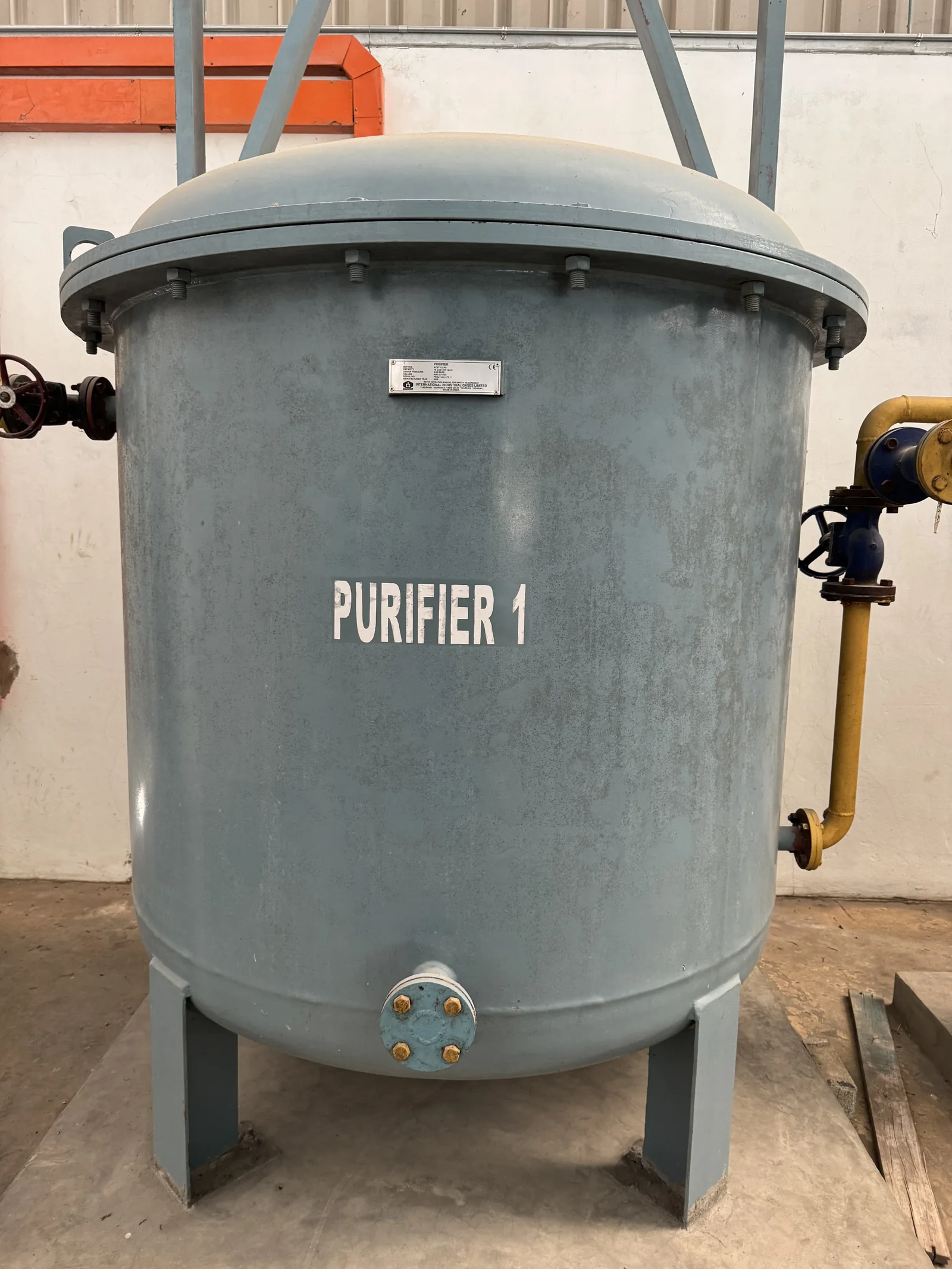
The C.P.I. (1968) described the downstream fate of each gas. Hydrogen sulphide and ammonia are soluble in water and are practically nil at the outlet of a generating installation with its usual washers and gasholders. Phosphine is practically insoluble in water and is not held back by lime water; it accompanies the acetylene as far as the plant where it is used, unless a chemical purifier removes it. The purifier oxidises phosphine to phosphates on a bed of ferric oxychloride, chromic acid or hypochlorite on an inert support; how the bed is loaded and regenerated is covered in purifier regeneration and bed life, and the works test for breakthrough in the silver nitrate test.
The Indian figures
The most striking data in Miller's compilation come from a BOC survey of 19 carbide manufacturers in 12 countries, which gave a world-normal range of 150–310 vpm phosphine in raw generator gas and the following outliers:
| Carbide origin | PH₃ in raw gas, vpm |
|---|---|
| World-normal range, 19 manufacturers | 150–310 |
| India | 800–1,000 |
| Czechoslovakia | 900 |
| Bulgaria | 710 |
| Poland | 600 |
| Spain | 500 |
| One Canadian product | 90 |
The US cylinder specification of the period allowed 50 vpm for Grade A and 500 vpm for Grade B; unpurified gas from Indian carbide failed even Grade B by a factor of two. EIGA Doc 123, the current European code of practice, gives unpurified gas at 300–500 ppm typically and over 1,000 ppm with poor carbide, which brackets the same range sixty years later, and notes that purified targets as low as 1 ppm are not uncommon. The survey figure for Indian carbide is from the 1960s, when Indian carbide manufacture was less than fifteen years old; whether it still describes today's supply is a question for the silver nitrate bottle, not for a book, and KIGL treats it as unconfirmed. What is not in doubt is the mechanism: whatever phosphorus the lime and coke bring in largely stays in the carbide, and the purifier inherits it.
The practical consequence for an Indian plant is that its purifier beds carry a multiple of the phosphine duty per cubic metre that the international literature assumes. A regeneration interval copied from a European manual, or set by the calendar, has no basis; the interval must be set by breakthrough on the silver nitrate test. That point is developed on the purifier page.
The standards, old and new
Carbide standards have always limited phosphine, and always as a property of the gas evolved rather than of the carbide. The C.P.I.'s International Standards for Calcium Carbide, in force from 9 July 1930, set 0.06 % by volume with an analytical latitude of 0.01 %. Miller's compilation of 1960s national standards gives 0.04 % in the USA and France, 0.06 % in Britain, Germany and the international draft, 0.08 % in Russia and 0.05–0.10 % across the three Japanese grades. IS 1040:1987, the Indian carbide specification since superseded by IS 1040:2024, set 0.06 % for Quality A and C carbide and 0.08 % for Quality B, with 0.15 % H₂S, 0.001 % AsH₃ and 0.10 % NH₃, all as a percentage by volume of the acetylene evolved by its own test method.
The cylinder specification is written by a different committee and to a different purpose. IS 308:2024 caps phosphine in dissolved acetylene at 0.01 % by volume and hydrogen sulphide at 0.02 %. The gap between the carbide standard and the cylinder standard is the purifier's duty; a plant that buys compliant Quality B carbide and fills compliant cylinders is relying on its purifier for the whole of the difference. The exact factor depends on the carbide actually delivered and on the edition of IS 1040 in force, which is why this page does not print a single removal percentage. See IS 308 explained and acetylene grades explained.
Is phosphine dangerous?
Two questions have been asked of phosphine in acetylene since the 1890s: does it ignite spontaneously in air, and is it toxic. The C.P.I. answered both in 1968 at the 0.06 % then permitted: the proportion is too small for explosions or poisoning to be dreaded. Miller's compilation of the generator-hazard data reaches the same conclusion, that phosphine is not an ignition hazard at the concentrations found in carbide acetylene. The reasons the C.P.I. gave for limiting it are technical: it is not soluble in acetone and so accumulates in the gas phase of a dissolved acetylene cylinder, it causes operating difficulties in the welding of certain metals, it poisons catalysts in chemical use, and it gives commercial acetylene its garlic odour.
IS 14814:2023 is more careful on toxicity than the older literature: it sets 0.5 % (5,000 ppm) as the maximum permissible acetylene concentration in a working environment, falling to 500 ppm if the acetylene contains 0.05 % phosphine. Phosphine itself is highly toxic, so a plant that smells it strongly at the purifier outlet or the lime pit has a purification problem to fix, and work areas should be ventilated. Saying so plainly, rather than implying an explosion risk, is the accurate position.
Rules that matter
Rules to apply
- Buy carbide on phosphorus, not on sulphur. Ask the supplier for the PH₃ figure in the evolved gas by the IS 1040 method, and note which gasification method produced it.
- Test the purifier outlet on the silver nitrate test every shift and regenerate or change over on breakthrough, not on the calendar.
- Treat a purifier sized for European carbide as undersized for Indian carbide until the plant's own breakthrough data say otherwise.
- Expect sulphur and ammonia in the lime pit, not in the gas; they are an effluent question, covered in carbide lime sludge handling.
- Keep the KIGL purification system in rotation with a standby so that a failed bed never reaches the compressor.
Phosphine — frequently asked questions
Why does carbide acetylene contain phosphine?
Phosphorus enters the carbide furnace as P₂O₅ in the lime and the coke, about 0.5 g per kg of carbide made, and most of it reports to the product as calcium phosphide, Ca₃P₂, about 1 g/kg. In the generator Ca₃P₂ hydrolyses completely to phosphine and lime; published work puts the fraction of carbide phosphorus leaving as PH₃ at about 90 %.
How much phosphine is in Indian carbide acetylene?
A survey by BOC of 19 carbide manufacturers in 12 countries, compiled in 1965, gave a world-normal range of 150–310 vpm phosphine in the raw gas, with Indian carbide at 800–1,000 vpm, Czechoslovak at 900 and one Canadian product at 90. EIGA Doc 123 gives unpurified gas at 300–500 ppm typically and over 1,000 ppm with poor carbide. Whether the 1960s Indian figure still holds should be checked on current supply.
What is the phosphine limit in dissolved acetylene in India?
IS 308:2024 limits phosphine to 0.01 % by volume, which is 100 vpm, and hydrogen sulphide to 0.02 % by volume. The carbide standard IS 1040:1987 allowed 0.06–0.08 % PH₃ in the gas evolved from compliant carbide, so the purifier exists to close the gap between what compliant carbide may deliver and what a filled cylinder may contain.
Why does the purifier remove phosphine but not sulphur?
Because the two impurities behave differently in water. Hydrogen sulphide and ammonia dissolve in the generator water and condensate and are largely gone by the time the gas leaves the washer; the C.P.I. called them practically nil at the generator outlet. Phosphine is practically insoluble in water and is not held back by lime water, so it travels with the gas until a chemical purifier oxidises it.
Is phosphine in acetylene an explosion hazard?
Not at the concentrations found in carbide acetylene. The C.P.I. (1968) said there was no occasion to worry about spontaneous ignition or poisoning at the 0.06 % then permitted, and Miller's compilation reaches the same conclusion. The reasons phosphine is limited are product quality, welding defects, catalyst poisoning in chemical use, cylinder and porous mass life, and odour.
Can a carbide buyer reduce phosphine at source?
Only through the carbide maker's lime. Phosphorus volatilises strongly at furnace temperatures, whereas calcium sulphide needs about 2,600–2,800 °C to be destroyed and so survives normal furnace practice. A lime specification of under 0.01 % phosphorus is the one lever that acts on the impurity the purifier struggles with.
Does the test method change the phosphine result?
Yes. The same carbide gives different PH₃, H₂S and NH₃ results depending on whether it is gasified water-to-carbide or carbide-to-water, so a supplier's certificate by one method is not comparable with a works result by the other. IS 1040 fixes its own gasification method for this reason.
References
- Bureau of Indian Standards. (1987). Calcium Carbide, Technical (scan, Public Resource BIS mirror) (IS 1040:1987, Third Revision).
- Bureau of Indian Standards. (2024). Dissolved Acetylene (Gas) — Specification (IS 308:2024, Fourth Revision).
- CGA publications on acetylene
- European Industrial Gases Association. (n.d.). Code of Practice: Acetylene (EIGA Doc 123).
Enquiries
Request a quotation
State the gas or equipment, the quantity or capacity, and your location. KIGL will confirm the grade, the cylinder or plant size, and whether the location can be served from Noonmati, or through the agent network.