
Guide
Permanent liquefied and dissolved gases: why an oxygen cylinder is sold by cubic metre, a CO₂ cylinder by kilogram and an acetylene cylinder by net weight
A permanent gas such as oxygen, nitrogen or argon has a critical temperature below −10 °C and stays gaseous, so cylinder pressure shows contents. A liquefied gas such as CO₂ is liquid inside and holds about 57 bar at 20 °C until the liquid is gone, so it is sold by weight, like dissolved acetylene.
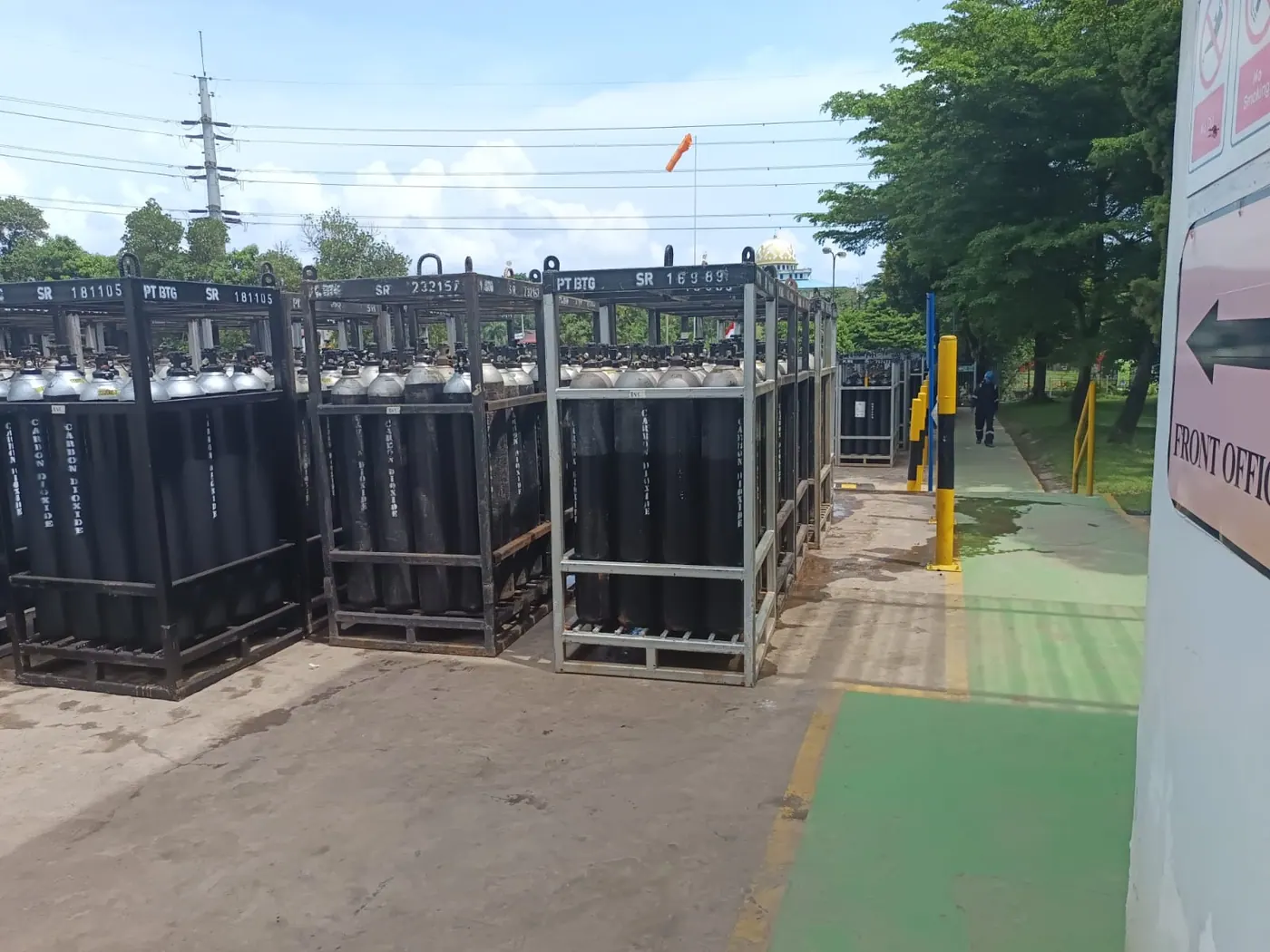
- Permanent gas
- Critical temperature below −10 °C; working pressure is the internal pressure at 15 °C
- Liquefiable gas
- Liquefied by pressure at −10 °C but fully vaporised at 760 mm Hg and 17.5 °C
- CO₂ cylinder pressure
- 5.73 MPa
- CO₂ left when the gauge starts to fall
- About 9 kg in a 46.7 litre cylinder at 20 °C
- Dissolved acetylene
- Cylinder pressure not to exceed 16 kgf/cm² at 15 °C; contents are gross weight minus stamped tare
Gases go into cylinders in three physical forms, and the form decides how the contents are measured, sold and checked. Permanent gases such as oxygen, nitrogen and argon stay gaseous at any pressure at room temperature, so the gauge tells you the contents. Liquefied gases such as carbon dioxide and nitrous oxide are liquid in the cylinder, so the gauge reads the same until the liquid is gone and they are sold by weight. Acetylene is a dissolved gas, held in acetone or DMF inside a porous mass, and it is also measured by weight.
Permanent, liquefied and dissolved gases compared
| Gas | Critical temperature | Class under GCR 2016 | Form in the cylinder at 15 °C | Contents measured by | Does the gauge show contents? |
|---|---|---|---|---|---|
| Oxygen | −118.57 °C | Permanent | Compressed gas | m³ from pressure and temperature | Yes |
| Nitrogen | −146.96 °C | Permanent | Compressed gas | m³ from pressure and temperature | Yes |
| Argon | −122.46 °C | Permanent | Compressed gas | m³ from pressure and temperature | Yes |
| Compressed air | about −140.6 °C | Permanent | Compressed gas | m³ from pressure and temperature | Yes |
| Hydrogen | −240.01 °C | Permanent | Compressed gas | m³ from pressure and temperature | Yes |
| Helium | −267.95 °C | Permanent | Compressed gas | m³ from pressure and temperature | Yes |
| Carbon dioxide | 30.98 °C | High-pressure liquefiable | Liquid and vapour | kg, by weight minus tare | No |
| Nitrous oxide | 36.37 °C | High-pressure liquefiable | Liquid and vapour | kg, by weight minus tare | No |
| Propane (LPG) | 96.74 °C | Low-pressure liquefiable | Liquid and vapour | kg, by weight minus tare | No |
| Ammonia | about 132.3 °C | Low-pressure liquefiable | Liquid and vapour | kg, by weight minus tare | No |
| Acetylene | 35.18 °C | Dissolved acetylene cylinder | Dissolved in acetone or DMF | kg, gross weight minus stamped tare | No |
Critical temperatures are from the NIST Chemistry WebBook, except acetylene (Ambrose, Trans. Faraday Soc. 1956) and air (pseudo-critical, Lemmon and co-workers, 2000); ammonia's value differs slightly between equations of state and is rounded. The full set of constants is in critical temperature and pressure of gases.
Rules that matter
Rule 2 of the Gas Cylinders Rules 2016 sets out every category, and the definitions are the legal basis for how each gas is filled.
What the Gas Cylinders Rules 2016 say
- Compressed gas, Rule 2(v): any gas exerting more than 2.5 kgf/cm² absolute (1.5 kgf/cm² gauge) at 15 °C, or more than 3 kgf/cm² absolute at 50 °C, including cryogenic liquids. Every gas in the table above is a compressed gas in this broad sense.
- Permanent gas, Rule 2(xliii): critical temperature below −10 °C. Its working pressure is the internal pressure at 15 °C (Rule 2(liii)).
- Liquefiable gas, Rule 2(xxxviii): a gas that can be liquefied by pressure at −10 °C but is completely vaporised at 760 mm Hg and 17.5 °C (30 °C for toxic gases).
- High-pressure liquefiable gas, Rule 2(xxx): critical temperature between −10 °C and +70 °C. Carbon dioxide and nitrous oxide.
- Low-pressure liquefiable gas, Rule 2(xl): critical temperature above +70 °C. Its working pressure is the saturated vapour pressure at 65 °C (Rule 2(lii)). LPG and ammonia.
- Dissolved acetylene cylinder, Rule 2(xix): a cylinder containing a porous mass, a solvent and at least enough acetylene to saturate the solvent at atmospheric pressure and 15 °C.
- Cryogenic liquid, Rule 2(xvii): the liquid form of a permanent gas boiling below −150 °C.
- Filling pressure, Rule 2(xxiv), and filling ratio, Rule 2(xxv): the first governs permanent gases (the maximum gauge pressure converted to 15 °C), the second governs liquefiable gases (weight of gas divided by the weight of water the cylinder holds at 15 °C).
Why the CO₂ gauge stays flat
Liquid carbon dioxide in a closed cylinder sits under its own vapour. The pressure of that vapour depends only on the temperature of the liquid, not on how much liquid there is. NIST saturation data give 34.9 bar absolute at 0 °C, 50.9 bar at 15 °C, 57.3 bar at 20 °C and 64.3 bar at 25 °C.
Draw gas off, and some liquid evaporates to replace it. The pressure holds. A full cylinder and a quarter-full cylinder at 20 °C both read about 56 bar on a gauge.
The pressure starts to fall only when the last liquid has evaporated. At that moment the cylinder is full of saturated vapour at 194.2 kg/m³ (NIST, 20 °C), so a 46.7 litre cylinder still holds about 9 kg of CO₂. For a cylinder charged with 30 kg, roughly 30 % of the gas is still inside when the needle first moves. From then on the gas behaves like a compressed gas and the pressure falls steadily.
Two practical effects follow.
- Heavy draw cools the liquid. Each kilogram that evaporates at 20 °C absorbs about 152 kJ (NIST latent heat), so a high flow chills the cylinder, the vapour pressure falls with the temperature, and the outside frosts. The gauge drops though liquid remains. This is why CO₂ regulators on high-flow duty carry heaters.
- Temperature moves the gauge more than contents do. The same cylinder reads about 34 bar on a cold morning near 0 °C and about 63 bar at 25 °C. Neither reading says anything about how much is inside.
Selling by weight and by volume
For permanent gases the trade unit is the cubic metre. IS 309:2023 cl 6.2 and IS 1747:2023 cl 6.2 require the quantity of oxygen and nitrogen in a cylinder to be stated in cubic metres at 27 °C and 760 mm Hg. A filler calculates it from water capacity, settled pressure, temperature and the gas's compressibility, as shown in gas cylinder sizes and contents in India and gas laws for cylinder users.
For liquefied and dissolved gases the trade unit is the kilogram. The cylinder is weighed on a calibrated scale and the stamped tare is subtracted. Converting to volume needs the gas density at a stated temperature:
| Gas | m³ of gas per kg at 0 °C, 1 atm | m³ of gas per kg at 15 °C, 1 atm | Source |
|---|---|---|---|
| Carbon dioxide | 0.506 | 0.534 | NIST Chemistry WebBook |
| Nitrous oxide | 0.506 | 0.534 | NIST Chemistry WebBook |
| Propane | 0.497 | 0.527 | NIST Chemistry WebBook |
| Acetylene | 0.853 | 0.902 | Bottomley, Reeves and Seitlow |
Full tables for ten gases are in Nm³ to kg conversion.
Dissolved gas: the acetylene case
Acetylene's critical temperature, 35.18 °C, would make it a high-pressure liquefiable gas, but liquid acetylene and acetylene under high pressure can decompose explosively. Indian law therefore does not allow free acetylene to be liquefied or held at cylinder pressure like CO₂. Instead it is dissolved in acetone (or DMF for high-purity grades) held in a porous mass that fills the cylinder. Rule 37(vi) of the Gas Cylinders Rules 2016 caps the pressure at 16 kgf/cm² at 15 °C, and IS 14814:2023 cl 7.2.2 gives a maximum working pressure of 15.495 atm at 15 °C with acetone as the solvent.
The pressure of a DA cylinder depends on temperature and on the acetone content as well as on the acetylene, so the gauge is a poor guide to contents. Rule 37(ix) requires each cylinder to be stamped with its tare weight (inclusive of valve), its porous mass identity and its maximum gas capacity. The procedure is in how to check acetylene cylinder contents by weight, and the reason the gauge misleads in acetylene cylinder pressure does not show contents. KIGL fills dissolved acetylene in acetone and ultra-high-purity acetylene in DMF.
Cryogenic liquids: a fourth form
Liquid oxygen, nitrogen and argon are permanent gases cooled below their boiling points (−182.96 °C, −195.80 °C and −185.85 °C at 1 atm). They are held at low pressure in vacuum-insulated containers rather than high-pressure cylinders. Rule 2(xvi) defines a cryogenic container as a double-walled insulated vessel of more than 500 ml and not more than 1,000 litres; larger static tanks fall under the SMPV(U) Rules 2016. They are sold by weight or by litres of liquid. See cryogenic cylinders, dewars and tanks.
Rules that matter
Rules to apply
- Find the gas's form before reading the gauge. For a permanent gas, pressure and temperature give contents. For CO₂, N₂O, LPG and acetylene, only weight does.
- Never fill a liquefiable gas by pressure. Fill by weight to the permitted filling ratio; an overfilled CO₂ cylinder can become liquid-full on a hot day.
- Weigh on a calibrated scale and use the tare stamped on the cylinder, not a typical figure.
- When a CO₂ cylinder's pressure falls during use, check whether it is frosted before deciding it is empty.
Permanent — frequently asked questions
Why does a CO₂ cylinder gauge not drop as the gas is used?
Because the cylinder holds liquid carbon dioxide, and the pressure above a liquid is its vapour pressure, set by temperature alone: about 57 bar at 20 °C by NIST data. As gas is drawn off, more liquid evaporates and the pressure holds. Only when the last liquid has boiled away does the gauge start to fall, and by then a 46.7 litre cylinder at 20 °C still holds about 9 kg of vapour.
What is a permanent gas?
Under Rule 2(xliii) of the Gas Cylinders Rules 2016, a gas whose critical temperature is below −10 °C. Oxygen, nitrogen, argon, hydrogen, helium, air, methane and carbon monoxide all qualify. The name is historical: these gases were once thought impossible to liquefy. They can be, but only by cooling them far below room temperature, never by pressure alone.
Is acetylene a compressed gas or a liquefied gas?
Neither, in practice. Acetylene is a dissolved gas. Its critical temperature, 35.18 °C, would make it a liquefiable gas, but liquid or highly compressed acetylene is unstable, so it is dissolved in acetone or DMF held in a porous mass. Rule 2(xix) of the Gas Cylinders Rules defines the dissolved acetylene cylinder, and Rule 37(vi) caps its pressure at 16 kgf/cm² at 15 °C.
How do you weigh a liquefied gas cylinder to find its contents?
Weigh it. Subtract the tare weight stamped on the cylinder (which includes the valve) from the gross weight on a calibrated scale. The difference is the gas remaining in kilograms. For carbon dioxide, multiply by about 0.534 to get cubic metres at 15 °C and 1 atm. The gauge only tells you that some liquid remains, not how much.
Why is CO₂ sold by the kilogram and oxygen by the cubic metre?
Because their contents behave differently. Oxygen's contents follow its pressure, so a gauge and a temperature reading give the cubic metres, and IS 309:2023 states them at 27 °C and 760 mm Hg. Carbon dioxide's pressure does not change with contents while liquid remains, so only weight is a reliable measure. Each kilogram of CO₂ is about 0.53 m³ of gas at 15 °C.
What is the difference between a liquefied gas and a cryogenic liquid?
A liquefied gas such as CO₂ or propane is liquid at room temperature under its own vapour pressure, in a high-pressure cylinder. A cryogenic liquid is a permanent gas cooled below its boiling point, for example liquid nitrogen at −195.80 °C, held at low pressure in an insulated container. Rule 2(xvii) defines it as the liquid of a permanent gas boiling below −150 °C.
Why does a CO₂ cylinder lose pressure and frost during heavy use?
Evaporating liquid CO₂ absorbs about 152 kJ per kilogram at 20 °C (NIST). At a high draw rate the liquid cools faster than the room can warm it, its vapour pressure falls with its temperature, and the cylinder frosts. The gauge drops even though plenty of liquid remains. It recovers when the draw stops. Regulators on heavy CO₂ duty are fitted with heaters for this reason.
References
- Bureau of Indian Standards. (2023). Acetylene — Code of Safety (IS 14814:2023, First Revision).
- Bureau of Indian Standards. (2023). Oxygen and IS 1747:2023 Nitrogen, compressed gas and liquid — Specifications (IS 309:2023, Fifth Revision).
- Government of India. (2016). Gas Cylinders Rules, 2016 (G.S.R. 1081(E)). Petroleum and Explosives Safety Organisation.
- Linstrom, P. J., & Mallard, W. G. (Eds.). (n.d.). NIST Chemistry WebBook (NIST Standard Reference Database 69). National Institute of Standards and Technology. [, SRD 69 — Thermophysical Properties of Fluid Systems] https://webbook.nist.gov/chemistry/fluid/
Enquiries
Request a quotation
State the gas or equipment, the quantity or capacity, and your location. KIGL will confirm the grade, the cylinder or plant size, and whether the location can be served from Noonmati, or through the agent network.