
Guide
Nm³ to kg and back: a conversion table for oxygen nitrogen, argon, CO₂, hydrogen, helium, N₂O, acetylene, air and propane
One normal cubic metre (Nm³, gas at 0 °C and 1.01325 bar) of oxygen weighs 1.429 kg, so 1 kg of oxygen is 0.700 Nm³. Nitrogen is 1.250 kg/Nm³, argon 1.784, carbon dioxide 1.977, hydrogen 0.0899 and acetylene 1.172. Multiply Nm³ by the density to get kg; divide kg by it to get Nm³.
- Oxygen
- 1.4290 kg/Nm³; 0.6998 Nm³/kg; 1 litre of liquid oxygen at its boiling point gives 0.799 Nm³
- Nitrogen
- 1.2504 kg/Nm³; 0.7997 Nm³/kg; 1 litre of liquid nitrogen gives 0.645 Nm³
- Carbon dioxide
- 1.977 kg/Nm³; 0.506 Nm³/kg; 0.534 m³/kg at 15 °C
- Hydrogen
- 0.08988 kg/Nm³; 11.13 Nm³ per kg
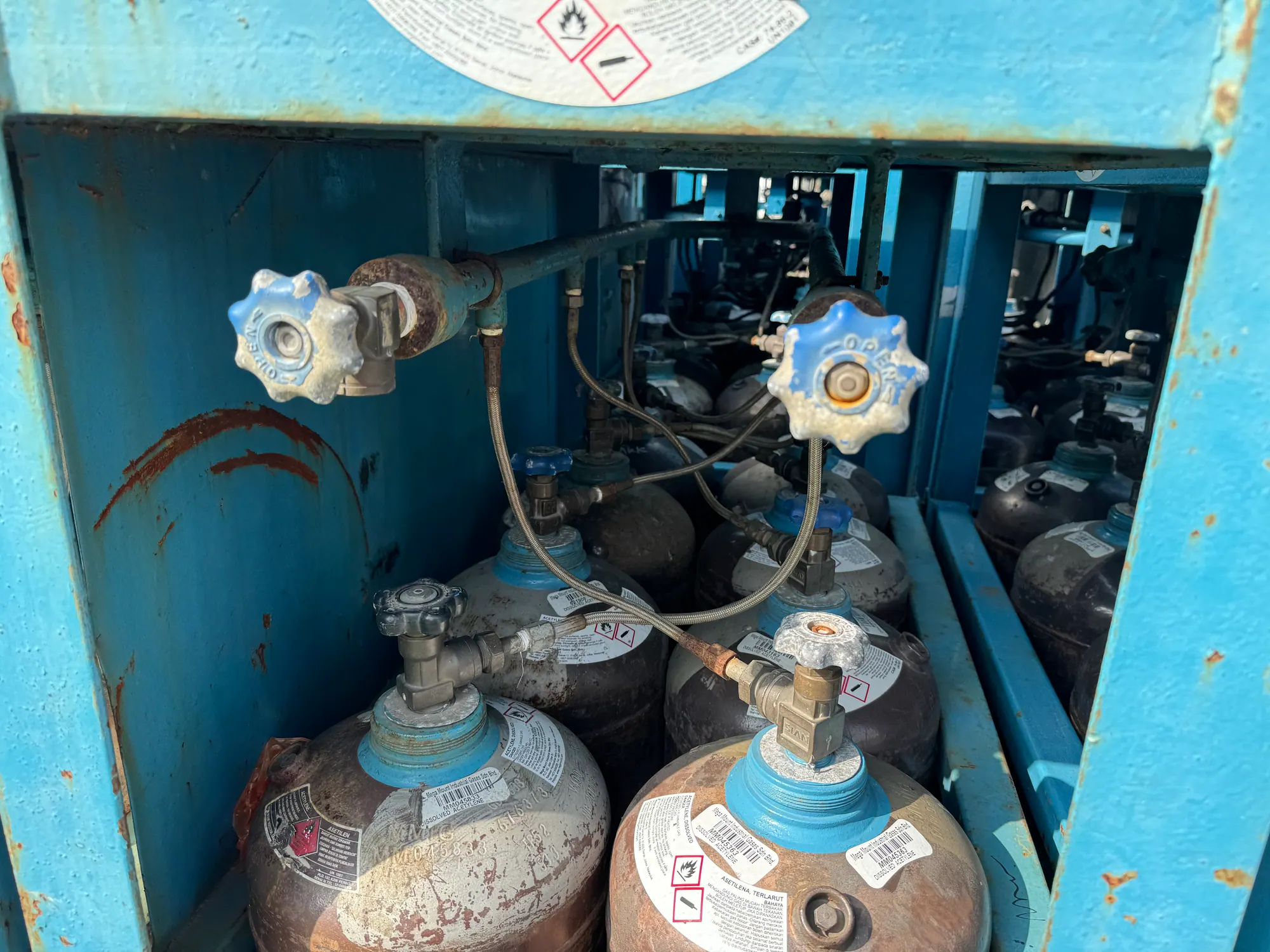
- Acetylene
- 1.17167 kg/Nm³; 0.8535 Nm³/kg; 0.918 m³/kg at 20 °C
To convert normal cubic metres of a gas to kilograms, multiply by the gas's density at 0 °C and 1.01325 bar; to go from kilograms to Nm³, divide by it. Oxygen weighs 1.429 kg/Nm³, nitrogen 1.250, argon 1.784 and carbon dioxide 1.977. The difficulty is not the arithmetic but the reference conditions, which differ between Nm³, Sm³ and scf, and between suppliers. This page fixes them, gives NIST-based densities for ten gases, and adds the litres of liquid that one Nm³ represents for gases supplied as liquid.
Nm³, Sm³ and scf: say which one you mean
| Unit | Temperature | Pressure | Common user | Factor from 1 Nm³ |
|---|---|---|---|---|
| Normal cubic metre, Nm³ | 0 °C (273.15 K) | 101.325 kPa (1 atm) | European and Indian plant ratings, PSA and ASU capacity | 1 |
| Standard cubic metre, Sm³ | 15 °C (288.15 K) | 101.325 kPa | Natural gas (ISO 13443); Gas Cylinders Rules 2016 use 15 °C | 1.055 |
| Cylinder contents to IS 309 / IS 1747 | 27 °C (300.15 K) | 760 mm Hg | Oxygen and nitrogen cylinder contents in India | 1.099 |
| Standard cubic foot, scf (60 °F) | 15.6 °C | 14.696 psia | Natural gas practice | 37.33 scf |
| Standard cubic foot, scf (70 °F) | 21.1 °C | 14.696 psia | US industrial-gas practice | 38.04 scf |
The factors use the ideal-gas temperature ratio at constant pressure, which holds within a fraction of a per cent at atmospheric pressure. One cubic foot is 0.0283168 m³.
A PSA oxygen plant rated at 50 Nm³/h and a cylinder quoted at 7.6 m³ (at 27 °C) are therefore on different scales: 7.6 m³ at 27 °C is only 6.9 Nm³.
The Nm³ to kg conversion table
| Gas | kg per Nm³ | Nm³ per kg | kg per m³ at 15 °C, 1 atm | Litres of liquid per Nm³ | Nm³ per litre of liquid | Liquid basis |
|---|---|---|---|---|---|---|
| Oxygen, O₂ | 1.4290 | 0.6998 | 1.354 | 1.252 | 0.799 | 1,141.2 kg/m³ at −182.96 °C |
| Nitrogen, N₂ | 1.2504 | 0.7997 | 1.185 | 1.551 | 0.645 | 806.1 kg/m³ at −195.80 °C |
| Argon, Ar | 1.7840 | 0.5605 | 1.690 | 1.278 | 0.782 | 1,395.4 kg/m³ at −185.85 °C |
| Carbon dioxide, CO₂ | 1.977 | 0.5058 | 1.872 | 1.919 | 0.521 | about 1,030 kg/m³, saturated at −20 °C |
| Hydrogen, H₂ | 0.08988 | 11.126 | 0.0852 | 1.269 | 0.788 | 70.85 kg/m³ at −252.78 °C |
| Helium, He | 0.17848 | 5.603 | 0.1692 | 1.432 | 0.698 | 124.7 kg/m³ at −268.93 °C |
| Nitrous oxide, N₂O | 1.9779 | 0.5056 | 1.873 | 1.608 | 0.622 | 1,230.4 kg/m³ at −88.47 °C |
| Acetylene, C₂H₂ | 1.17167 | 0.8535 | 1.109 | — | — | Never handled as liquid |
| Air (dry) | 1.2929 | 0.7735 | 1.225 | — | — | Not supplied as liquid |
| Propane, C₃H₈ | 2.0105 | 0.4974 | 1.899 | 3.962 | 0.252 | 507.5 kg/m³, saturated at 15 °C |
Sources: NIST Chemistry WebBook, Thermophysical Properties of Fluid Systems, for all gas and liquid densities except acetylene, air and the CO₂ liquid figure. Acetylene: Bottomley, Reeves and Seitlow, as used on the acetylene technical data sheet. Air: standard dry air at 0 °C, and the ICAO standard atmosphere at 15 °C. CO₂ liquid: NIST saturation data as tabulated on carbon dioxide technical data. Litres of liquid per Nm³ = gas density ÷ liquid density × 1,000.
Liquid figures are for liquid at its boiling point at 1 atm unless stated. Liquid in a pressurised storage tank is a few degrees warmer and slightly less dense, so it yields a little less gas per litre than the table shows.
Worked examples
Oxygen for a hospital or a cutting shop
A hospital's medical oxygen use is 500 Nm³ per day.
- Mass: 500 × 1.429 = 714.5 kg per day.
- As liquid oxygen: 500 × 1.252 = 626 litres of liquid per day.
- As cylinder contents to IS 309 (27 °C): 500 × 1.099 = 549 m³.
A PSA plant rating
A PSA oxygen plant producing 50 Nm³/h delivers 50 × 1.429 = 71.5 kg/h, or about 1,715 kg in 24 hours. KIGL's PSA oxygen plants and PSA nitrogen plants are rated in Nm³/h, which is the comparison basis to use against liquid or cylinder supply; see cylinder supply or on-site generation.
Liquid nitrogen to gas
A 1,000 litre delivery of liquid nitrogen weighs 1,000 × 0.8061 = 806 kg and gives 806 ÷ 1.2504 = 645 Nm³, or about 680 m³ at 15 °C. The commonly quoted expansion ratio of about 694 is the same liquid measured as gas at 21 °C. More on liquid nitrogen properties and safety.
Carbon dioxide by weight
A cylinder holding 30 kg of carbon dioxide gives 30 × 0.5058 = 15.2 Nm³, or 30 ÷ 1.872 = 16.0 m³ at 15 °C. Because CO₂ is liquid in the cylinder, its contents can only be checked by weighing; see permanent vs liquefied gases.
Acetylene by weight
Dissolved acetylene is sold by net weight. Each kilogram is 0.8535 Nm³, 0.902 m³ at 15 °C and 0.918 m³ at 20 °C, from the measured densities of Bottomley, Reeves and Seitlow. The weighing procedure is on how to check acetylene cylinder contents by weight.
Hydrogen
One kilogram of hydrogen is 11.13 Nm³. Hydrogen's real-gas behaviour at cylinder pressure (Z above 1) means a cylinder holds less than Boyle's law suggests; see gas laws for cylinder users.
Why not just use 22.414 litres per mole
The ideal-gas molar volume at 0 °C and 1 atm is 22.414 litres, so the ideal density is molar mass ÷ 22.414. For the permanent gases it is close: oxygen 1.4276 against the real 1.4290 kg/m³. For gases near condensation it is not:
| Gas | Ideal density, kg/Nm³ | Real density, kg/Nm³ | Real heavier by |
|---|---|---|---|
| Oxygen | 1.4276 | 1.4290 | 0.1 % |
| Carbon dioxide | 1.9635 | 1.977 | 0.7 % |
| Acetylene | 1.1617 | 1.17167 | 0.85 % |
| Propane | 1.9674 | 2.0105 | 2.2 % |
For billing CO₂, acetylene or LPG by volume, the difference is commercially significant; use the measured density.
Three conversion mistakes that recur in quotations
- Mixing Nm³ and m³ at 27 °C. A cylinder quoted at "7 m³" under IS 309 conventions and a plant quoted at "7 Nm³" differ by almost 10 %. Convert both to Nm³ before comparing cost per unit of gas.
- Using the room-temperature expansion ratio for liquid. The 694:1 ratio for liquid nitrogen (gas at 21 °C) and roughly 860:1 for liquid oxygen (gas at 20 °C) are not normal-condition figures; in Nm³ they are 645 and 799. A bulk contract stated in Nm³ needs the Nm³ figures.
- Treating a pressure gauge as a contents meter for liquefied gases. For CO₂, N₂O and propane, convert from weighed kilograms, never from pressure.
Rules that matter
Rules to apply
- Write the reference conditions next to every volume: Nm³ (0 °C), Sm³ (15 °C) or m³ at 27 °C.
- Convert kg to Nm³ by dividing by the density in the table; convert Nm³ to kg by multiplying.
- To move between reference temperatures, multiply by the ratio of absolute temperatures: Nm³ × 1.055 = m³ at 15 °C; Nm³ × 1.099 = m³ at 27 °C.
- For liquids, use the density of the liquid as delivered, and accept that warm tank liquid yields slightly less than the boiling-point figure.
- For gas properties beyond density, see the industrial gas properties table.
Nm³ — frequently asked questions
How many kg is 1 Nm³ of oxygen?
1.429 kg. The NIST Chemistry WebBook gives oxygen a density of 1.4290 kg/m³ at 0 °C and 1.01325 bar, the conditions that define the normal cubic metre. Going the other way, 1 kg of oxygen is 0.700 Nm³. At 15 °C the same kilogram occupies 0.738 m³, and at 27 °C, the temperature IS 309:2023 uses for cylinder contents, about 0.77 m³.
What is the difference between Nm³ and Sm³?
The reference temperature. A normal cubic metre is gas at 0 °C and 101.325 kPa (DIN 1343). A standard cubic metre is usually gas at 15 °C and 101.325 kPa (ISO 13443), the temperature the Gas Cylinders Rules 2016 also use. The same quantity of gas is about 5.5 % larger in Sm³: 1 Nm³ ≈ 1.055 Sm³. Always ask which convention a quotation uses.
How do I convert a gas flow in Nm³/h to kg/h?
Multiply by the gas density at normal conditions. A 50 Nm³/h oxygen supply is 50 × 1.429 = 71.5 kg/h; 50 Nm³/h of nitrogen is 62.5 kg/h; 50 Nm³/h of acetylene is 58.6 kg/h. To convert kg/h back to Nm³/h, divide by the same density. The figures are in the table on this page, from NIST data and, for acetylene, measured densities.
How many Nm³ of carbon dioxide are in 1 kg?
0.506 Nm³, since carbon dioxide weighs 1.977 kg/Nm³ (NIST). At 15 °C and 1 atm the kilogram occupies 0.534 m³, and at 20 °C about 0.544 m³. A cylinder holding 30 kg of CO₂ therefore delivers about 15.2 Nm³ or 16.0 m³ at 15 °C, which is why CO₂ is bought and checked by weight rather than volume.
What is 1 Nm³ in standard cubic feet?
About 37.3 scf if the standard is 60 °F (15.6 °C) and 14.696 psia, or about 38.0 scf at 70 °F (21.1 °C), the convention common in the US industrial-gas trade. One cubic foot is 0.0283168 m³, and the gas expands with temperature from 0 °C. The figures use the ideal-gas temperature ratio, which is within a fraction of a per cent at 1 atm.
Why not use 22.4 litres per mole for every gas?
Because 22.414 litres per mole is the ideal-gas molar volume at 0 °C and 1 atm, and real gases differ. For oxygen, nitrogen and argon the error is under 0.1 %, but carbon dioxide is 0.7 % denser than ideal, acetylene 0.85 % and propane 2.2 %. Use measured densities, as in the table here, for any figure that affects billing or filling.
How many kg is 1 Nm³ of argon?
1.784 kg, from the NIST density of argon at 0 °C and 1 atm. One kilogram of argon is 0.5605 Nm³, or 0.592 m³ at 15 °C. Argon is the densest of the three air gases, so a cylinder of argon weighs noticeably more than an oxygen or nitrogen cylinder of the same size and pressure: about 12.5 kg of gas in a 46.7 litre cylinder at 150 bar, against about 10.1 kg of oxygen.
References
- Bureau of Indian Standards. (2023). Oxygen and IS 1747:2023 Nitrogen — Specifications (cl 6.2 contents at 27 °C) (IS 309:2023, Fifth Revision).
- CGA — Compressed Gas Association
- Government of India. (2016). Gas Cylinders Rules, 2016 (G.S.R. 1081(E)). Petroleum and Explosives Safety Organisation.
- Linstrom, P. J., & Mallard, W. G. (Eds.). (n.d.). NIST Chemistry WebBook (NIST Standard Reference Database 69). National Institute of Standards and Technology. [, SRD 69 — Thermophysical Properties of Fluid Systems] https://webbook.nist.gov/chemistry/fluid/
Enquiries
Request a quotation
State the gas or equipment, the quantity or capacity, and your location. KIGL will confirm the grade, the cylinder or plant size, and whether the location can be served from Noonmati, or through the agent network.