
Guide
Gas laws for cylinder users: Boyle Charles, Gay-Lussac, the compressibility factor Z, and what heat does to a full cylinder
For a gas cylinder, the gas laws say pressure rises with absolute temperature at fixed volume. An oxygen cylinder at 150 bar and 15 °C would ideally reach 165.6 bar at 45 °C; NIST real-gas data give 172.4 bar. Contents also need the compressibility factor Z, 0.93 for oxygen at 150 bar.
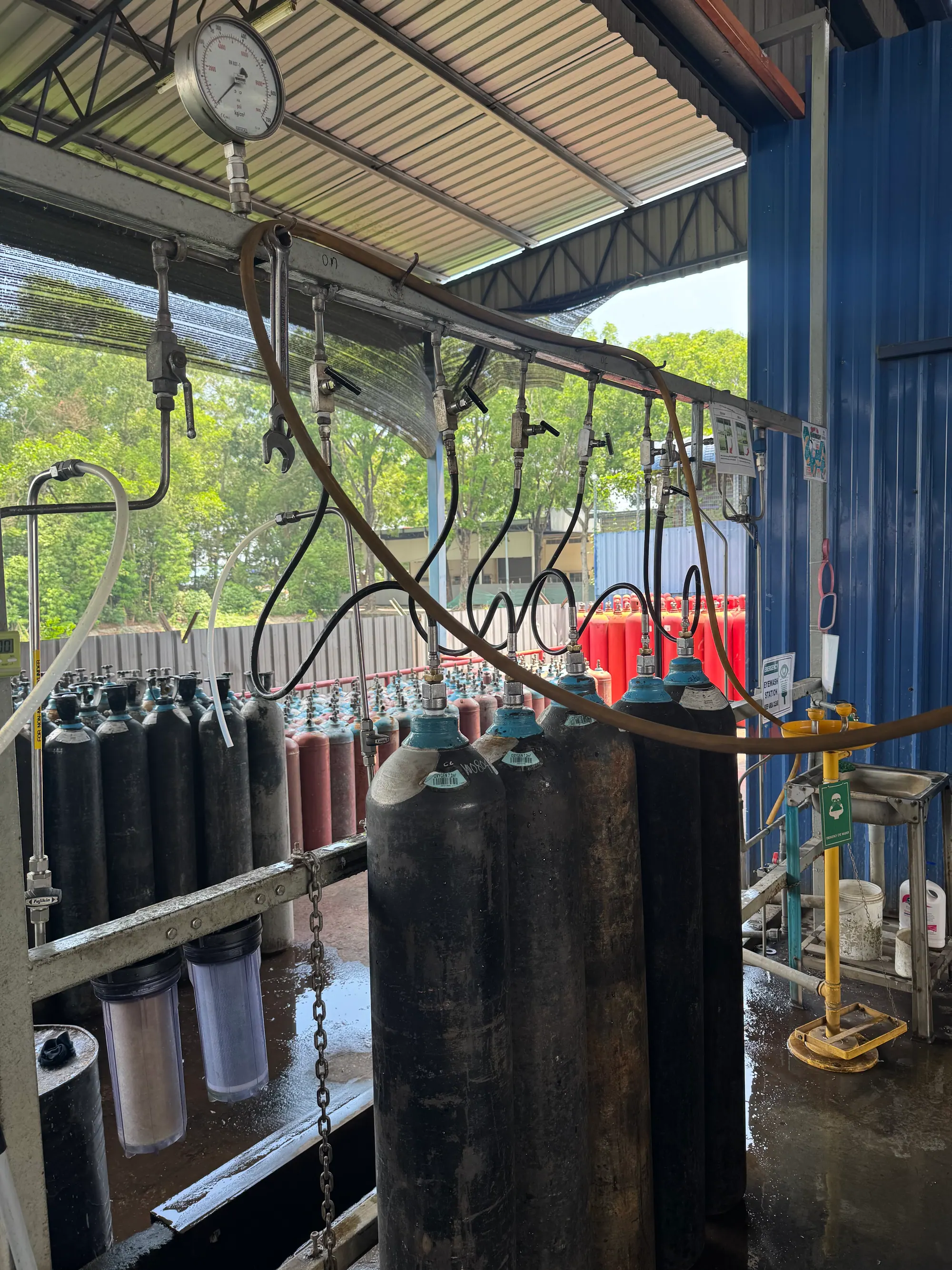
- Oxygen heated at constant volume
- 150 bar at 15 °C becomes 172.4 bar at 45 °C and 187.2 bar at 65 °C
- Nitrogen heated at constant volume
- 150 bar at 15 °C becomes 167.5 bar at 40 °C and 184.8 bar at 65 °C
- Compressibility at 150 bar, 15 °C
- Oxygen Z = 0.929
- Compressibility at 200 bar, 15 °C
- Oxygen Z = 0.931
- Real oxygen content, 46.7 litre cylinder
- 10.07 kg = 7.44 m³ at 15 °C and 1 atm at 150 bar absolute; the water-capacity × pressure rule gives 7.0 m³
The gas laws describe how the pressure, volume and temperature of a gas move together, and for anyone who fills, stores or uses cylinders they answer three practical questions: how much gas is in this cylinder, what happens to the pressure when it gets hot, and why the simple arithmetic is wrong by several per cent. The short answer is that pressure rises with absolute temperature at fixed volume, about 0.35 % per °C for an ideal gas and closer to 0.5 % per °C for real oxygen at 150 bar, and that real contents need a compressibility factor, Z.
All pressures and temperatures in the laws below are absolute: bar absolute (gauge + 1.013) and kelvin (°C + 273.15).
The four gas laws in one table
| Law | Holds constant | Relationship | Cylinder meaning |
|---|---|---|---|
| Boyle (1662) | Temperature, amount of gas | P₁V₁ = P₂V₂ | Gas released from a cylinder expands in inverse proportion to pressure |
| Charles (1787) | Pressure, amount of gas | V₁/T₁ = V₂/T₂ | One cubic metre at 0 °C is 1.055 m³ at 15 °C and 1.099 m³ at 27 °C |
| Gay-Lussac (1802) | Volume, amount of gas | P₁/T₁ = P₂/T₂ | A closed cylinder's pressure rises with its temperature |
| Combined gas law | Amount of gas | P₁V₁/T₁ = P₂V₂/T₂ | Converts cylinder contents between any two sets of conditions |
| Real gas | Nothing assumed ideal | PV = ZnRT | Z corrects for molecular attraction and size at cylinder pressures |
The first three are special cases of the ideal gas law, PV = nRT, with R = 8.314 J/mol·K. Real gases follow it closely at atmospheric pressure and drift from it at 150–200 bar, which is where cylinders operate.
Worked example 1: Boyle's law and cylinder contents
A 46.7 litre cylinder of oxygen holds gas at 150 bar absolute and 15 °C. How much gas is that at 1 atm (1.01325 bar) and 15 °C?
- Ideal (Boyle): V₂ = 46.7 × 150 ÷ 1.01325 = 6,913 litres, or 6.91 m³.
- Real (NIST): the density of oxygen at 150 bar and 15 °C is 215.64 kg/m³, so the cylinder holds 0.0467 × 215.64 = 10.07 kg. At 1 atm and 15 °C oxygen weighs 1.3544 kg/m³, so the content is 10.07 ÷ 1.3544 = 7.44 m³.
Boyle's law undercounts oxygen by 7.7 % at this pressure. The correction is the compressibility factor: Z = 6.91 ÷ 7.44 = 0.929.
Compressibility factor Z for oxygen, nitrogen and argon
Z is the ratio of the real volume to the ideal volume at the same pressure and temperature. Below 1, molecular attraction lets the gas pack more densely than ideal and the cylinder holds more; above 1, molecular size dominates and it holds less.
| Gas, 15 °C | Z at 150 bar abs | Z at 200 bar abs | Mass in 46.7 L at 150 / 200 bar | Content at 15 °C, 1 atm, at 150 / 200 bar | Ideal-gas content at 150 / 200 bar |
|---|---|---|---|---|---|
| Oxygen | 0.929 | 0.931 | 10.07 / 13.40 kg | 7.44 / 9.89 m³ | 6.91 / 9.22 m³ |
| Argon | 0.933 | 0.937 | 12.51 / 16.62 kg | 7.40 / 9.83 m³ | 6.91 / 9.22 m³ |
| Nitrogen | 1.016 | 1.048 | 8.06 / 10.42 kg | 6.80 / 8.80 m³ | 6.91 / 9.22 m³ |
Calculated from NIST Chemistry WebBook densities at 15 °C: oxygen 215.64 and 286.88 kg/m³, argon 267.96 and 355.99 kg/m³, nitrogen 172.56 and 223.19 kg/m³ at 150 and 200 bar; gas densities at 15 °C and 1 atm of 1.3544 (oxygen), 1.690 (argon) and 1.185 (nitrogen) kg/m³. Hydrogen and helium have Z above 1 at all cylinder pressures, so like nitrogen they hold less than the ideal figure.
The practical point: at the same pressure, an oxygen or argon cylinder holds about 9 % more gas by volume than a nitrogen cylinder of the same size at 150 bar, and about 12 % more at 200 bar.
Why contents are not water capacity times pressure
The trade shortcut multiplies water capacity by gauge pressure: 46.7 × 150 = 7,005 litres, "7 m³". It is wrong for three independent reasons, and they do not cancel.
- Gauge or absolute. The gas laws need absolute pressure, about 1 bar more than the gauge reads, and atmospheric pressure is 1.013 bar, not 1.
- Reference temperature. IS 309:2023 and IS 1747:2023 require oxygen and nitrogen contents to be stated at 27 °C and 760 mm Hg; the Gas Cylinders Rules 2016 fix filling pressure at 15 °C; the normal cubic metre is at 0 °C. Between 0 °C and 27 °C the same gas occupies 9.9 % more volume.
- Compressibility. Z is 0.93 for oxygen and 1.02–1.05 for nitrogen at 150–200 bar, a spread of more than 10 %.
The arithmetic for every common cylinder is set out in gas cylinder sizes and contents in India, and the mass–volume conversions in Nm³ to kg.
Worked example 2: a 150 bar cylinder heated from 15 °C to 45 °C
A cylinder is filled to 150 bar absolute at 15 °C and left in the sun until the gas reaches 45 °C. The volume does not change, so Gay-Lussac's law applies.
- Ideal: P₂ = 150 × (45 + 273.15) ÷ (15 + 273.15) = 150 × 318.15 ÷ 288.15 = 165.6 bar.
- Real oxygen (NIST isochoric data at 215.64 kg/m³): 172.4 bar.
| Gas filled to 150 bar abs at 15 °C | 40 °C | 45 °C | 65 °C | Source |
|---|---|---|---|---|
| Ideal gas | 163.0 bar | 165.6 bar | 176.0 bar | Gay-Lussac's law |
| Oxygen | 168.7 bar | 172.4 bar | 187.2 bar | NIST Chemistry WebBook |
| Nitrogen | 167.5 bar | 170.9 bar | 184.8 bar | NIST Chemistry WebBook |
Real oxygen and nitrogen gain pressure faster than the ideal law predicts, by 3 to 4 % at 45 °C and 5 to 6 % at 65 °C. The ideal rule of thumb, 0.35 % per °C, understates the real rise of oxygen at cylinder pressure, which is nearer 0.5 % per °C between 15 °C and 45 °C.
Worked example 3: filling hot, settling cold
Compression heats gas. A cylinder brought up to 150 bar while the gas inside is at 45 °C contains less gas than one filled to 150 bar at 15 °C. Working the oxygen figures backwards, a cylinder that reads 172.4 bar at 45 °C settles to 150 bar at 15 °C; one that reads only 150 bar at 45 °C will settle to roughly 131 bar. This is why Rule 2(xxiv) of the Gas Cylinders Rules 2016 defines the filling pressure as the maximum gauge pressure converted to 15 °C, and why a filler either cools the cylinders or fills to a temperature-corrected pressure.
Rules that matter
The same arithmetic is the reason cylinders are kept out of the sun.
Heat and cylinder safety
- Indian rules anchor the filling pressure of a permanent gas at 15 °C and treat 65 °C as the top of the service range: under the Gas Cylinders Rules 2016 the working pressure of a liquefiable gas is its developed pressure at 65 °C, and IS 3224:2021 requires cylinder valves to stay leak-tight from −20 °C to +65 °C. The NIST figures show an oxygen cylinder filled correctly to 150 bar at 15 °C reaches about 187 bar at 65 °C, which is why the margin to test pressure matters.
- A cylinder on an open truck bed or against a hot wall in an Indian summer can exceed 50 °C at the shell. Store and transport cylinders shaded, upright and secured; the Gas Cylinders Rules 2016 prohibit storing cylinders exposed to the sun or near a source of heat (Rule 15(3)).
- In a fire, pressure rises while the steel weakens. Cool cylinders with water from a safe position and evacuate if they cannot be cooled. For acetylene the specific procedure is on acetylene cylinder fire: what to do.
- Liquefied gases behave worse. A CO₂ cylinder's pressure follows its vapour-pressure curve, 57 bar at 20 °C and 73.77 bar at its 30.98 °C critical point, and an overfilled cylinder can become liquid-full and rise very steeply. See permanent vs liquefied gases.
Periodic hydrostatic testing, which checks that a cylinder can still withstand these pressures, is covered on cylinder testing and retest.
Rules that matter
Rules to apply
- Convert to absolute pressure and kelvin before using any gas law.
- State the reference temperature with every cylinder content figure: 0 °C, 15 °C or 27 °C.
- Use Z, or NIST densities directly, for oxygen, nitrogen and argon at 150–200 bar. Boyle's law alone is wrong by 2–8 %.
- Read a cylinder's pressure only when it has settled to room temperature, and correct to 15 °C before comparing with the filling pressure.
- Keep every cylinder below 50 °C in storage and transport, and treat a hot cylinder as one at higher pressure than the ideal rule suggests.
Gas laws — frequently asked questions
How much does cylinder pressure rise with temperature?
For an ideal gas, by the ratio of absolute temperatures: about 0.35 % per °C near room temperature. Real oxygen, nitrogen and argon at 150 bar rise faster. NIST data put an oxygen cylinder filled to 150 bar at 15 °C at 172.4 bar at 45 °C, about 0.5 % per °C, against 165.6 bar from the ideal law. Use the real figure when judging a hot cylinder.
What is the compressibility factor Z of oxygen at 150 bar?
About 0.929 at 15 °C and 150 bar absolute, calculated from the NIST Chemistry WebBook density of 215.64 kg/m³. At 200 bar it is 0.931. A Z below 1 means oxygen packs more densely than the ideal gas law predicts, so a cylinder holds about 7.7 % more oxygen than a simple Boyle's law calculation suggests.
Why does a cylinder filled hot read lower the next morning?
Because compression heats the gas, and as it cools to room temperature at fixed volume its pressure falls. A cylinder filled to 150 bar while the gas is at 45 °C will settle well below 150 bar at 15 °C. This is why the Gas Cylinders Rules define the filling pressure as the pressure converted to 15 °C, and why fillers correct for gas temperature.
Should gauge pressure or absolute pressure be used in gas law calculations?
Absolute. Boyle's, Charles's and Gay-Lussac's laws all work in absolute pressure and absolute temperature (kelvin). Add atmospheric pressure, 1.013 bar, to a gauge reading first. At 150 bar the difference is under 1 %, but at low pressures it dominates: a regulator at 1 bar gauge is at 2 bar absolute, twice what the gauge suggests.
Does Boyle's law apply to a CO₂ cylinder?
Not while liquid remains. A carbon dioxide cylinder's pressure is the vapour pressure of the liquid, about 57 bar at 20 °C by NIST, and it does not fall as gas is drawn off. Boyle's law only begins to describe it once the liquid has all evaporated. Liquefied gases are measured by weight for this reason.
Why does a nitrogen cylinder hold less gas than an oxygen cylinder at the same pressure?
Because nitrogen's compressibility factor at 15 °C is above 1 (1.016 at 150 bar, 1.048 at 200 bar), while oxygen's is below 1 (0.93). At 150 bar absolute a 46.7 litre cylinder holds about 7.44 m³ of oxygen but only about 6.80 m³ of nitrogen, both measured at 15 °C and 1 atm, from NIST densities.
References
- Bureau of Indian Standards. (2023). Oxygen and IS 1747:2023 Nitrogen — Specifications (IS 309:2023, Fifth Revision).
- EIGA — European Industrial Gases Association, safety publications
- Government of India. (2016). Gas Cylinders Rules, 2016 (G.S.R. 1081(E)). Petroleum and Explosives Safety Organisation.
- Linstrom, P. J., & Mallard, W. G. (Eds.). (n.d.). NIST Chemistry WebBook (NIST Standard Reference Database 69). National Institute of Standards and Technology. [, SRD 69 — Thermophysical Properties of Fluid Systems (isothermal and isochoric data)] https://webbook.nist.gov/chemistry/fluid/
Enquiries
Request a quotation
State the gas or equipment, the quantity or capacity, and your location. KIGL will confirm the grade, the cylinder or plant size, and whether the location can be served from Noonmati, or through the agent network.