
Guide
Carbon dioxide technical data sheet: triple point vapour pressure, IS 307:2024 grades, liquid CO₂ cylinders and dry ice
Carbon dioxide (CO₂, 44.010 g/mol) has its triple point at −56.56 °C and 5.18 bar, so it cannot be liquid at atmospheric pressure and sublimes at −78.46 °C as dry ice. Its critical temperature is 30.98 °C; in a cylinder it is liquid at about 57 bar at 20 °C. IS 307:2024 sets 2 grades.
- Triple point
- −56.56 °C at 5.185 bar
- Critical point
- 30.98 °C
- Sublimation point
- −78.46 °C at 1.013 bar
- Vapour pressure
- About 34.9 bar at 0 °C
- Gas density
- 1.977 kg/m³ at 0 °C
Carbon dioxide behaves unlike the other industrial gases KIGL supplies. Oxygen, nitrogen and argon are permanent gases sold by pressure. CO₂ is a liquefied gas below 30.98 °C, sold by weight, held in the cylinder as liquid under its own vapour pressure of about 57 bar at 20 °C, and it cannot be liquid at all at atmospheric pressure because its triple point is at 5.185 bar. Every handling rule on this page follows from those three numbers. The physical data are from the NIST Chemistry WebBook and the specification from IS 307:2024.
Physical properties
| Property | Value | Source |
|---|---|---|
| Formula, molar mass | CO₂, 44.010 g/mol | NIST |
| Triple point | −56.56 °C, 5.185 bar (5.11 atm) | NIST |
| Sublimation point at 1.013 bar | −78.46 °C | NIST |
| Critical temperature | 30.98 °C | NIST |
| Critical pressure | 73.77 bar | NIST |
| Critical density | 468 kg/m³ | NIST |
| Gas density, 0 °C, 1 atm | 1.977 kg/m³ | NIST |
| Gas density, 15 °C, 1 atm | 1.872 kg/m³ | NIST |
| Relative density to air | 1.52 | NIST |
| Gas volume per kg, 15 °C, 1 atm | about 0.53 m³ | Computed from NIST density |
| Liquid density, saturated, 0 °C / 20 °C | about 928 / 773 kg/m³ | NIST |
| Solid (dry ice) density | about 1,560 kg/m³ | Literature value |
| Latent heat of sublimation at −78.5 °C | about 571 kJ/kg | NIST |
| Specific heat Cp, gas, 25 °C | about 0.849 kJ/kg·K | NIST |
| Ratio of specific heats Cp/Cv | about 1.29 | NIST |
| Thermal conductivity, gas, 25 °C | about 0.0166 W/m·K | NIST |
| Viscosity, gas, 25 °C | about 14.9 µPa·s | NIST |
| Content of dry air | about 0.04 % (about 420 ppm) and rising | NOAA global monitoring |
| UN number | 1013 compressed/liquefied; 2187 refrigerated liquid; 1845 solid | IS 4379:2021 Table 1; UN list |
Rules that matter
Because the triple point pressure, 5.185 bar, is above atmospheric, the only stable phases at 1 atm are solid and gas. Three consequences follow.
The phase diagram in practice
- Liquid CO₂ released to atmosphere flashes. Part becomes gas and part becomes solid "snow" at −78 °C. This is how fire extinguishers and snow horns work and how dry ice is made, by expanding liquid through a nozzle and pressing the snow into blocks or pellets.
- A liquid line depressurised below about 5.2 bar forms dry ice in the line, which can plug valves and later sublime to pressurise a closed section. Liquid CO₂ systems are designed so the liquid side never falls below the triple point pressure.
- Dry ice sublimes at −78.46 °C and produces about 0.53 m³ of gas per kilogram at 15 °C, roughly 800 times the volume of the block. In a sealed container it bursts the container; in a closed vehicle or cold room it raises the CO₂ concentration to dangerous levels.
Vapour pressure and the critical temperature
| Temperature | Vapour pressure (bar, absolute) | Saturated liquid density |
|---|---|---|
| −20 °C | about 19.7 | about 1,030 kg/m³ |
| 0 °C | about 34.9 | about 928 kg/m³ |
| 15 °C | about 50.9 | about 821 kg/m³ |
| 20 °C | about 57.3 | about 773 kg/m³ |
| 25 °C | about 64.3 | about 710 kg/m³ |
| 30.98 °C (critical) | 73.77 | 468 kg/m³ |
Source: NIST saturation tables, rounded. At 30.98 °C the liquid and vapour become one phase, and in Indian summer conditions a CO₂ cylinder is often above that temperature. Above it, the pressure is set by how much CO₂ is in the cylinder rather than by a vapour pressure, and it rises steeply with temperature. That is why the legal charge is limited by a filling ratio, the mass of gas divided by the mass of water the cylinder holds at 15 °C (Gas Cylinders Rules 2016, rule 2(xxv)), and why the valve of every CO₂ cylinder must carry a softened copper bursting disc set between 200 and 220 kg/cm² (rule 4(2)). The CO₂ filling ratio itself is not in any current standard KIGL holds: IS 3710:1978 covers only gases with a critical temperature above 70 °C, IS 8866:1978, which covered CO₂, is withdrawn, and the figure now lives in IS 15975:2020 and the Rules.
IS 307:2024 grades
IS 307:2024, the third revision, has two grades: Grade 1 for reagent and welding use, Grade 2 for beverages, fire extinguishers, refrigeration and general commercial use (cl 3). The material must be odourless (cl 4.1).
| Characteristic | Grade 1 (as printed) | Grade 2 (as printed) | Method |
|---|---|---|---|
| Carbon dioxide, % v/v, min | 99.7 | 99.9 | A-2 |
| Carbon monoxide, ppm, max | 10 | 10 | A-3 |
| Acid and sulphur dioxide | To pass test | To pass test | A-4 |
| Phosphine and hydrogen sulphide | To pass test | To pass test | A-5 |
| Moisture, % v/v, max | 0.001 | 0.1 | A-6 |
| Arsenic, mg/normal m³, max | 0.5 | 0.5 | A-7 |
| Oil, ppm by mass, max | 5 | 5 | A-8 |
Source: IS 307:2024 Table 1, as printed. There is an unresolved inconsistency: the foreword says the Grade 1 requirement was raised from 99.7 to 99.9 %, but the table prints Grade 1 at 99.7, and the tighter moisture limit sits with the lower purity figure. The purity columns may be transposed. Until a print copy is checked, quote IS 307 grades by name and characteristic, not by purity. IS 307 does not cover medical CO₂, which is in the Indian Pharmacopoeia (cl 1.2). A lot is one shift's filling from one manifold. Sampling draws two samples from each selected cylinder, with the number of cylinders rising from 3 for a lot of up to 25 to 10 for a lot of 181 to 300, and every sample must pass. KIGL's product is described on the carbon dioxide product page and the standards on carbon dioxide standards.
Liquid CO₂ cylinders
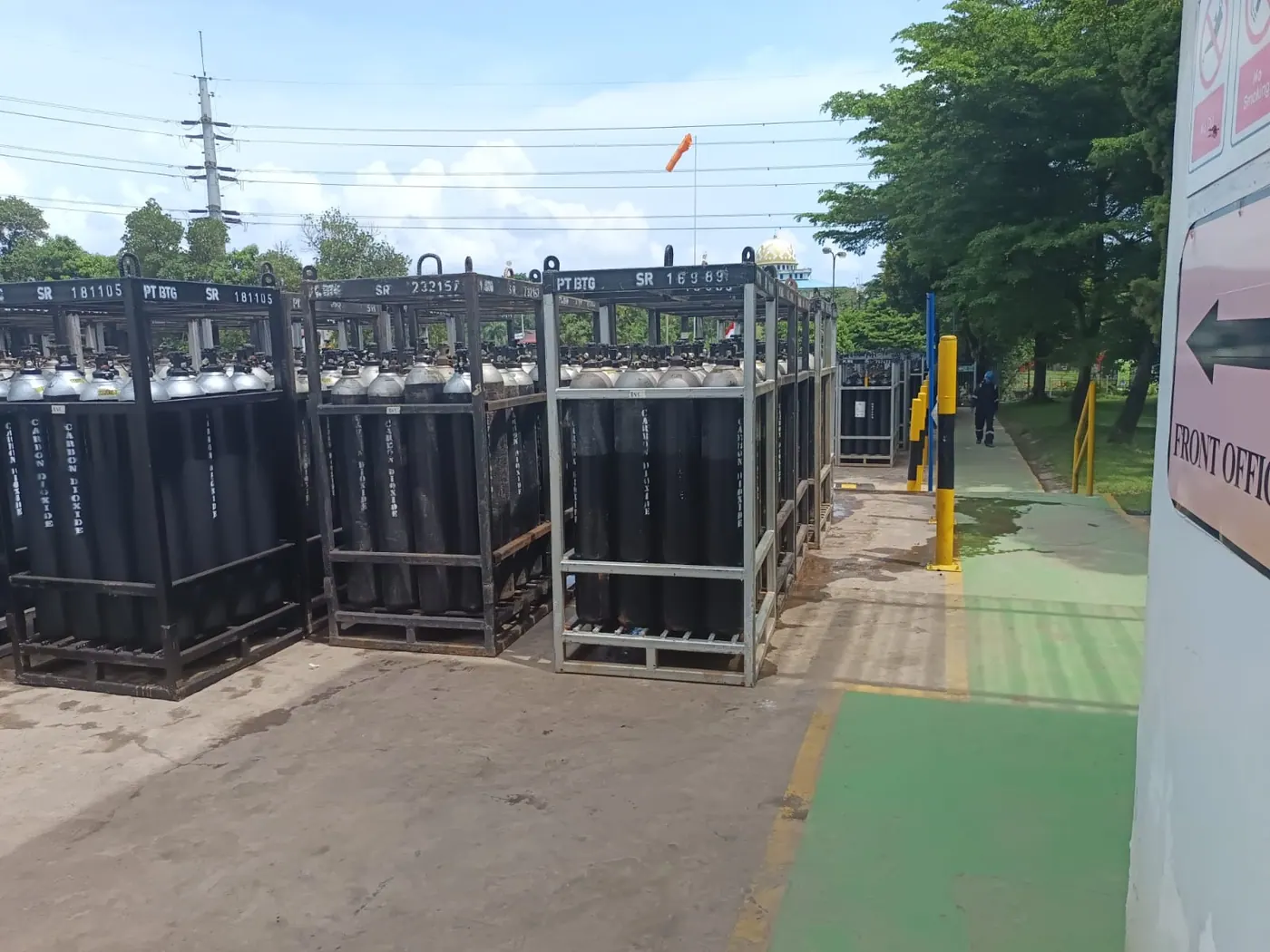
Industrial CO₂ is supplied in seamless steel cylinders to IS 7285, filled by weight. A cylinder without a dip tube delivers gas from the vapour space; one with a dip tube (siphon) delivers liquid from the bottom, for fire suppression, cryogenic cooling and snow production. GCR 2016 rule 7 requires the dip-tube length to be marked on the valve or a badge.
The charge in kilograms is the water capacity multiplied by the filling ratio, and each kilogram is about 0.53 m³ of gas at 15 °C; the ratio itself must come from IS 15975 and the Rules. To check contents, weigh and subtract the stamped tare; the method is on gas cylinder sizes and contents in India.
Drawing gas fast from a vapour-withdrawal cylinder cools the liquid, because each kilogram that evaporates absorbs its latent heat. Pressure falls with temperature, and at high draw rates the regulator can freeze from the Joule-Thomson cooling of expansion. Welding and beverage users fit a heated regulator or manifold several cylinders rather than pulling one hard.
Cylinder identification under IS 4379:2021 is a Graphite Black body, a white or aluminium shoulder and a Graphite Black band; medical CO₂ under IS 3933:2021 is French grey.
Toxicity and the static hazard
CO₂ is toxic as well as an asphyxiant. It stimulates and then depresses breathing and acts on the central nervous system at concentrations far below those at which oxygen is significantly displaced. The ACGIH threshold limit is 5,000 ppm (0.5 %) as an 8-hour average and 30,000 ppm (3 %) short-term; around 4 % is treated as immediately dangerous to life or health, and about 10 % causes unconsciousness within minutes. Because CO₂ is 1.52 times as dense as air, it collects in cellars, pits, fermentation vessels and cold stores. The detail is on carbon dioxide safety data explained.
Fast release of liquid CO₂ produces charged dry ice particles that can build up a static charge. EIGA's safety advisory SAC NL 76 warns against using CO₂ as an inerting agent where static ignition matters, and the Gas Cylinders Rules 2016 Form E conditions for acetylene plants forbid CO₂ fire extinguishers on flammable gas fires for that reason, specifying dry chemical powder instead. Nitrogen, not CO₂, is the purge gas for acetylene systems.
Uses by grade, from beverage carbonation to MIG shielding, are on uses of carbon dioxide gas; first aid and transport on the carbon dioxide safety data sheet.
Carbon dioxide technical data sheet — frequently asked questions
What is the triple point of carbon dioxide?
−56.56 °C at 5.185 bar absolute, which is 5.11 atmospheres, from the NIST Chemistry WebBook. Because this pressure is above atmospheric, liquid CO₂ cannot exist in the open: released liquid flashes to gas and solid snow, and the solid sublimes directly to gas at −78.46 °C. It is also why a liquid CO₂ line depressurised below about 5 bar can block with dry ice.
What is the pressure in a CO₂ cylinder?
The vapour pressure of the liquid at the cylinder's temperature: about 35 bar at 0 °C, 51 bar at 15 °C, 57 bar at 20 °C and 64 bar at 25 °C. It stays at that pressure as gas is drawn off until the liquid is almost gone, so the gauge does not show contents. Above 30.98 °C there is no liquid and the pressure depends on the fill.
How do I know how much CO₂ is left in a cylinder?
Weigh it. Subtract the tare weight stamped on the cylinder from the gross weight; the difference is the CO₂ in kilograms. Each kilogram is about 0.53 m³ of gas at 15 °C and 1 atm. The pressure gauge reads the vapour pressure of the liquid and only begins to fall when the liquid has gone, by which time the cylinder is nearly empty.
What are the IS 307 grades of carbon dioxide?
IS 307:2024 has two grades. Grade 1 is for reagent and welding use and Grade 2 for beverages, fire extinguishers, refrigeration and general purposes. Table 1 as printed gives Grade 1 at 99.7 % and Grade 2 at 99.9 %, but the foreword says Grade 1 was raised to 99.9 %, so the columns may be transposed. Check a print copy before quoting either.
How cold is dry ice and how much gas does it make?
Dry ice sublimes at −78.46 °C at atmospheric pressure. Each kilogram becomes about 0.53 m³ of gas at 15 °C, roughly 800 times the volume of the solid block. Dry ice in a closed container builds pressure and can burst it, and dry ice in a closed room, vehicle or cold store can raise CO₂ to dangerous levels as it sublimes.
Is carbon dioxide toxic?
Yes; it is not just an asphyxiant. CO₂ acts on breathing and the nervous system at concentrations far below those at which oxygen is displaced. The ACGIH threshold limit is 5,000 ppm (0.5 %) as an 8-hour average with a 30,000 ppm (3 %) short-term limit; around 4 % is immediately dangerous and about 10 % causes loss of consciousness within minutes.
Can CO₂ be used to purge an acetylene system?
No. EIGA Doc 237 cl 6.1 permits only nitrogen for purging acetylene generators, citing EIGA safety advisory SAC NL 76 on the static electricity risk when CO₂ is used as an inerting agent. The Gas Cylinders Rules 2016 Form E conditions likewise bar CO₂ extinguishers on flammable gas fires at acetylene plants for the same reason. Nitrogen is the purge gas.
References
- Bureau of Indian Standards. (2021). Colour identification of gas cylinders and related equipment for medical use (IS 3933:2021).
- Bureau of Indian Standards. (2021). Identification of the contents of industrial gas cylinders (IS 4379:2021, Second Revision).
- Bureau of Indian Standards. (2024). Carbon dioxide — Specification (IS 307:2024, Third Revision).
- EIGA SAC NL 76 — static electricity risk when using CO₂ as an inerting agent
- Government of India. (2016). Gas Cylinders Rules, 2016 (G.S.R. 1081(E)). Petroleum and Explosives Safety Organisation. [rules 2, 4(2), Form E Part B]
- Linstrom, P. J., & Mallard, W. G. (Eds.). (n.d.). NIST Chemistry WebBook (NIST Standard Reference Database 69). National Institute of Standards and Technology. [carbon dioxide thermophysical and saturation properties] https://webbook.nist.gov/cgi/cbook.cgi?ID=C124389
- NIOSH — carbon dioxide exposure data
Enquiries
Request a quotation
State the gas or equipment, the quantity or capacity, and your location. KIGL will confirm the grade, the cylinder or plant size, and whether the location can be served from Noonmati, or through the agent network.