
Guide
How much gas is in a cylinder? Water capacity filling pressure and the arithmetic for every industrial gas in India
Gas cylinder contents in India are worked out from water capacity, not from a table. For a compressed gas, contents ≈ water capacity × absolute pressure ÷ compressibility: a 46.7 litre cylinder at 150 bar holds about 7 m³ of nitrogen. Liquefied gases such as CO₂ and dissolved acetylene are sold and checked by weight.
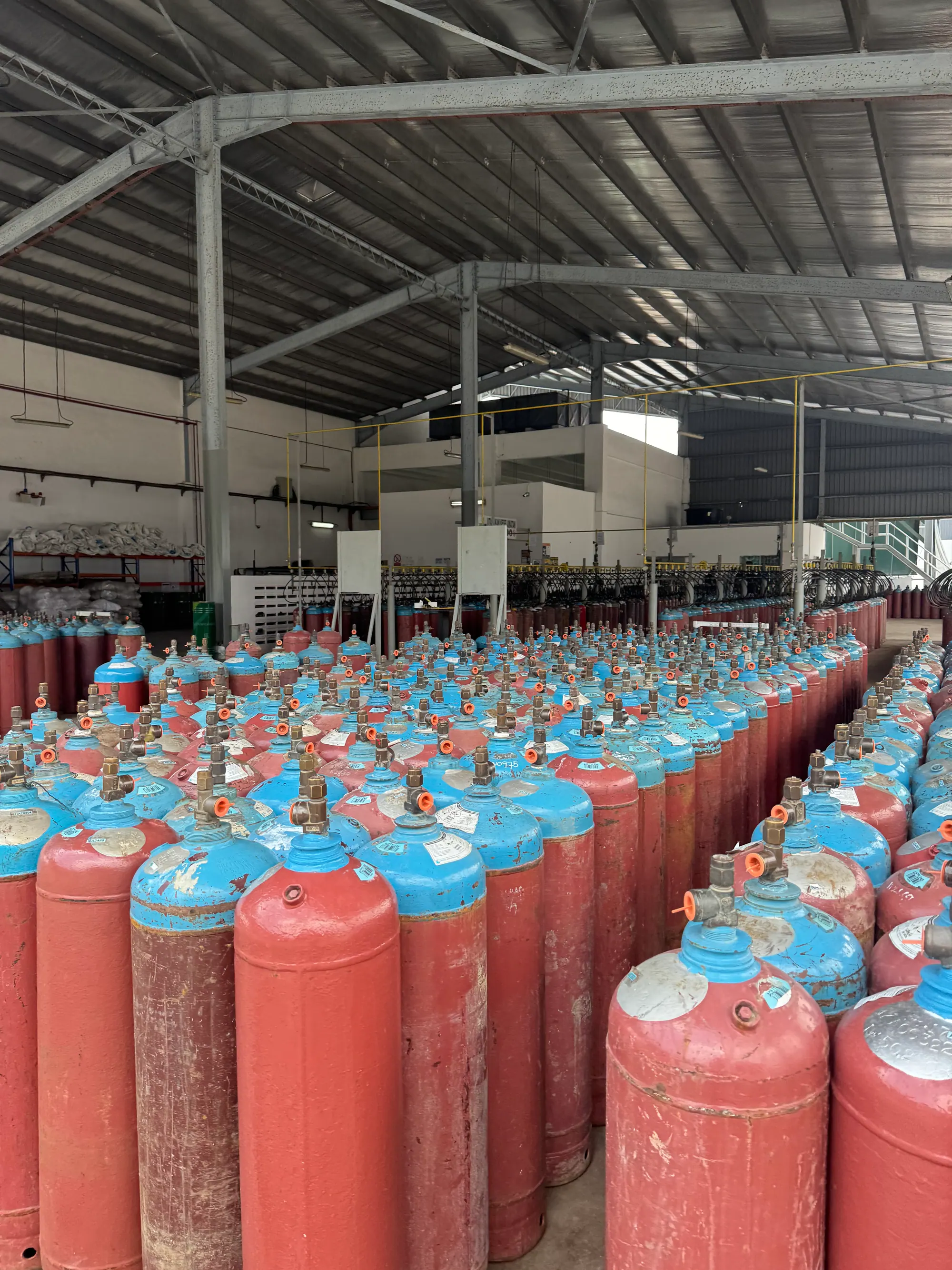
- Legal size range
- A gas cylinder is a container of more than 500 ml and not more than 1
- Reference temperature
- Water capacity at 15 °C; filling pressure stated at 15 °C; developed pressure checked at 65 °C
- Worked example
- 46.7 L × 151 bar absolute ÷ 1.013 bar = 6.96 m³ ideal at 15 °C
- Compressibility at 150 bar, 15 °C
- Oxygen and argon about 0.93
- Stated temperature for contents
- IS 309:2023 and IS 1747:2023 state cylinder contents in m³ at 27 °C and 760 mm Hg
Nobody in India can give you a single table of "cylinder contents" that is correct, because cylinder contents are not a property of the gas. They follow from four things: three figures that define the fill, namely the water capacity, the filling pressure and the reference temperature, and one property of the gas, its compressibility. This page shows the arithmetic, so a buyer can check any figure a supplier quotes, and it separates the two kinds of gas that must be treated differently: compressed gases, measured by pressure, and liquefied or dissolved gases, measured by weight.
Rules that matter
Under the Gas Cylinders Rules 2016 a gas cylinder is a closed metal container of more than 500 ml and not more than 1,000 litres water capacity, extended to 3,000 litres for CNG, nitrogen and compressed air where the diameter does not exceed 60 cm (rule 2(xxviii)). Rule 6 requires each cylinder to be stamped with, among other things, its water capacity, working and test pressures, tare weight and the date of its last hydrostatic test. Those are the inputs.
What the cylinder tells you
- Water capacity (WC) is the volume of water the cylinder holds at 15 °C (rule 2(li)).
- Filling pressure is the maximum permissible gauge pressure converted to 15 °C (rule 2(xxiv)), and IS 8775:1978 defines the matching developed pressure at 65 °C, the maximum temperature a cylinder is expected to reach in India.
- Tare weight is the empty weight; for liquefiable gases it includes the valve, and for acetylene it includes the porous mass, solvent and saturation gas.
Seamless cylinders for oxygen, nitrogen, argon, hydrogen, helium, air and CO₂ are made to IS 7285 (Part 1):2018 and IS 7285 (Part 2):2017; the old single-document IS 7285:1988 is withdrawn. Their periodic testing is covered on cylinder testing and retest, and the colour that tells you what is inside on cylinder colour codes.
Compressed gases: the arithmetic
For oxygen, nitrogen, argon, air, hydrogen and helium the gas stays gaseous at any pressure at room temperature, because each has a critical temperature far below ambient (oxygen −118.6 °C, argon −122.5 °C, nitrogen −147.0 °C). Contents follow from Boyle's law with a correction:
Contents (m³ at 15 °C, 1 atm) = WC (litres) × (filling pressure in bar gauge + 1.013) ÷ 1.013 ÷ 1,000 ÷ Z
where Z is the compressibility factor of the gas at the filling pressure and 15 °C. Z = 1 for an ideal gas. Below 1, the molecules attract each other and the cylinder holds more than ideal; above 1, they repel and it holds less.
Worked example, 46.7 litre cylinder filled to 150 bar gauge at 15 °C:
- Absolute pressure = 150 + 1.013 = 151.0 bar.
- Ideal content = 46.7 × 151.0 ÷ 1.013 ÷ 1,000 = 6.96 m³.
- Divide by Z for the gas.
| Gas | Approximate Z at 150 bar, 15 °C | Content of 46.7 L at 150 bar | Content of 46.7 L at 200 bar | Content of 10 L at 150 bar |
|---|---|---|---|---|
| Ideal gas (reference) | 1.00 | 6.96 m³ | 9.26 m³ | 1.49 m³ |
| Oxygen | about 0.93 | about 7.4 m³ | about 9.8 m³ | about 1.6 m³ |
| Argon | about 0.93 | about 7.4 m³ | about 9.8 m³ | about 1.6 m³ |
| Nitrogen | about 1.02 | about 6.8 m³ | about 9.0 m³ | about 1.5 m³ |
| Compressed air | about 0.99 | about 7.0 m³ | about 9.3 m³ | about 1.5 m³ |
| Helium | about 1.07 | about 6.5 m³ | about 8.4 m³ | about 1.4 m³ |
| Hydrogen | about 1.09 | about 6.4 m³ | about 8.3 m³ | about 1.4 m³ |
Compressibility is from the NIST Chemistry WebBook fluid-property data, rounded; volumes at 15 °C and 1.013 bar. Nitrogen's Z crosses 1 between 150 and 200 bar, which is why its 200 bar content is slightly less than the pro-rata figure. Hydrogen and helium stay above 1 at every cylinder pressure, so a hydrogen cylinder always holds less than the same cylinder of oxygen.
Why quoted figures differ by several per cent
Three conventions change the number without changing the gas.
- Reference temperature. IS 309:2023 cl 6.2 and IS 1747:2023 cl 6.2 require oxygen and nitrogen contents to be stated in m³ at 27 °C and 760 mm Hg. Gas at 27 °C occupies 300.15 ÷ 288.15 = 1.042 times its volume at 15 °C, so the same oxygen cylinder is about 7.4 m³ at 15 °C and about 7.7 m³ at 27 °C. Some suppliers use 0 °C "normal" cubic metres, which gives a figure 5 % smaller than one at 15 °C.
- Compressibility ignored. Many trade tables simply multiply WC by gauge pressure: 46.7 × 150 = 7,005 litres, "7 m³". That happens to land close for nitrogen and air but undercounts oxygen and argon by about 5 %.
- Temperature at filling. A cylinder filled hot to 150 bar settles to a lower pressure, and therefore lower contents, when it cools. The legal limit is the pressure at 15 °C, which is why fillers correct for temperature.
What happens to pressure with temperature
At constant volume the pressure of a compressed gas rises in proportion to absolute temperature, about 0.4 % per °C near room temperature. An oxygen cylinder filled to 150 bar at 15 °C reads roughly 165 bar at 35 °C and 176 bar at 50 °C (NIST oxygen data). This is the basis of IS 8775:1978: fix the filling pressure at 15 °C so the developed pressure at 65 °C stays inside what the cylinder was tested for. Store cylinders shaded; a cylinder in Indian summer sun on a truck bed can exceed 50 °C at the shell.
Liquefied gases: weigh, do not read the gauge
Carbon dioxide and nitrous oxide are liquids in the cylinder at room temperature, with a vapour space above. The pressure is the vapour pressure of the liquid, about 57 bar for CO₂ at 20 °C, and it stays there until almost all the liquid has evaporated. The gauge therefore reads "full" until the cylinder is nearly empty. Contents are set and checked by weight.
The legal charge is defined by the filling ratio, the mass of gas divided by the mass of water the cylinder holds at 15 °C (GCR 2016 rule 2(xxv); IS 3710:1978 cl 2.1.2). Example, using an illustrative ratio of 0.667: a 46.7 litre cylinder may hold 46.7 × 0.667 = 31.1 kg of CO₂. At 15 °C and 1 atm, CO₂ has a density of about 1.87 kg/m³, so 31.1 kg is about 16.6 m³ of gas. To check a cylinder, weigh it and subtract the stamped tare.
The Indian filling ratio for CO₂ and N₂O is not in any current standard KIGL holds: IS 3710 covers only gases with a critical temperature above 70 °C, and IS 8866, which covered CO₂, is withdrawn. The figure now lives in IS 15975:2020 and the Gas Cylinders Rules. Overfilling is the danger: CO₂'s critical temperature is 31.0 °C, so above that a liquid-full cylinder becomes a single dense phase whose pressure climbs steeply with temperature. This is why GCR 2016 rule 4(2) requires a CO₂ cylinder valve to carry a bursting disc that opens between 200 and 220 kg/cm². The detail is on carbon dioxide technical data.
Dissolved acetylene: weight against tare
A DA cylinder is a third case. The acetylene is dissolved in acetone held in a porous mass, the pressure depends on temperature and on how much acetone is present, and the cylinder pressure is a poor guide to contents. GCR 2016 rule 37(ix) requires each cylinder to be stamped with its maximum gas capacity, its tare weight (inclusive of valve) and the porous mass identity, and rule 41 requires the filler to record the empty weight, the solvent added and the full weight at each charge. Contents are the gross weight minus the tare. Each kilogram of acetylene is about 0.92 m³ at 20 °C and 1 atm, from a gas density of 1.0896 g/l measured by Bottomley, Reeves and Seitlow. The procedure is on checking acetylene cylinder contents by weight, and why pressure misleads is on acetylene cylinder pressure does not show contents.
Rules that matter
Rules to apply
- Read the WC, test date and gas from the cylinder; never assume a size.
- For compressed gases, use WC × absolute pressure ÷ 1.013 ÷ Z, and say which reference temperature the answer is at.
- For CO₂, N₂O and acetylene, weigh. A pressure reading is not a contents reading.
- Do not accept a cylinder past its test date, marked on the ring between valve and neck (GCR 2016 rule 9 warning label).
- Compare suppliers' quotes on the same basis: same pressure, same temperature, same Z treatment. The rules that govern fillers and users are on Gas Cylinders Rules 2016 for fillers and users, and KIGL's gases by cylinder are on the oxygen and other product pages.
How much gas is — frequently asked questions
How many cubic metres of oxygen are in a cylinder?
It depends on the cylinder's water capacity and filling pressure, which are stamped on it. For a 46.7 litre cylinder at 150 bar, the ideal-gas figure at 15 °C is 6.96 m³, and oxygen's compressibility adds roughly 7 % to give about 7.4 m³. Quoted at 27 °C, as IS 309:2023 requires, the same cylinder is about 7.6 m³. Always ask which pressure and reference temperature a quoted figure uses.
What is water capacity?
The volume of water, in litres, the empty cylinder holds at 15 °C (Gas Cylinders Rules 2016, rule 2(li)). It is stamped on the cylinder as WC and it is the starting point for every contents calculation. It is not the volume of gas the cylinder holds, which is tens to hundreds of times larger for a compressed gas.
Why do two cylinders of the same size hold different amounts of gas?
Because the filling pressure differs, because gases do not compress ideally, and because suppliers quote contents at different reference temperatures. A 150 bar and a 200 bar cylinder of the same water capacity differ by a third; hydrogen and helium hold about 7 to 9 % less than ideal, oxygen and argon about 5 % more; and a figure at 27 °C is 4 % larger than one at 15 °C.
How is a CO₂ cylinder's content measured?
By weight. Carbon dioxide is liquid in the cylinder at room temperature, and the pressure stays at the vapour pressure, about 57 bar at 20 °C, until the liquid is gone. The gauge therefore says nothing about contents. The legal charge is the water capacity times the filling ratio; weigh the cylinder and subtract the tare stamped on it.
How much acetylene is in a DA cylinder?
The maximum acetylene mass is stamped on every DA cylinder under GCR 2016 rule 37(ix), and contents are checked by weighing against the tare, which for acetylene includes the porous mass and the solvent. Each kilogram of acetylene is about 0.92 m³ at 20 °C. The cylinder pressure varies with temperature and does not indicate contents.
Does a full cylinder in the sun hold more gas?
No, the same mass, but at higher pressure. For a permanent gas the pressure rises about 0.4 % per degree; an oxygen cylinder filled to 150 bar at 15 °C reads about 176 bar at 50 °C. That is why the Indian system fixes filling pressure at 15 °C and checks the developed pressure at 65 °C (IS 8775:1978), and why cylinders are stored shaded.
Which standard covers seamless gas cylinders in India?
IS 7285 (Part 1):2018 for normalised steel and IS 7285 (Part 2):2017 for quenched and tempered steel below 1,100 MPa, with IS/ISO 9809-2:2019 above that. The single IS 7285:1988 document is withdrawn. Welded cylinders for gases other than LPG fall under IS 3196 (Part 2), and dissolved acetylene cylinders under IS 7312:2018.
References
- Bureau of Indian Standards. (1978). Filling pressure and developed pressure for permanent gases (IS 8775:1978).
- Bureau of Indian Standards. (2023). Nitrogen, compressed gas and liquid — Specification (IS 1747:2023, Second Revision).
- Bureau of Indian Standards. (2023). Oxygen, compressed gas and liquid — Specification (IS 309:2023, Fifth Revision).
- EIGA — cylinder filling and gas properties documents
- Government of India. (2016). Gas Cylinders Rules, 2016 (G.S.R. 1081(E)). Petroleum and Explosives Safety Organisation.
- IS 7285 (Parts 1 and 2) seamless steel cylinders
- Linstrom, P. J., & Mallard, W. G. (Eds.). (n.d.). NIST Chemistry WebBook (NIST Standard Reference Database 69). National Institute of Standards and Technology. [thermophysical properties of fluid systems (compressibility, density)] https://webbook.nist.gov/chemistry/fluid/
Enquiries
Request a quotation
State the gas or equipment, the quantity or capacity, and your location. KIGL will confirm the grade, the cylinder or plant size, and whether the location can be served from Noonmati, or through the agent network.