
Guide
Acetylene vapour pressure why it would take about 43 bar to liquefy at 20 °C, and why liquid acetylene is never used
The vapour pressure of liquid acetylene is about 43.7 bar at 20 °C, and its triple point at 1.2651 atm lies above atmospheric pressure, so it has no liquid phase at 1 atm. Liquid acetylene is, in the C.P.I.'s words, a real explosive; its industrial use is prohibited and only dissolved acetylene is sold.
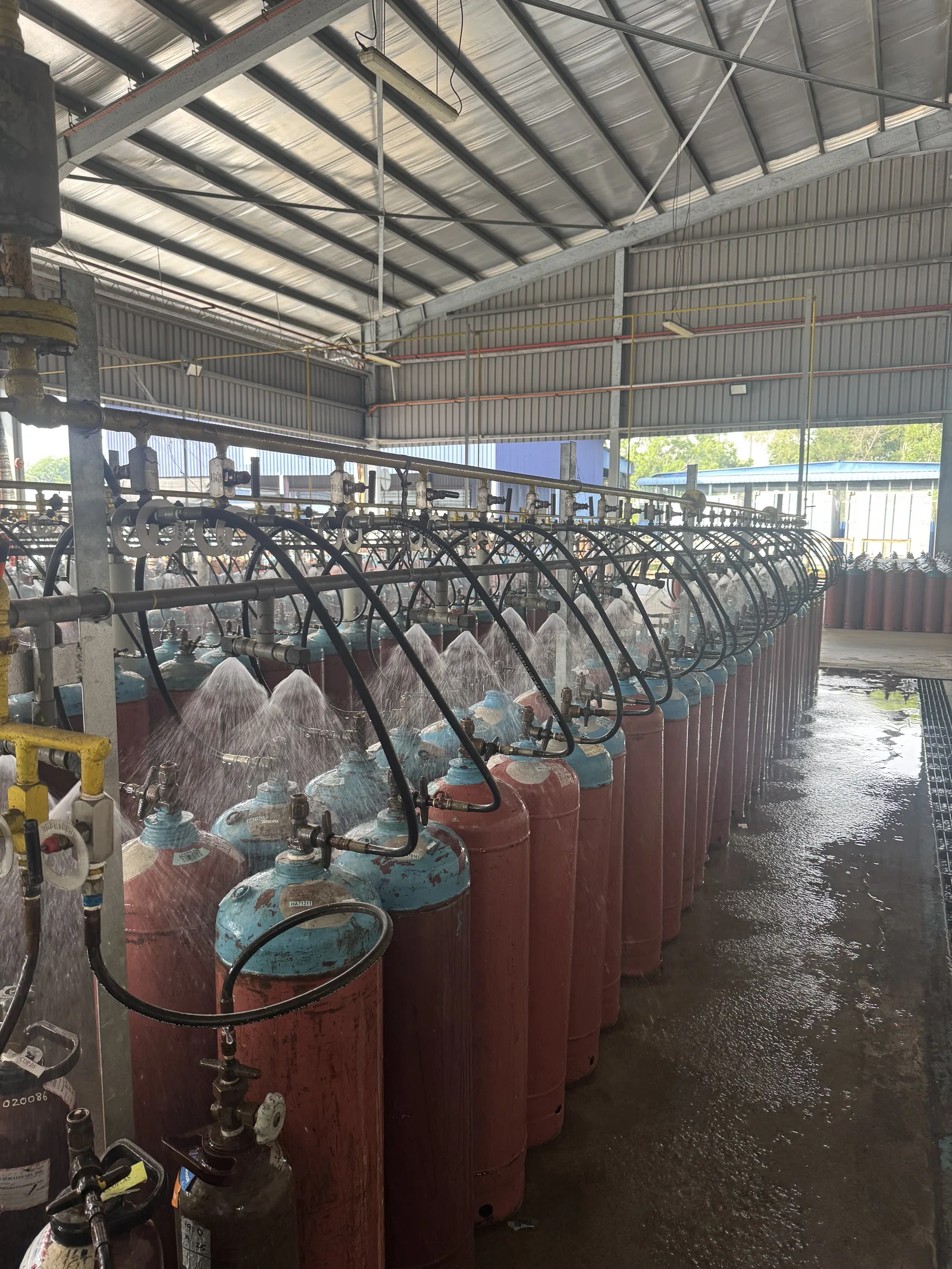
- Vapour pressure at 20 °C
- about 43.1 atm absolute = 43.7 bar; IS 14814:2023 gives 4
- Vapour pressure at 0 °C
- 26.39 atm; C.P.I. liquefaction table 27.2 kg/cm² absolute
- Triple point
- −80.55 °C at 1.2651 atm
- Status of liquid acetylene
- liquefied acetylene under pressure at ambient temperature constitutes a real explosive; its use is prohibited in industry
- Indian legal status
- acetylene when liquid
At 20 °C it takes about 43 atmospheres, roughly 43.7 bar, to hold acetylene as a liquid. Below its critical temperature of 35.18 °C the gas will liquefy if compressed to that pressure, exactly as propane or butane does at much lower pressures. It is never handled that way. The C.P.I. handbook of 1968 states plainly that liquefied acetylene under pressure at ambient temperature is a real explosive and that its use is prohibited in industry, and Indian law, through notification GSR 625(E) of 1983, declares liquid acetylene an explosive. This page gives the vapour-pressure figures and explains why the dissolved acetylene cylinder exists instead.
The vapour-pressure figures
The measurements of Hölemann and Hasselmann (Forschungsberichte des Landes Nordrhein-Westfalen No. 792, 1959) cover 213–293 K and fit a simple log P against 1/T relation to an average of 0.3 %. The saturated-liquid table compiled in 1965 extends them to the triple and critical points using Ambrose's data. The C.P.I. handbook prints a separate liquefaction table in kg/cm² absolute.
| Temperature | Vapour pressure, atm absolute | C.P.I. 1968, kg/cm² absolute | Liquid molar volume, cm³/mol |
|---|---|---|---|
| −80.55 °C (triple point) | 1.2651 | — | 42.2 |
| −20 °C | about 14.9 | 15.4 | about 51 |
| −10 °C | about 20.0 | 20.7 | about 53 |
| 0 °C | 26.39 | 27.2 | 56.0 |
| 10 °C | about 34.1 | 35.0 | about 60 |
| 20 °C | about 43.1 | 44.5 | about 66 |
| 26.85 °C | 50.93 | — | 70.9 |
| 35.18 °C (critical point) | 61.1 | — | 112.8 |
Rows marked "about" are interpolated from the tabulated values at 10 K intervals. IS 14814:2023 cl 4.3.11 gives 4,406 kPa at 20 °C, which is 43.5 atm and sits between the two older figures. In gauge terms, the figure at 20 °C is roughly 43.5 kg/cm². KIGL literature that has carried 44.6 kg/cm² gauge at 20 °C is describing a temperature nearer 21 °C.
No liquid at atmospheric pressure
Acetylene's triple point, measured by Ambrose (1956), is −80.55 °C at 961.5 mm Hg, or 1.2651 atm. That pressure is above one atmosphere. At 1 atm, therefore, there is no liquid phase at any temperature: cooled solid acetylene sublimes straight to gas at −83.80 °C. Carbon dioxide shares this behaviour; most industrial gases do not. IS 14814:2023 lists a boiling point of −84 °C at 1 atm and a triple point of −82 °C at 122 kPa, and the −84 °C figure is strictly the sublimation point. The practical consequence is that a cylinder or line over-chilled at low pressure deposits solid acetylene, not liquid, and solid acetylene is an explosive too.
Rules that matter
The C.P.I. (Paris, 1968) lists three ways of packing acetylene for transport: compression into metal containers, liquefaction at low temperature, and dissolution under pressure. It rejects the first two outright, citing the risks of liquid acetylene and of compressed acetylene once its excess pressure goes beyond a few tenths of an atmosphere. Its reasons, and the physics behind them:
Why liquid acetylene is banned
- Liquid acetylene is a condensed explosive The C.P.I. records that its decomposition can be started by an impact, a chemical reaction or overheating. Unlike gaseous acetylene, the liquid needs no pressure threshold to be dangerous; it is already at forty atmospheres and dense. The heat of formation released on decomposition is +226.9 kJ/mol, about 8,714 kJ/kg, explained in heat of formation and flame temperature.
- There is no safe ullage The liquid's molar volume is 56.0 cm³/mol at 0 °C and 112.8 cm³/mol at 35.18 °C. A container filled with liquid on a cool morning would need half its volume empty to survive an Indian afternoon, and at the critical point the liquid ceases to exist at all. The critical temperature's position inside the Indian summer is covered in critical temperature and hot weather.
- The latent heat collapses The heat of vaporisation falls from 584 kJ/kg at the triple point to 383 kJ/kg at 0 °C and to zero at 35.18 °C, so a warming liquid has little thermal buffer.
- Solid acetylene is no better The C.P.I. records that solid acetylene is also an explosive, somewhat less sensitive to impact, friction and heat than the pressurised liquid.
The C.P.I. notes that at low temperature near atmospheric pressure, with suitable additions, liquid acetylene is much more stable, and such techniques exist in chemical processing. None of them has any place in gas supply.
What the trade does instead
The solution was found between 1897 and 1901: Claude and Hess showed that acetone dissolves acetylene readily; Berthelot and Vieille showed that the solution does not decompose gradually up to about 10 atm; Le Chatelier proposed the porous mass; and Janet combined them in a cylinder. The story, with its primary citations, is in history of the dissolved acetylene cylinder.
In a modern dissolved acetylene cylinder the acetylene is held in solution at about 15 kg/cm² at 15 °C, roughly a third of the vapour pressure of the liquid. IS 14814:2023 cl 7.2.2 sets the maximum working pressure of a cylinder charged at 15 °C at 15.495 atm when acetone is the solvent, the same rule the C.P.I. recorded in 1968. The cylinder pressure rises with temperature because acetylene leaves solution, but it never approaches the liquid's vapour pressure, because the gas is dissolved, not condensed. Why acetone, and how much it holds, is in why acetylene is dissolved in acetone; the cylinder standards are on acetylene cylinder standards.
Rules that matter
Even with liquefaction excluded from the trade, the conditions for condensed acetylene can arise by accident:
Where liquid or solid acetylene can still appear
- Compressors in cold weather The C.P.I. required a table of maximum compression pressure against ambient temperature to be posted at each compressor: 25 kg/cm² at 4 °C and above, 20 at 0 °C, 17 at −5 °C and 14.5 at −10 °C. Its purpose was to stay below the liquefaction pressure, 20.7 kg/cm² absolute at −10 °C. This is history, not Indian law, but the principle stands: a high-pressure line must never be cold enough for its working pressure to exceed the vapour pressure of liquid acetylene.
- Air-separation units Solid acetylene dissolves in liquid oxygen only to about 6–7 parts per million molar at 90 K (Fedorova 1940; Ishkin and Burbo 1939; McKinley and Himmelberger 1957). Any more precipitates as solid inside the column. That is the origin of the acetylene limits in air-separation practice and the reason oxygen plants are sited away from acetylene sources; PESO requires 90 m between an acetylene plant and air-compressor intakes.
- Hydrates Wet acetylene under pressure forms a solid hydrate above 0 °C, a separate hazard covered in acetylene hydrate.
Rules that matter
Rules to apply
- Quote the vapour pressure of liquid acetylene as about 43.7 bar absolute at 20 °C, with IS 14814:2023's 4,406 kPa beside it, and never present it as a cylinder pressure.
- Never liquefy, solidify or compress acetylene outside purpose-built filling plant; the only commercial form is dissolved acetylene, such as KIGL's dissolved acetylene.
- Keep high-pressure acetylene lines and driers warm enough that working pressure is always well below the liquid's vapour pressure at the coldest point.
- Treat any solid deposit found in a cold acetylene line or in an air-separation unit as an explosive until proved otherwise.
- Use the acetylene technical data sheet for the full set of phase constants.
Acetylene vapour pressure — frequently asked questions
What is the vapour pressure of acetylene at 20 °C?
About 43 atm absolute, or 43.7 bar, from the vapour-pressure measurements of Hölemann and Hasselmann (1959) over 213–293 K. IS 14814:2023 gives 4,406 kPa (44.1 bar) and the C.P.I. liquefaction table 44.5 kg/cm² absolute; the three agree within about 1 %. In gauge terms it is roughly 43.5 kg/cm². This is the pressure over pure liquid acetylene.
Can acetylene be liquefied?
Physically yes: below its critical temperature of 35.18 °C it liquefies under its vapour pressure, about 27 kg/cm² absolute at 0 °C and 44.5 at 20 °C. Commercially no: the C.P.I. (1968) describes liquefied acetylene under pressure at ambient temperature as a real explosive whose use is prohibited in industry, and Indian law declares liquid acetylene an explosive.
Why is acetylene not sold as a liquid like LPG?
Because liquid acetylene can be set off by impact, a chemical reaction or overheating, and because its liquid doubles in volume between 0 °C and its 35.18 °C critical point, so no safe ullage can be designed for Indian temperatures. Instead it is dissolved in acetone at about 15 kg/cm² inside a porous mass, which stops decomposition propagating.
Does acetylene have a boiling point?
Not at 1 atm. Its triple point is −80.55 °C at 1.2651 atm, above atmospheric pressure, so at 1 atm solid acetylene sublimes directly to gas at −83.80 °C. IS 14814:2023 lists a boiling point of −84 °C at 1 atm and a triple point of −82 °C at 122 kPa; strictly the −84 °C figure is the sublimation point.
Is solid acetylene dangerous?
Yes. The C.P.I. (1968) records that solid acetylene also constitutes an explosive, though rather less sensitive to impact, friction and heat than liquid acetylene under pressure. The practical case is in air-separation units: solid acetylene is soluble in liquid oxygen only to about 6 parts per million molar at 90 K, and anything above that precipitates.
Why do acetylene compressors not liquefy the gas?
Because filling pressures are far below the vapour pressure at ambient temperature. At 20 °C liquefaction needs about 44.5 kg/cm² absolute. The C.P.I. compressor table capped compression at 14.5 kg/cm² at −10 °C precisely because liquefaction then needs only 20.7. In Indian conditions the margin is wide, but cold driers and coolers still need watching.
What pressure does a dissolved acetylene cylinder actually run at?
About 15 kg/cm² at 15 °C, roughly a third of the vapour pressure of liquid acetylene. IS 14814:2023 cl 7.2.2 sets the maximum working pressure of an acetone cylinder charged at 15 °C at 15.495 atm. The pressure rises with temperature as gas leaves solution, but it never approaches liquid acetylene's vapour pressure because the gas is dissolved.
References
- Ambrose, D., Trans. Faraday Soc. 1956, 52, 772 — triple point and critical temperature
- Bureau of Indian Standards. (2023). Acetylene — Code of Safety (IS 14814:2023, First Revision).
- C.P.I. (1968). Safety in the production and use of acetylene. Paris.
- Hölemann, P. and Hasselmann, R., Forschungsberichte des Landes Nordrhein-Westfalen No. 792 (1959) — vapour pressure of liquid acetylene
- Petroleum and Explosives Safety Organisation. (n.d.). Petroleum and Explosives Safety Organisation. Government of India.
Enquiries
Request a quotation
State the gas or equipment, the quantity or capacity, and your location. KIGL will confirm the grade, the cylinder or plant size, and whether the location can be served from Noonmati, or through the agent network.