
Guide
Acetylene's critical temperature is 35.18 °C what that means for a cylinder standing in an Indian summer
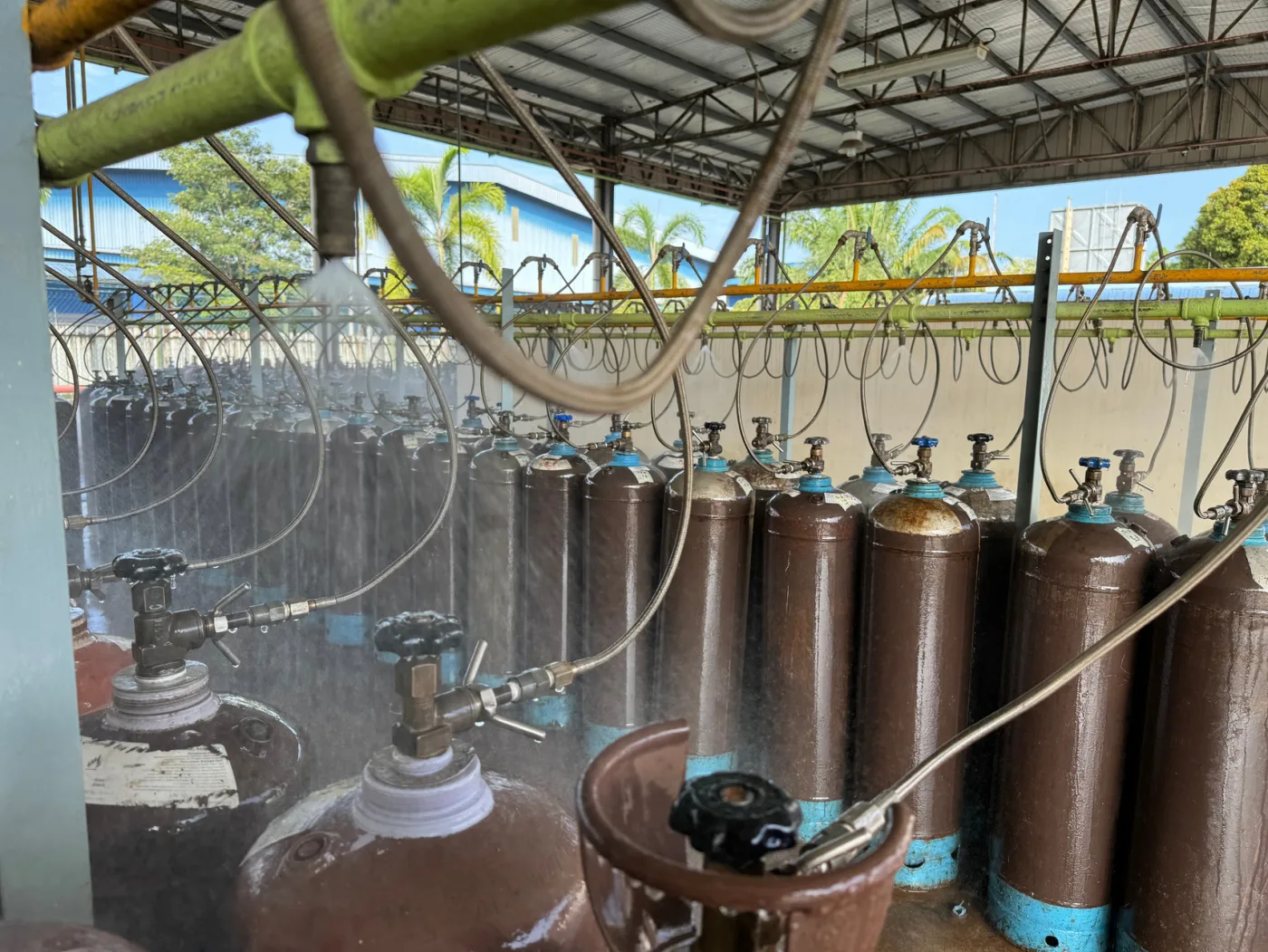
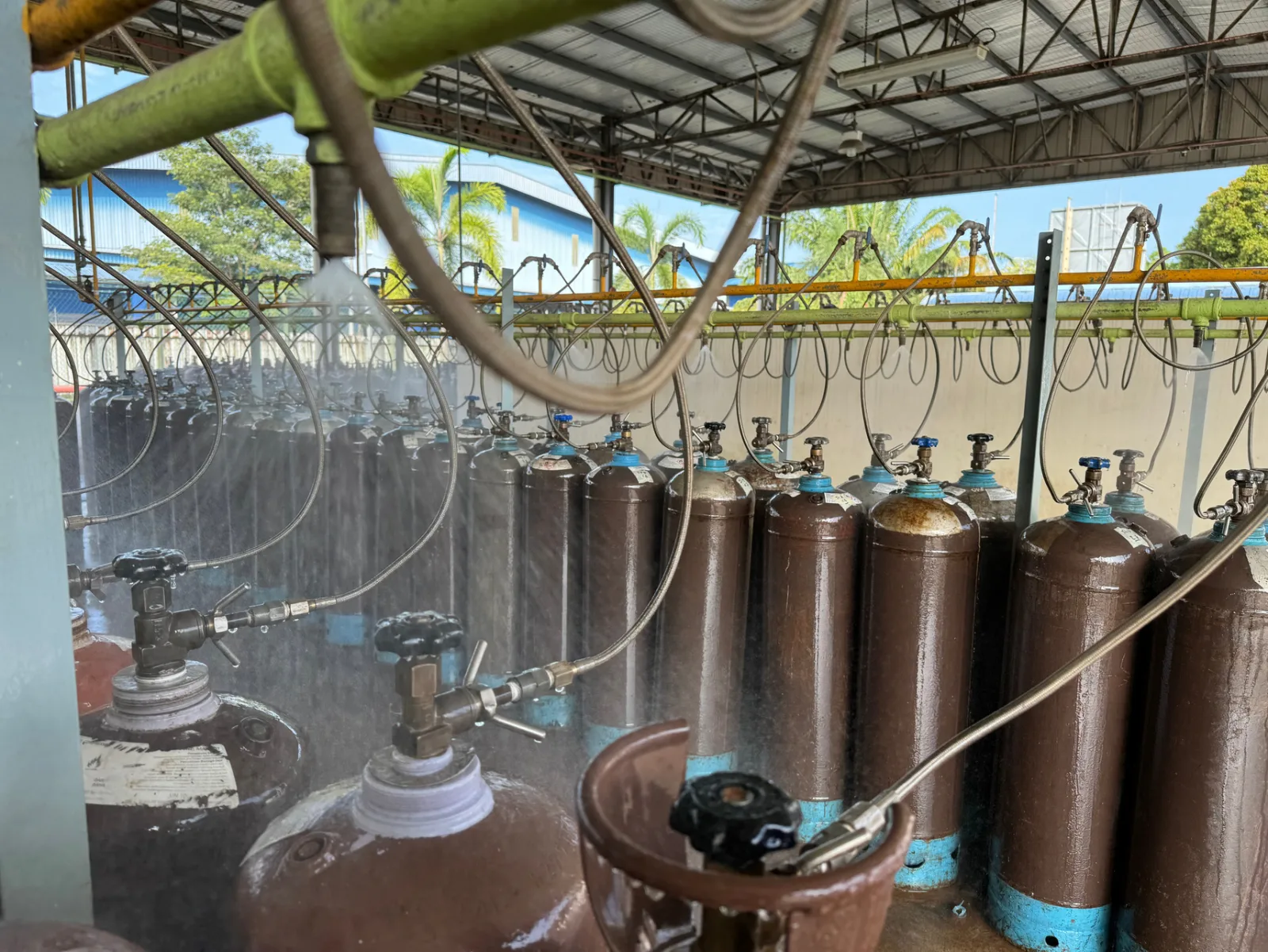
The critical temperature of acetylene is 35.18 °C (Ambrose, 1956), regularly exceeded in Indian summers. Above it no liquid acetylene can exist at any pressure. In a dissolved acetylene cylinder the acetone holds 15 % less gas per 10 °C rise at 15 atm and expands 0.23 % per °C.
- Critical temperature
- 35.18 ± 0.04 °C; IS 14814:2023 prints 35.15 °C
- Critical pressure
- 61.1 atm
- Solubility in acetone at 15 atm total
- 546 g/kg at 15 °C; 472 at 20 °C; 413 at 25 °C; 364 at 30 °C
- Thermal expansion of loaded solvent
- 0.23 % per °C for acetone holding 600 g/kg
- Settled pressure rule
- maximum working pressure 15.495 atm at 15 °C with acetone as solvent; never heat a cylinder with a flame
Acetylene's critical temperature is 35.18 °C. Above that temperature no pressure, however high, will liquefy it. In Britain or Germany, where the acetylene literature was written, that is an abstract number; in Guwahati, Kolkata or Singrauli it is a temperature the shade thermometer passes for weeks every year, and a cylinder in direct sun exceeds it for months. This page explains what the critical point is, why it is of only indirect consequence for the acetylene itself, and why the same heat matters a great deal for the acetone that holds the acetylene in solution.
The short version: a hot dissolved acetylene (DA) cylinder is not about to turn into liquid acetylene, but its solvent holds a third less gas at 30 °C than at 15 °C, swells by 0.23 % for every degree, and vents acetone far faster when used. Shade, upright storage and residual-pressure discipline are the responses.
What the critical point is
Every gas has a temperature above which the distinction between liquid and vapour disappears. For acetylene the measurement that matters is Ambrose's (Trans. Faraday Soc. 1956): 35.18 ± 0.04 °C, with a critical pressure selected from the literature at 61.1 atm (61.9 bar). IS 14814:2023 prints 35.15 °C and 6,059 kPa. The critical density is 0.2308 g/cm³ (112.8 cm³/mol) and the critical compressibility factor about 0.27.
| Property | Value | Source |
|---|---|---|
| Critical temperature | 35.18 ± 0.04 °C (308.33 K) | Ambrose 1956 |
| Critical pressure | 61.1 atm = 61.9 bar; IS 14814 6,059 kPa | selected value; IS 14814:2023 |
| Critical density | 0.2308 g/cm³ | from the saturated-liquid molar volume |
| Vapour pressure of liquid at 20 °C | about 43.1 atm (43.7 bar); IS 14814 4,406 kPa | Hölemann and Hasselmann 1959; IS 14814:2023 |
| Vapour pressure at 26.85 °C (300 K) | 50.93 atm | saturated-liquid table |
| Latent heat of vaporisation | 383 kJ/kg at 0 °C, falling to zero at 35.18 °C | Hölemann 1959 |
| Liquid molar volume | 56.0 cm³/mol at 0 °C rising to 112.8 at the critical point | saturated-liquid table |
Two features of that table explain why liquid acetylene is never handled commercially. The liquid's molar volume doubles between 0 °C and the critical point, so there is no ullage design that survives a warm day, and the latent heat that would otherwise moderate a temperature rise vanishes at 35 °C. The full argument is in why liquid acetylene is banned.
Near the critical point the gas is strongly non-ideal. At 20 °C and 15 atm the fugacity coefficient is already about 0.88; the specific heat Cp at constant pressure rises steeply with pressure as the critical region is approached, and the thermal expansion coefficient at high pressure passes through a minimum and then climbs. Anyone computing the gas-space inventory of a cylinder from the ideal gas law at filling pressure is out by about 12 %, and the error grows as the critical point is approached.
Why it matters less for the acetylene than you might think
In a DA cylinder there is no liquid acetylene to lose. The acetylene is dissolved in acetone held in a porous mass; the only free gas is in the void space above the solution and in the pores. Passing the critical temperature changes the behaviour of that free gas (it becomes a supercritical fluid, with the steep property changes just described) but it does not change the physical state of the contents. The cylinder's safety against decomposition rests on the porous mass and the solvent, not on the acetylene staying below any temperature.
So the critical temperature is not, by itself, a reason to fear a hot cylinder. The real consequences of heat are indirect, and they act on the solvent.
What the heat does to the acetone
The measurements of Hölemann and Hasselmann (Forschungsberichte des Landes Nordrhein-Westfalen, 1952–1959) are the basis of every modern filling table. At a constant total pressure of 15 atm, close to the settled pressure of a full cylinder:
| Temperature | Acetylene held, g per kg acetone | g per litre of charged solution | Change from 15 °C |
|---|---|---|---|
| 15 °C | 546 | 235 | — |
| 20 °C | 472 | 211 | −14 % |
| 25 °C | 413 | 195 | −24 % |
| 30 °C | 364 | 180 | −33 % |
Roughly 15 % of the dissolved charge comes out of solution for every 10 °C of warming at constant pressure. In a sealed cylinder the pressure rises instead; the solubility curve is the reason cylinder pressure is no guide to contents, which is dealt with in why cylinder pressure does not show contents, and the reason IS 14814:2023 cl 7.2.2 defines the maximum working pressure, 15.495 atm with acetone as solvent, at 15 °C and nowhere else.
The second effect is thermal expansion of the loaded solvent. Pure acetone expands 0.15 % per °C; acetone holding 600 g of acetylene per kg expands 0.23 % per °C, half as fast again. A 30 °C excursion swells the charged solvent by about 7 %.
Rules that matter
Take an illustrative cylinder of 41 litres water capacity with a porous mass of 92 % porosity (37.7 litres of void), charged with 12.8 kg of acetone and 7.0 kg of acetylene, filled to 15 atm at 15 °C. These are typical figures from the reference literature and not a KIGL specification; KIGL's own cylinder data are on the acetylene gas page.
A worked cylinder, from 15 °C to 45 °C
- At 15 °C the 12.8 kg of acetone occupies 16.1 litres unloaded. Loaded to 546 g/kg it swells by the dilation factor 0.981 + 1.58 × 0.546 = 1.84, to 29.7 litres, filling 79 % of the void and leaving 21 % as gas space.
- At 45 °C the loaded solvent has expanded by 30 × 0.23 % = 6.9 %, to 31.8 litres, now 84 % of the void. Simultaneously the solubility has fallen, so gas has left the solution and the pressure has risen.
- The cylinder has lost roughly a quarter of its remaining gas space to a hot afternoon. That gas space is the margin that keeps liquid away from the valve and prevents liquid carry-over on withdrawal.
Nothing in that sequence breaches the cylinder, provided it was correctly filled. What it does is erode the margin that a correct fill provides, which is the quantitative argument for not overcharging solvent at the filling station and for not storing cylinders in the sun.
The third effect: acetone leaves with the gas
The fraction of the gas leaving the valve that is acetone vapour is set by the vapour pressure of acetone at the cylinder temperature. Computed from the partial-pressure table of Hölemann and Hasselmann:
| Cylinder temperature | Acetone in withdrawn gas at 15 atm | at 5 atm | at 1 atm |
|---|---|---|---|
| 20 °C | 1.2 % | 4.0 % | 23 % |
| 30 °C | 2.0 % | 6.6 % | 34 % |
| 40 °C | 3.1 % | 10.2 % | 55 % |
A hot cylinder run down to low pressure vents acetone at roughly the rate it vents acetylene. The remedy is the residual-pressure rule covered in acetone carry-over and residual pressure: return cylinders with pressure still in them, and keep them cool.
Hot weather in the plant, not just the store
Two further points concern the filling plant rather than the user. The C.P.I. handbook of 1968 required a table of maximum compression pressures against ambient temperature to be posted at every acetylene compressor: 25 kg/cm² at +4 °C and above, 20 at 0 °C, 17 at −5 °C and 14.5 at −10 °C. Its purpose was to stay below the liquefaction pressure in cold weather (20.7 kg/cm² absolute at −10 °C). It is history, not Indian law, and its ceiling is not a licence to compress to 25 kg/cm² here. In Indian conditions the cold-weather limit is rarely the constraint; the heat is. Filling into a warm cylinder means the heat of solution (684–757 kJ per kg of acetylene dissolved, Schay et al. 1958) is being added to a solvent that already holds less, and the cylinder must be allowed to cool and settle before its pressure is read against the 15 °C rule. Cylinder checks at the filling station are covered in inspection at the time of filling.
Rules that matter
Rules to apply
- Store and use DA cylinders in shade, upright, away from radiators and other heat sources; the C.P.I. applied that rule even to cylinders that had been emptied, because the acetone still holds acetylene at atmospheric pressure.
- Never apply heat to a cylinder, and never use a flame on one for any reason. In Indian conditions there is no reason to warm a DA cylinder at all.
- Read pressure only with the temperature beside it. The filling limit is 15.495 atm at 15 °C (IS 14814:2023); at 35 °C the same correct fill reads much higher.
- Do not run a hot cylinder below residual pressure; the acetone loss climbs steeply below 5 atm.
- Expect the gas-space margin to shrink by a quarter on a 45 °C afternoon, and fill solvent to specification, never above it.
- For property values use the acetylene technical data sheet; for cylinder construction and inspection standards, the acetylene cylinder standards page.
Acetylene's critical temperature is 35.18 °C — frequently asked questions
What happens to acetylene above its critical temperature?
Above 35.18 °C acetylene cannot be liquefied by any pressure; it exists only as a dense gas, a supercritical fluid. In a dissolved acetylene cylinder that is not dramatic, because the gas is in solution, not liquid, but the gas-space acetylene becomes strongly non-ideal: its specific heat and thermal expansion rise steeply near the critical point.
How much does acetylene cylinder pressure rise in hot weather?
Markedly, because solubility in acetone falls as temperature rises. At 15 atm the solvent holds 546 g of acetylene per kg at 15 °C but only 364 g at 30 °C; the difference comes out of solution and raises the pressure. That is why cylinder pressure is no guide to contents and why the filling pressure is defined at 15 °C.
Can an acetylene cylinder explode if left in the sun?
A sound cylinder within its filling limits is designed for summer temperatures; the fusible plugs do not yield until 98–104 °C (IS 13497:2017). The real effects of sun are loss of gas space as the loaded solvent swells 0.23 % per °C, higher pressure, and far higher acetone carry-over on use. Store in shade, upright, away from radiators, and never warm a cylinder with a flame.
Why does IS 14814 define the cylinder pressure at 15 °C?
Because the pressure of a dissolved acetylene cylinder is a function of temperature, not of contents. IS 14814:2023 cl 7.2.2 sets the maximum working pressure at 15.495 atm with the cylinder at 15 °C and acetone as solvent, the same 15 kg/cm² settled-pressure rule the C.P.I. recorded in 1968. A cylinder read at 35 °C will show well above that and still be correctly filled.
How much acetone is lost from a hot cylinder?
Much more than from a cool one. From the partial-pressure data of Hölemann and Hasselmann, acetone vapour is 1.2 % of the withdrawn gas at 20 °C and 15 atm, 3.1 % at 40 °C and 15 atm, 23 % at 20 °C and 1 atm, and 55 % at 40 °C and 1 atm. A hot cylinder run to low pressure vents nearly as much acetone as acetylene.
Does the critical temperature matter for acetylene compressors?
Yes. The old C.P.I. rule (1968, history and not Indian law) capped compression at 25 kg/cm² at ambient temperatures of 4 °C and above, falling to 14.5 kg/cm² at −10 °C, to stay below the liquefaction pressure (20.7 kg/cm² absolute at −10 °C). In Indian heat the opposite applies: the gas is far from liquefying, but its compressibility and specific heat near 35 °C make the discharge behave less ideally.
Is 35.18 °C or 35.15 °C the correct critical temperature?
Ambrose measured 35.18 ± 0.04 °C in 1956 and that is the value adopted in the standard compilation; IS 14814:2023 prints 35.15 °C. The difference of 0.03 °C is within the measurement uncertainty and has no practical consequence. KIGL quotes 35.18 °C with the source and notes the IS figure.
References
- Ambrose, D., Trans. Faraday Soc. 1956, 52, 772 — critical temperature and triple point of acetylene
- Bureau of Indian Standards. (2023). Acetylene — Code of Safety (IS 14814:2023, First Revision).
- C.P.I. (1968). Safety in the production and use of acetylene. Paris.
- Linstrom, P. J., & Mallard, W. G. (Eds.). (n.d.). NIST Chemistry WebBook (NIST Standard Reference Database 69). National Institute of Standards and Technology. [acetylene phase data] https://webbook.nist.gov/cgi/cbook.cgi?ID=C74862
Enquiries
Request a quotation
State the gas or equipment, the quantity or capacity, and your location. KIGL will confirm the grade, the cylinder or plant size, and whether the location can be served from Noonmati, or through the agent network.