
Guide
Acetylene hydrate the ice-like solid that forms in wet acetylene under pressure, above freezing point
Acetylene hydrate is a solid clathrate, C₂H₂·5.75H₂O, first made by Villard in 1895. Wet acetylene tends to form it above about 7 atm at 0 °C and 20 atm at 10 °C. It is not ice: it forms above freezing and can plug intercoolers, drains and driers.
- Composition
- clathrate C₂H₂·5.75H₂O
- Dissociation pressure
- 5.75 atm at 0 °C; 1 atm absolute at −38 °C
- Formation conditions in water
- tends to form above about 7 atm at 0 °C and above about 20 atm at 10 °C
- Heat of formation
- 15.4 kcal/mol; can be formed at 2 °C by vigorously stirring water under 25 atm of acetylene
- Acetone-containing hydrate
- 2C₂H₂·
Wet acetylene under pressure can turn into a solid at temperatures well above freezing. The solid is acetylene hydrate, a cage compound of water and acetylene first prepared by Paul Villard in 1895, and it is one of the least discussed hazards in the dissolved acetylene trade. At 0 °C it is stable above 5.75 atm; acetylene-saturated water tends to deposit it above about 7 atm at 0 °C and above about 20 atm at 10 °C. Nobody watching for ice expects a blockage at 8 °C. This page explains what the hydrate is, where in a plant the conditions for it arise, and how to keep water out of its way.
What acetylene hydrate is
Villard (Compt. rend. 1895; Ann. chim. 1897) obtained a white solid by cooling compressed acetylene in the presence of water to 0 °C. He formulated it as C₂H₂·6H₂O and measured a dissociation pressure of 5.75 atm at 0 °C and a heat of formation of 15.4 kcal/mol; he also made it at 2 °C by stirring water vigorously under 25 atm of acetylene, and found its dissociation pressure falls to 1 atm absolute at −38 °C. De Forcrand and Thomas (1897) made a different hydrate in the presence of carbon tetrachloride, with a dissociation pressure just over 1 atm at 5 °C.
The structure was explained half a century later by von Stackelberg and co-workers (Naturwissenschaften 1949 and 1951; Z. Elektrochem. 1954). Gas hydrates are clathrates: the water forms a lattice with cavities, and the gas molecules sit in the cavities without chemical bonding. One lattice has 46 water molecules with cavities of about 5.2 and 5.9 Å; the other has 136 water molecules with 8 cavities of 6.9 Å and 16 of 4.8 Å. Filling the cavities of the first lattice gives the ideal formula C₂H₂·5.75H₂O, and Villard's experimental 6H₂O is the same compound with a few cavities empty. The mixed hydrate with acetone, 2C₂H₂·(CH₃)₂CO·17H₂O, has a dissociation pressure of 1 atm at −21 °C.
| Hydrate | Formula | Dissociation conditions | Source |
|---|---|---|---|
| Simple hydrate | C₂H₂·5.75H₂O | 5.75 atm at 0 °C; 1 atm at −38 °C | Villard 1895–97; von Stackelberg 1949–54 |
| Formation in saturated water | — | above about 7 atm at 0 °C; above about 20 atm at 10 °C | as compiled by S. A. Miller (1965) |
| Carbon tetrachloride hydrate | 2C₂H₂·CCl₄·17H₂O | just over 1 atm at 5 °C | de Forcrand and Thomas 1897 |
| Acetone hydrate | 2C₂H₂·(CH₃)₂CO·17H₂O | 1 atm at −21 °C | as compiled by S. A. Miller (1965) |
Natural-gas engineers know this behaviour well, because natural-gas hydrates block pipelines the same way. Acetylene is no different in kind.
Why it is not ice, and why that matters
Ice forms at 0 °C at any pressure; acetylene hydrate forms at higher temperatures as the pressure rises. The practical consequence is that the conditions for a blockage overlap the conditions an operator thinks of as safely above freezing. Two further properties make it awkward:
- It is a solid that holds gas. When it warms or the pressure drops, it dissociates and releases acetylene, which can produce a sudden pressure rise in a closed section or a release when a line is opened.
- It forms where water collects: low points, drains, gauge connections, separators. These are exactly the places a blockage defeats an instrument, a drain or a relief path.
The solubility of acetylene in water also climbs with pressure (1.97 g/kg at 0 °C and 1 atm, roughly five times that at 5 atm), so a wet line at pressure carries a great deal of dissolved gas ready to form hydrate as it cools. The water data are on acetylene solubility in water and carbide sludge.
Where the conditions arise in a dissolved acetylene plant
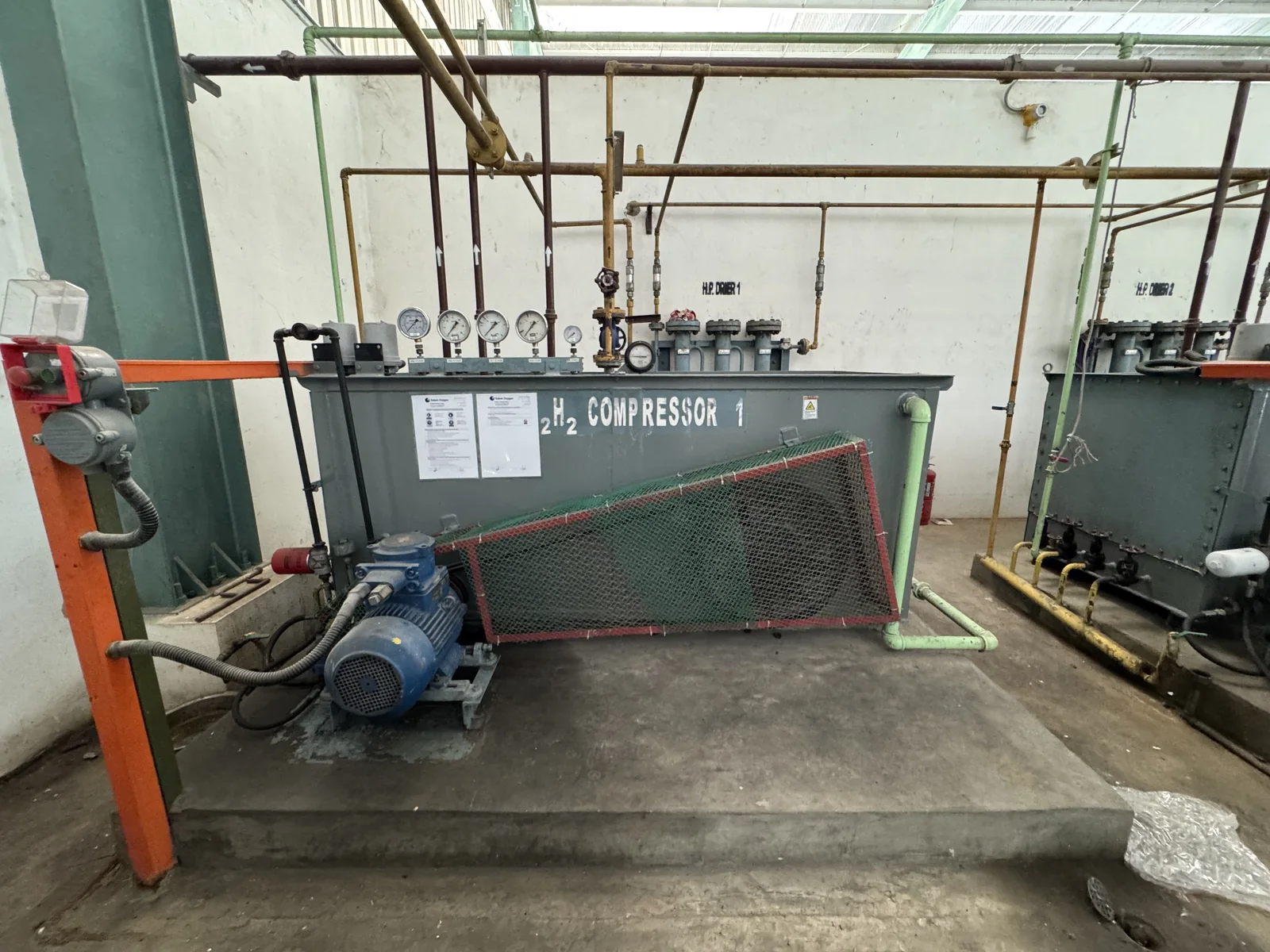
Gas from a carbide-to-water generator leaves warm and saturated with water vapour. Most of the water condenses as it cools to ambient in the cooler-condenser, washer and gasholder, and the C.P.I. handbook (Paris, 1968) requires condensate to be drawn from the low-pressure pipes. What remains is ambient-saturated gas, and the compressor raises its pressure to filling pressure, well above the hydrate threshold. At each stage the gas is cooled, and wherever it is cooled at pressure with free water present, the hydrate becomes possible.
| Location | Pressure | Why hydrate can form | Control |
|---|---|---|---|
| Interstage coolers and separators | intermediate | gas saturated and cooled by water; condensate collects | drain every shift; keep cooling water above the hydrate temperature |
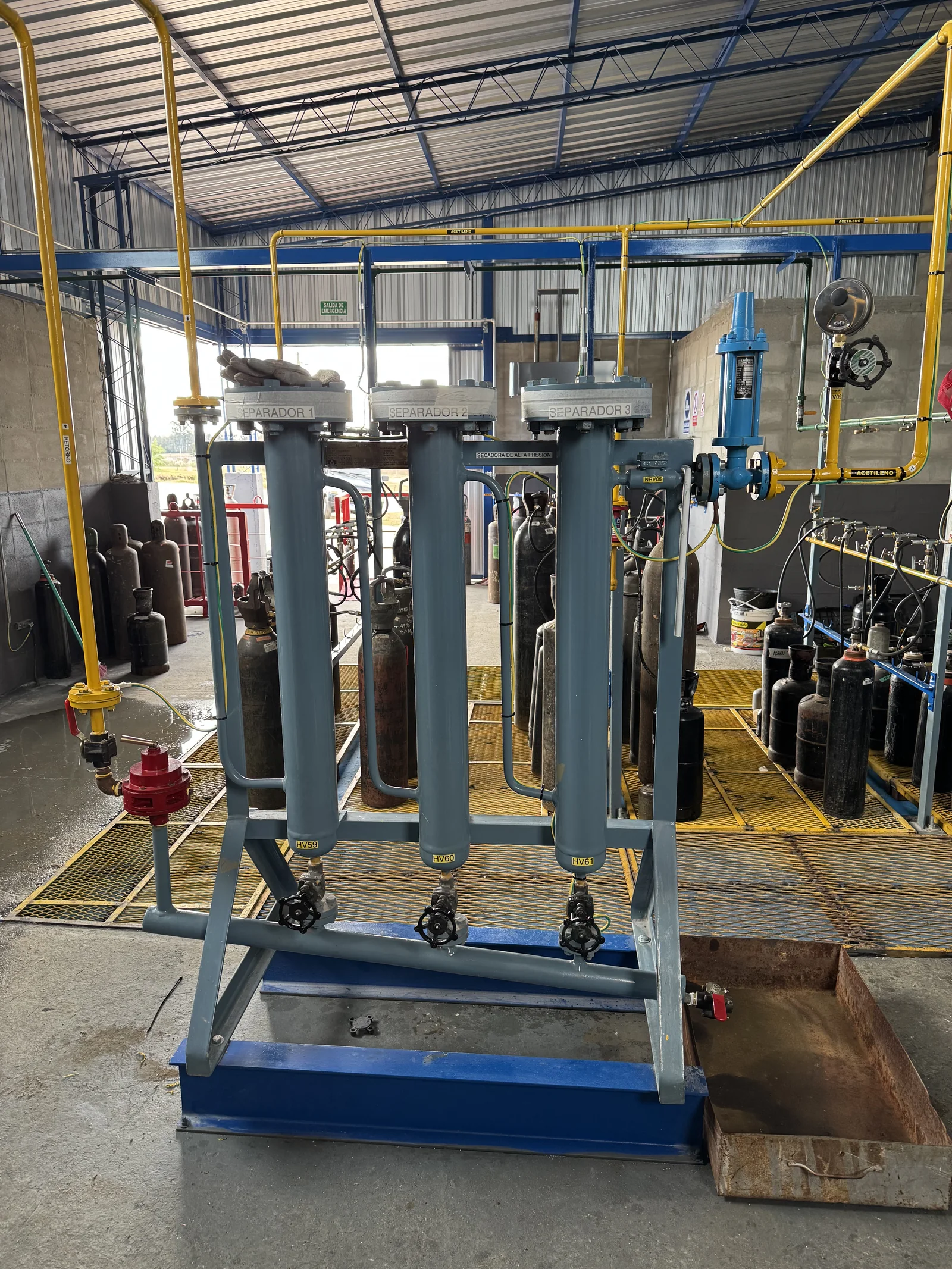
| Final cooler and high-pressure drier inlet | filling pressure | highest pressure, free water present before the drier | drain the drier bottom; keep drier and its drain warm in winter |
| Drain valves and condensate lines | filling pressure down to atmospheric | water and dissolved gas trapped, then cooled on expansion | open slowly; keep drain lines short and free of dead-ends |
| Pressure-gauge impulse lines | any | stagnant, wet, cold | slope lines back to the main; protect from cold |
| Cylinder filling bath | filling pressure | cooling water around the rack in a cold season | the gas here should already be dry |
The C.P.I. handbook's rules for high-pressure driers apply directly: keep the empty space in the drier to a minimum, open the outlet valve slowly when liquid is drawn off, and never discharge drier drainings to a sewer. The drier itself is covered in acetylene drying, condensate and high-pressure driers, and the compressor side in acetylene compressor operation and oil.
Indian ambient temperatures keep most of a plant out of hydrate territory most of the year, because the threshold rises steeply with temperature — from about 7 atm at 0 °C to about 20 atm at 10 °C in the solubility data as compiled by S. A. Miller (1965). The risk concentrates in the cold months in the north-east and in hill stations, on equipment cooled by chilled or well water, and on any point chilled by rapid expansion of gas across a partly open valve.
Rules that matter
A hydrate needs water. Dry gas cannot form one, whatever its pressure and temperature. That gives a simple order of defences:
Why drying is the real cure
- Condense and drain as much water as possible at low pressure, where the hydrate cannot form; the C.P.I. requires slopes and drains on low-pressure lines for this reason.
- Separate and drain free water after every stage of compression, on a schedule logged by the shift, not when the operator remembers.
- Dry the gas at high pressure before it reaches anything cold. EIGA Doc 241 gives a moisture target of not more than 100 ppm by volume after the high-pressure drier; IS 308:2024 limits moisture in the product to 0.25 % by mass, which is a product limit, not a plant design target.
- Keep cooling water above the temperature at which hydrate can form at the local pressure, particularly in winter.
- Protect drain lines, gauge lines and drier bottoms from cold.
Drying has a second benefit and a caveat. Wet acetylene resists decomposition better than dry: the Rimarski limits recorded by the C.P.I. show the propagation pressure at 80 °C rising from 0.40 kg/cm² dry to 1.4 kg/cm² saturated. Drying therefore removes a moderating agent as well as a plugging agent; the C.P.I. separately requires the empty space in high-pressure driers to be kept to a minimum, so that little compressed gas is available to decompose. That trade-off is discussed in wet acetylene is safer than dry.
Rules that matter
The rule is the one the C.P.I. gives for frozen acetylene pipes: thaw with hot water only, avoiding every source of naked light. In practice:
Clearing a hydrate blockage
- Isolate and depressurise the section first; the hydrate will release gas as it dissociates.
- Apply hot water or hot cloths to the outside of the line or valve. Never use a flame, a heat gun with an exposed element, or electric heating tape not rated for a Group IIC atmosphere.
- Ventilate and keep ignition sources away; the release is acetylene.
- Never hammer, rod or blow through a blocked acetylene line. Mechanical shock and a sudden release are both ignition risks.
- Find out why water reached that point and correct the drain schedule or drier operation before restarting.
KIGL's plant fault register, condensed in acetylene plant troubleshooting, treats a drier drain that opens but passes nothing as a clogged valve to be cleaned with the compressor stopped and the drier vented, and the same discipline applies to a suspected hydrate.
Rules that matter
Rules to apply
- Treat any wet acetylene line above about 7 atm and below about 10 °C as a potential hydrate location.
- Drain condensate on a logged schedule at every low point, separator and drier.
- Dry the gas before it meets anything cold, and keep cooling water above the hydrate temperature.
- Thaw only with hot water, isolated and depressurised; never with flame.
- Keep drains and gauge lines short, sloped and warm.
- Specify driers and coolers for Indian winter conditions, not just summer, when selecting acetylene gas plants and purification systems.
Acetylene hydrate — frequently asked questions
What is acetylene hydrate?
A crystalline solid in which acetylene molecules sit inside cages formed by water molecules, a clathrate of approximate formula C₂H₂·5.75H₂O. Villard first prepared it in 1895 by cooling compressed acetylene in the presence of water, and von Stackelberg's X-ray work around 1950 established the cage structure. It looks like snow or ice but is a distinct compound.
At what pressure does acetylene hydrate form?
At 0 °C the hydrate is stable above its dissociation pressure of 5.75 atm, and in water saturated with acetylene it tends to separate above about 7 atm. At 10 °C the threshold rises to about 20 atm. The colder the gas, the lower the pressure needed; at −38 °C the dissociation pressure falls to 1 atm.
Can acetylene hydrate form in India?
Yes, though not at normal ambient temperature. It needs pressure and cold together: wet gas at filling pressure in a water-cooled intercooler, a drier or a drain line in winter, or gas chilled by rapid expansion across a valve. North-east Indian winters and cooled filling baths bring parts of a plant into the range where it can form.
Why is acetylene hydrate dangerous?
Because it blocks. A hydrate plug in an interstage line, a condensate drain or a pressure-gauge connection can stop flow, falsify a reading or isolate a relief device, and when it dissociates it releases a slug of acetylene. Because it forms above 0 °C, operators who are watching for ice do not expect it.
How do you prevent acetylene hydrate formation?
Remove the water before the gas reaches pressure and cold together. Drain condensate from low-pressure lines and interstage separators every shift, run high-pressure driers to their moisture target (EIGA Doc 241 gives 100 ppm by volume), keep cooling water above the hydrate temperature, and never let drain lines and gauge impulse lines sit cold and wet.
How should a hydrate plug be cleared?
As the C.P.I. (1968) instructs for frozen acetylene pipes: with hot water only, never with a flame or any naked light, and with the section isolated and depressurised first. Warming dissociates the hydrate and releases acetylene, so the area must be ventilated and free of ignition sources. Never hammer or rod a blocked acetylene line.
Does acetone affect hydrate formation?
Acetone forms its own mixed hydrate, 2C₂H₂·(CH₃)₂CO·17H₂O, with a dissociation pressure of 1 atm at −21 °C, slightly lower than the simple hydrate. It is relevant mainly to low-temperature processes; in a filling plant the concern is the simple water hydrate in the wet gas upstream of the driers.
References
- Bureau of Indian Standards. (2023). Acetylene — Code of Safety (IS 14814:2023, First Revision).
- C.P.I. (1968). Safety in the production and use of acetylene. Paris.
- European Industrial Gases Association. (n.d.). — acetylene plant guidance (high-pressure drier moisture limit) (EIGA Doc 241).
- Villard, P., Compt. rend. 1895, 120, 1262; Ann. chim. phys. 1897, (7), 11, 363 — acetylene hydrate
- von Stackelberg, M. et al., Naturwissenschaften 1949, 36, 327; Z. Elektrochem. 1954, 58 — gas hydrates as clathrates
Enquiries
Request a quotation
State the gas or equipment, the quantity or capacity, and your location. KIGL will confirm the grade, the cylinder or plant size, and whether the location can be served from Noonmati, or through the agent network.