
Guide
One number two consequences: how acetylene's +226.9 kJ/mol heat of formation gives the hottest fuel-gas flame and makes the gas decomposable
Acetylene has a positive heat of formation of +226.9 kJ/mol (+8,714 kJ/kg). That stored energy is released on combustion on top of the fuel's normal heat, giving an oxy-acetylene flame of about 3,100 °C. The same energy is released if the gas decomposes to carbon and hydrogen with no air, roughly twice TNT per kilogram.
- Heat of formation
- +54.2 kcal/mol = +226.9 kJ/mol = +8
- Decomposition energy per cubic metre
- 2
- Calculated oxy-acetylene flame temperature
- 3
- Flame temperature without dissociation
- about 7
- Air–acetylene flame
- calculated maximum 2
Acetylene is endothermic: making it from carbon and hydrogen takes in 226.9 kJ for every mole, and that energy stays in the molecule. Almost everything distinctive about the gas follows from that single positive number. It is why the oxy-acetylene flame is hotter than any other fuel-gas flame, about 3,100 °C at the inner cone, and it is why acetylene, alone among the common fuel gases, can decompose explosively with no air at all. This page sets out the figure, its sources, and the two consequences, which are the two halves of the acetylene business: the cutting torch and the porous-mass cylinder.
The number
The heat of formation of acetylene is +54.2 kcal/mol, which is +226.9 kJ/mol or +8,714 kJ per kilogram. Valatin (J. Chem. Phys. 1948) gave 54.33 kcal/mol; the C.P.I. handbook (Paris, 1968) used 54.19 kcal; the NIST WebBook carries the modern value at the same level. For comparison, the products of combustion have strongly negative heats of formation: carbon dioxide −393.5 kJ/mol, water vapour −241.8 kJ/mol, ammonia −45.9 kJ/mol. Methane and propane have negative heats of formation; hydrogen, as an element, has zero.
| Quantity | Value | Source |
|---|---|---|
| Heat of formation ΔHf | +226.9 kJ/mol; +8,714 kJ/kg | Valatin 1948; compiled 1965 |
| Decomposition C₂H₂ → 2C + H₂ | −226.9 kJ/mol released | same |
| Per cubic metre of gas | 2,313 kcal at 15 °C and 760 Torr | C.P.I. 1968 |
| Heat of combustion | 312 kcal/mol (IS 14814); 311 kcal/mol (C.P.I.) | IS 14814:2023 cl 4.3.12; C.P.I. 1968 |
| Calorific value | about 14,000 kcal/m³ at 0 °C | C.P.I. 1968 |
| Bond dissociation HC₂–H | 114 kcal/mol | Knox and Palmer, Chem. Rev. 1961 |
| C≡C bond dissociation | 228 kcal/mol | same |
Consequence one: the hottest flame
When acetylene burns, the combustion releases the heat of forming CO₂ and H₂O, as it does for any hydrocarbon, plus the 226.9 kJ/mol the acetylene brought with it. And because acetylene has only one hydrogen per carbon, its products contain less water to absorb heat by dissociation than those of methane or propane.
Flame temperatures are calculated by assuming no heat loss and chemical equilibrium in the burnt gas, a condition approximately reached at the centre of a large premixed flame just above the inner cone. The US Bureau of Mines equilibrium calculations of Edwards, Smith and Brinkley give:
| Oxygen-to-acetylene ratio (molar) | Calculated flame temperature | Comment |
|---|---|---|
| 0.25 | 2,814 °C | very rich; solid carbon in products |
| 0.5 | 2,941 °C | carburising |
| 1.0 | 3,114 °C | equimolar neutral flame — the maximum |
| 2.5 | 3,086 °C | fully stoichiometric |
| 4.0 | 2,937 °C | strongly oxidising |
| Air, stoichiometric | 2,250 °C | |
| Air, about 8.5 % acetylene | 2,331 °C | maximum in air (Smith, Manton and Brinkley, USBM RI 5035) |
The maximum falls in the slightly rich region near a 1:1 ratio, not at the stoichiometric 2.5:1, which is precisely why welders use a neutral flame made with roughly equal volumes of the two gases; the C.P.I. gives approximately 3,100 °C for that equal-volume normal flame, 2,100–2,420 °C for an air-acetylene burner and about 1,900 °C for an illuminating flame. The trade figure of 3,070–3,100 °C sits inside the calculated band. Flame types and tip selection are covered in oxy-acetylene welding and cutting.
Two further points explain why the flame works so well on steel. First, the ceiling is set by dissociation: if CO₂ and H₂O did not dissociate at these temperatures, the stoichiometric flame would reach about 7,000 °C. The energy absorbed by dissociation is not lost; the fragments recombine on the cold workpiece and give it back. Second, the flame is fast and concentrated: the C.P.I. gives a maximum rate of propagation of combustion of 1,350 cm/s and a specific flame power of 10.7 kcal per cm² per second. (Measured and calculated burning velocities in oxygen depend strongly on mixture and conditions; the calculated laminar value for the equimolar flame at 15 °C, as compiled by S. A. Miller (1965), is about 6.2 m/s.) Propane delivers its heat in a cooler, less concentrated flame, which is the substance of acetylene vs LPG for cutting.
Rules that matter
The same 226.9 kJ/mol is released if acetylene simply falls apart into soot and hydrogen. No oxygen is needed. The C.P.I. (1968) describes acetylene at ordinary temperature as being in a state of "false balance", ready to polymerise or decompose, and records that once a decomposition starts in a confined mass above a limiting pressure it can propagate through the whole mass.
At atmospheric pressure and ambient temperature pure acetylene is stable; even a melted wire or a fulminate primer produces only local decomposition. The behaviour changes once the initial pressure exceeds atmospheric. In the classic US Bureau of Mines tests (Jones, Scott, Kennedy and Huff, RI 3755, 1944) the limit for propagation from a fused-wire igniter was about 1.42 atm absolute in a 30 × 5 cm vessel at 25 °C, and stronger igniters or wider pipes push it lower. The story of that figure, and why national pressure limits sit above it, is told in where the 1.5 bar acetylene rule comes from.
The C.P.I. classifies the result into three regimes:
Consequence two: decomposition with no oxidant
- Deflagration, at a few decimetres to some metres per second, which may die out after a distance.
- Explosion, in most cases, developing 11 to 20 times the initial absolute pressure.
- Detonation, especially in pipes, at 50 to 100 times the initial absolute pressure and more, propagating at 1 to 2 km/s.
Later work went further: Webster and co-workers (IChemE, 1972) measured terminal pressure ratios above 320:1 in pipeline detonations, as a lower bound. You cannot build ordinary plant to contain that, which is why the design rule is prevention and relief, small bore, and flashback arrestors, never containment. The mechanism is detailed in acetylene decomposition.
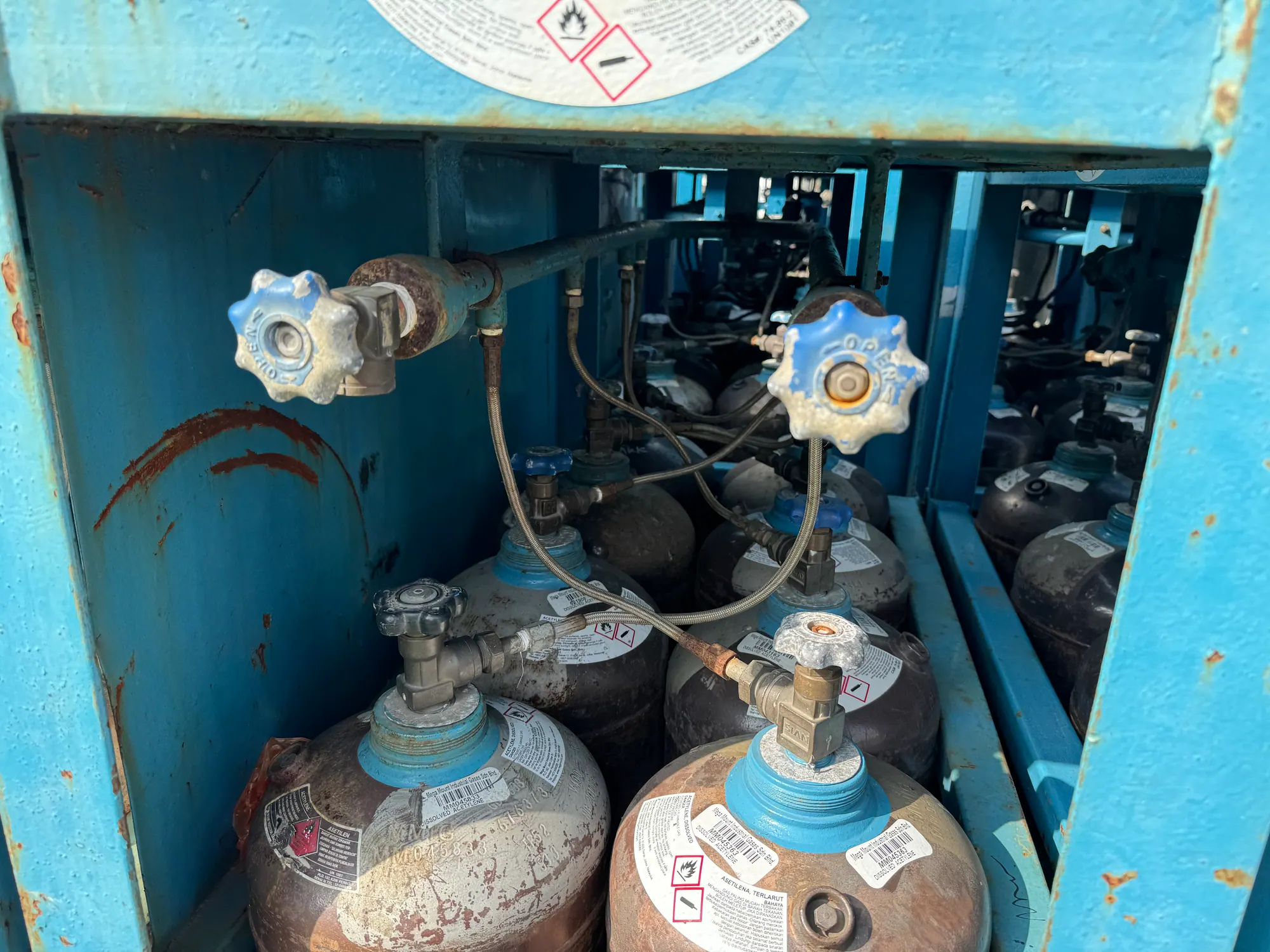
Per kilogram, 8,714 kJ is roughly twice the commonly cited energy of TNT. The comparison is about energy, not behaviour; a decomposing gas is far less dense than a solid explosive and needs pressure, confinement and an igniter to propagate. But it is the quantitative reason the dissolved acetylene cylinder is not an ordinary pressure vessel. It holds a porous mass of about 90 % porosity (KIGL specifies 90–92 %) filled with acetone, in which acetylene shows no gradual decomposition up to 10 atm (Berthelot and Vieille, 1900), with pores fine enough to quench a decomposition before it propagates; see inside a dissolved acetylene cylinder.
Why the same molecule is both easy and dangerous to use
| Property | Effect in the torch | Effect in the pipe or cylinder |
|---|---|---|
| ΔHf +226.9 kJ/mol | flame about 3,100 °C | decomposition without air |
| Low hydrogen content | less water to dissociate | soot-forming, radiant decomposition flame |
| Minimum ignition energy 0.02 mJ | easy lighting | almost any spark ignites a leak |
| Combustion propagation up to 1,350 cm/s in oxygen (C.P.I.) | concentrated, stable inner cone | fast flashback if the flame enters the hose |
Every safety rule for acetylene follows from the right-hand column, and every reason to keep using it follows from the left. Indian regulation recognises the hazard directly: Government of India notification GSR 625(E) of 1983, recorded in IS 14814:2023 cl 4.5.5, declares acetylene, liquid or under any pressure or mixed with air or oxygen, to be an explosive, and IS 14814 cl 7.2.1 limits free-state acetylene to 0.612 atm normally and 1.021 atm with PESO clearance.
Rules that matter
Rules to apply
- Quote the heat of formation as +226.9 kJ/mol (+8,714 kJ/kg) with its source, and the flame temperature as about 3,100 °C with the mixture stated.
- Use a neutral, roughly equimolar flame for welding; that is where the flame temperature peaks.
- Keep acetylene in free state at or below IS 14814:2023 limits; the energy that makes the flame is the same energy that drives decomposition.
- Never compress acetylene except in purpose-built plant, and never pressurise it in improvised vessels or hoses.
- Fit flashback arrestors at regulators and on pipelines; see KIGL's dissolved acetylene page, and the standards are on the acetylene safety standards page.
One number — frequently asked questions
What is the heat of formation of acetylene?
+226.9 kJ per mole (+54.2 kcal/mol), or about 8,714 kJ per kilogram. The positive sign means energy went into making the molecule from carbon and hydrogen and is available to come back out. Valatin (1948) gave 54.33 kcal/mol and the C.P.I. (1968) used 54.19 kcal; the differences are within the precision of the older measurements.
Why is the oxy-acetylene flame the hottest fuel-gas flame?
Because the fuel arrives carrying its own 226.9 kJ/mol of stored energy before any oxygen is consumed, and because its combustion products contain relatively little water to dissociate. Calculated adiabatic temperatures are 3,114 °C at the equimolar neutral ratio and 3,086 °C at full stoichiometry. Methane, propane and hydrogen all have zero or negative heats of formation.
What temperature does an oxy-acetylene flame reach?
About 3,100 °C at the inner cone of a neutral flame. The C.P.I. (1968) gives approximately 3,100 °C for equal volumes of acetylene and oxygen; US Bureau of Mines equilibrium calculations give 3,114 °C at O₂:C₂H₂ = 1.0 and 3,086 °C at 2.5. The trade figure of 3,070–3,100 °C sits inside that band. In air the calculated maximum is 2,331 °C.
Why can acetylene explode without air?
Because decomposition to carbon and hydrogen releases the heat of formation, about 8,714 kJ/kg, with no oxidant needed. Above a limiting pressure, about 1.4 atm absolute in the classic US Bureau of Mines tests, a local decomposition can propagate through the whole mass. That is why acetylene is stored dissolved in acetone inside a porous mass rather than compressed.
Is acetylene more powerful than TNT?
Per kilogram, its decomposition energy of about 8,700 kJ/kg is roughly twice the commonly cited 4,600 kJ/kg for TNT. That does not make a cylinder a bomb: the porous mass and solvent are designed to stop decomposition propagating, and a decomposing gas is far less dense than a solid explosive. It does explain why the hazard is taken so seriously.
Why does the flame not reach 7,000 °C?
Because at about 3,000 °C carbon dioxide and water vapour dissociate into CO, H₂, O, H and OH, absorbing energy. If they did not, the stoichiometric acetylene–oxygen flame would reach about 7,000 °C. The dissociated species recombine on a cold metal surface, returning that energy to the workpiece, which is part of why acetylene heats steel so quickly.
How much heat does burning acetylene give?
The heat of combustion is 312 kcal/mol (IS 14814:2023), about 1,306 kJ/mol or 50 MJ/kg, and the C.P.I. gives a calorific value of about 14,000 kcal per cubic metre at 0 °C. It is the concentration of heat in a small, very hot inner cone, rather than the total heat, that makes acetylene the cutting and welding gas.
References
- Bureau of Indian Standards. (2023). Acetylene — Code of Safety (IS 14814:2023, First Revision).
- C.P.I. (1968). Safety in the production and use of acetylene. Paris.
- Linstrom, P. J., & Mallard, W. G. (Eds.). (n.d.). NIST Chemistry WebBook (NIST Standard Reference Database 69). National Institute of Standards and Technology. [acetylene enthalpy of formation] https://webbook.nist.gov/cgi/cbook.cgi?ID=C74862
- US Bureau of Mines Reports of Investigations (Edwards, Smith and Brinkley; Smith, Manton and Brinkley RI 5035) — calculated flame temperatures
- Valatin, J. Chem. Phys. 1948, 16, 1018 — heat of formation of acetylene
Enquiries
Request a quotation
State the gas or equipment, the quantity or capacity, and your location. KIGL will confirm the grade, the cylinder or plant size, and whether the location can be served from Noonmati, or through the agent network.