
Guide
Choosing an acetylene grade: industrial high purity and ultra high purity
KIGL fills three acetylene grades. Industrial dissolved acetylene to IS 308 at ≥98 % in acetone covers cutting, welding and flame heating. High purity at 99 % serves work industrial grade cannot. Ultra high purity at 99.99 %, dissolved in DMF rather than acetone, is for atomic absorption spectroscopy.
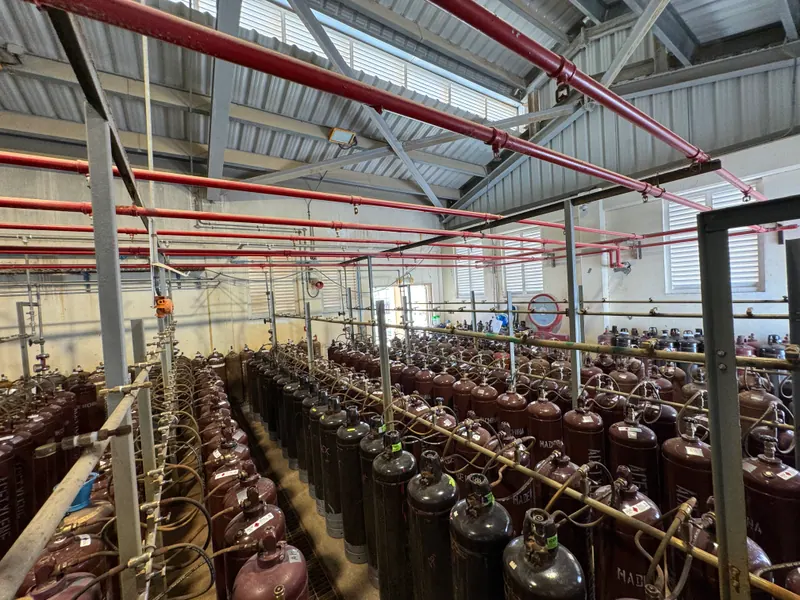
- Industrial grade
- ≥98 % C₂H₂
- High purity grade
- 99 %
- Ultra high purity grade
- 99.99 %
- Why DMF for UHP
- Much lower solvent carry-over than acetone
- Cylinder standard
- IS 7312
Three grades, three jobs
KIGL fills acetylene at three levels. The difference is not marketing: it is the purification the gas has been through and, at the top end, the solvent it is dissolved in.
| Grade | Purity | Solvent | Typical use |
|---|---|---|---|
| Industrial dissolved acetylene | ≥98 % | Acetone | Cutting, welding, brazing, flame heating |
| High purity | 99 % | Acetone | Where industrial grade is not clean enough |
| Ultra high purity | 99.99 % | DMF | Atomic absorption spectroscopy, analytical work |
What IS 308 does and does not tell you
This trips up nearly everyone who compares acetylene on paper, so let us be exact.
IS 308 sets no minimum acetylene purity at all. It does not say the gas must be 98 %, or any figure. What it does is cap what must not be in the gas: total impurities insoluble in acetone, sulphur compounds measured as hydrogen sulphide, phosphorus compounds measured as phosphine, and moisture. Four maxima, and no assay.
So when a supplier writes "98 %, as required by IS 308", they are quoting a number the standard does not contain. That does not make 98 % a bad figure. It is a perfectly sensible fill specification, and it is ours. It simply means it is the supplier's commitment rather than the standard's floor, and you should ask whose it is and whether they measure against it.
The practical consequence: conformity to IS 308 is not by itself a purity claim. Two cylinders can both conform and differ in assay. If purity matters to your process, the number has to come from a specification and a measurement, not from a standard number on a label.
Getting this wrong is expensive in both directions
Buying too high a grade is the common mistake. A cutting torch cannot distinguish 98 % from 99.99 %. Analytical acetylene on a profile cutting table is money set on fire, several times over per cylinder.
Buying too low a grade is the expensive one. Industrial acetylene in an AAS instrument does not give a slightly worse result — it gives a wrong one, and it may be a while before anyone realises the baseline is the fuel rather than the sample. By then the work in between is suspect too, which is a cost that has nothing to do with the price of gas.
What the solvent has to do with it
Every dissolved acetylene cylinder holds gas in a solvent inside a porous mass; the reason is on why acetylene is dissolved in acetone.
For industrial and high purity, that solvent is acetone, which has a relatively high vapour pressure, so a small amount always leaves with the gas. Irrelevant on a torch; the flame does not care and neither does the steel.
For ultra high purity it is dimethylformamide, whose vapour pressure is far lower, so much less solvent reaches the burner. UHP acetylene is not industrial acetylene filtered harder. It is a different fill in a different solvent, in a cylinder dedicated to that service. That is why it is a separate product line rather than an option, why the cylinder cannot simply be swapped between duties, and why very few suppliers anywhere offer it.
It also explains the one operational difference people notice: a DMF cylinder behaves slightly differently on draw-off, because the solvent it is losing to the gas stream is a different liquid with different properties. The handling rules are the same; the margins are not identical.
Rules that matter
What actually varies between grades
- Purity — the headline number, 98 % to 99.99 %
- Phosphine and hydrogen sulphide — carried over from the calcium carbide, capped by IS 308, and the real measure of whether the plant's purification train is being maintained
- Moisture — matters increasingly as purity rises
- Solvent carry-over — acetone at the industrial end, DMF at the analytical end
Of those, the impurity pair is the one that says most about a supplier. Phosphine and hydrogen sulphide come from the carbide itself rather than from the process, so they are always present to some degree and always have to be removed. They are removed in one vessel — the purifying chamber — and that vessel degrades silently: the plant keeps making gas at full output while the purification quietly falls off. Nothing trips. The first sign is a customer's analysis.
That is why the impurity figures on a certificate tell you more than the purity figure does. Purity is mostly a function of the carbide and the process; impurities are a function of maintenance.
Higher purity on request
The standard industrial fill is ≥98 %, which is KIGL's own specification and what cutting, welding and flame heating need.
Where a process needs cleaner gas, KIGL can supply dissolved acetylene at higher purity against a specific enquiry. Tell us the purity and the volume, and we will confirm what can be held and on what lead time. What we will not do is print a figure we cannot repeat batch after batch, which is a question worth asking every supplier you compare.
Ask for the certificate
Whichever grade you buy, ask for the test certificate for your batch, and read what it measures rather than what it claims.
A certificate stating purity and impurity levels actually determined, naming the method, is evidence. One restating the limits from the standard without a single measurement is a formality.
Two things worth checking on any acetylene certificate:
- Does it test phosphine? It is one of the four things IS 308 controls, and it is the one most often absent from a certificate that nonetheless concludes the gas conforms.
- Does it name the edition? IS 308 was revised in 2024. A certificate written against a withdrawn edition is not wrong about the gas, but it tells you how closely the paperwork is being kept.
The difference tells you a great deal about a supplier long before you have a problem.
Choosing an acetylene grade — frequently asked questions
Which grade do I need for cutting and welding?
Industrial dissolved acetylene, conforming to IS 308 and filled by KIGL to ≥98 %. IS 308 itself sets no minimum assay — it caps impurities — so the 98 % is our own fill specification, comfortably inside the standard. It is what the work needs. A torch cannot tell 98 % from 99.99 %, and paying for analytical gas to cut plate is money burned for no return.
What is ultra high purity acetylene actually for?
Atomic absorption spectroscopy, and analytical or synthesis work at a similar level. At 99.99 % and dissolved in DMF instead of acetone it gives a flame clean enough that the instrument measures your sample rather than the impurities arriving with the fuel.
Why is UHP dissolved in DMF rather than acetone?
Acetone has a relatively high vapour pressure, so a little always leaves the cylinder with the gas. On a cutting torch that is irrelevant. In an instrument it shows in the baseline. DMF's vapour pressure is far lower, so much less solvent reaches the burner — which is why UHP is a separate product rather than simply a purer fill.
What impurities matter in industrial acetylene?
Phosphine and hydrogen sulphide carried over from the calcium carbide, plus moisture and solvent. IS 308 sets limits on them. They matter because they attack downstream equipment and affect flame chemistry, and because they measure whether the purification train on the generating plant is being maintained.
Can industrial grade be supplied at higher purity?
Yes, against a specific enquiry. Tell us the purity your process needs and the volume, and we will confirm what can be held and on what lead time. What we will not do is quote a purity figure without knowing it can be met batch after batch.
How do I know what I am actually getting?
Ask for the test certificate for your batch, and read what it measures rather than what it claims. A certificate stating purity and impurity levels actually determined, naming the method, is evidence. One that restates the standard's limits without a measurement is a formality.
Enquiries
Request a quotation
State the gas or equipment, the quantity or capacity, and your location. KIGL will confirm the grade, the cylinder or plant size, and whether the location can be served from Noonmati, or through our agent network.