
Guide
Static electricity and acetylene: from 10.5 joules at 2 atm to 0.56 millijoules at 15 atm
Pure acetylene at 2 atm needs a 10.5 J static spark to decompose, but only 0.56 mJ at 15 atm (Hashiguchi and Fujisaki, 1958), about 19,000-fold less. Acetylene–air mixtures ignite at roughly 0.02 mJ at atmospheric pressure. Hence the 1960 International Acetylene Association code bonded every flanged joint to 1 ohm, checked annually.
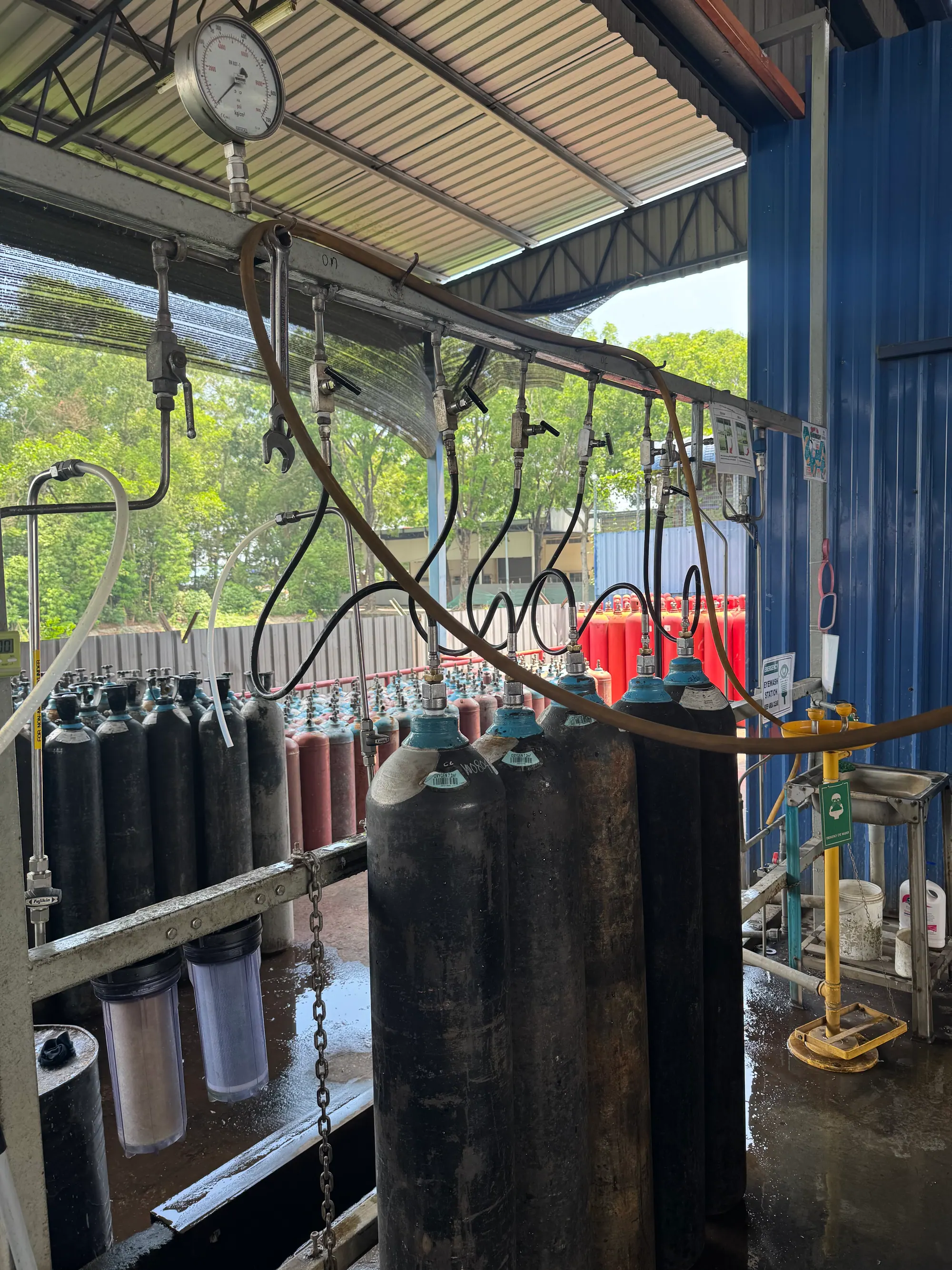
- Static spark energy, pure acetylene
- 10.5 J at 2 atm; 18.6 mJ at 5 atm; 2.9 mJ at 10 atm; 0.56 mJ at 15 atm
- Spark energy near the lower limit
- 1.5 J at 1.3
- Minimum ignition energy in air
- 0.019 mJ
- Earthing continuity
- Jumpers or shakeproof washers across flanged joints; maximum resistance 1 ohm
- Hose resistance
- Not more than 10⁶ ohm between end couplings; metallic braiding not to be used for earthing
Static electricity is the ignition source nobody can see, and in acetylene work its danger depends almost entirely on pressure. At the low pressures of a generator house, pure acetylene is surprisingly hard to set off with a spark; at the pressures of a cylinder-charging rack, a discharge of less than a millijoule will do it. Mixed with air, acetylene ignites at a lower energy than almost any other industrial gas. The earthing, flooring and footwear rules that follow from this are not box-ticking, and this page gives the numbers behind them.
Two different ignition problems
Acetylene presents two separate ignition hazards, and the figures for them must not be confused.
The first is ordinary combustion of acetylene mixed with air or oxygen. Here the minimum ignition energy is tiny — 0.019 mJ according to EIGA Doc 123/22 Table 1, and about 0.02 mJ in the general literature. That is the lowest of any common industrial combustible, and it is exceeded by the discharge from a charged human body. It is an atmospheric-pressure figure; the ignition energy of a mixture falls further as pressure rises. Any acetylene–air mixture inside the flammable range (2.3–82 % by volume in EIGA's figures; 2.5–82 % in IS 14814:2023) must be treated as ignitable by the smallest spark, including from clothing, a dropped tool or a synthetic hose rubbing on steel. The flammable range itself is set out under flammability limits and ignition temperature.
The second hazard is peculiar to acetylene: explosive decomposition without any air at all. Here the ignition energy is strongly pressure-dependent, and the dependence is dramatic.
The pressure dependence, measured
Hashiguchi and Fujisaki (Kogyo Kagaku Zasshi, 1958, 61, 515) ignited pure acetylene at 2–15 atm with static discharges of 6–16 kV between electrodes 0.2–0.6 mm apart, and measured the minimum spark energy needed to start a decomposition.
| Pressure | Minimum static spark energy | Relative to 15 atm |
|---|---|---|
| 2 atm | 10.5 J | about 19,000 times |
| 5 atm | 18.6 mJ | about 33 times |
| 10 atm | 2.9 mJ | about 5 times |
| 15 atm | 0.56 mJ | 1 |
The energy needed falls by a factor of roughly 19,000 between 2 and 15 atm. At the pressures of a generator, gasholder or low-pressure pipeline, a static spark is very unlikely to decompose pure acetylene. At compressor discharge and charging-rack pressures of 15–25 kg/cm², a static discharge is overwhelmingly capable of ignition. The same data explain why the high-pressure part of a dissolved acetylene plant is treated as a categorically different hazard from the low-pressure part — the distinction around which the C.P.I. (Safety in the Production and Use of Acetylene, Paris 1968) built its whole chapter on compression.
Kogarko and Ivanov (Doklady Akad. Nauk SSSR, 1961) extended the picture downward in a 1.5 m pipe of 16 cm bore. At 1.3–1.5 atm absolute the minimum spark energy was 1.5 J; at the extrapolated lower propagation limit of 0.65 atm absolute it was about 1,200 J. Put the two datasets together and the energy needed to start a decomposition spans roughly six orders of magnitude over a pressure range of only 0.65 to 15 atm. Pressure is not one variable among many for ignition; it is the variable. This is the other half of the story told in where the 1.5 bar rule comes from: pressure governs how hard acetylene is to ignite far more than whether a flame can travel once lit.
Rules that matter
A few findings compiled by S. A. Miller (1965) set the practical boundaries.
What a static spark can and cannot do in practice
- A jet of acetylene escaping into air can be ignited by a static discharge between the jet and a human finger, and under some conditions a burning leak will in turn ignite the pressurised acetylene behind it. A leak is therefore a two-stage hazard: first a flame, then possibly a decomposition.
- Field incidents are hard to attribute to static with any certainty, because the evidence is destroyed in the event. The conclusion drawn from this was not to dismiss static but to earth acetylene pipelines well as a matter of course.
- Release of gas through a bursting disc does not itself ignite the gas: in 104 trials of bursting steel tubes containing acetylene at 10–20 atm (Lagarde, Génie Chim., 1958, 79, 83), the escaping gas did not ignite. Sudden release is not an electrostatic ignition source in the way that CO₂ discharge is.
That last point is the reason carbon dioxide is singled out. The C.P.I. recorded in 1968 that when CO₂ emerges directly or in too large a quantity from the wide-open valve of a cylinder, static electricity appears which, on discharging, produces sparks capable of causing serious explosions, and required CO₂ for inerting to be introduced slowly through a pressure regulator. EIGA Doc 237/21 clause 6.1 goes further and prohibits CO₂ as a purge gas for acetylene generators, requiring nitrogen, on the authority of EIGA safety newsletter SAC NL 76. The Form E licence conditions under the Gas Cylinders Rules, 2016 carry the same warning for filling plants: CO₂ extinguishers are not to be used on flammable gas fires because of the static they generate, and dry chemical powder is specified instead. IS 14814:2023 cl 9.2 is less restrictive and states that carbon dioxide can be used to extinguish the flame; where the two differ, a licensed plant follows its licence conditions. Purging practice is covered in start-up, shutdown and purging.
The earthing rules and where they come from
The International Acetylene Association's code, Acetylene Transmission for Chemical Synthesis (New York, 1960), as compiled by S. A. Miller (1965), set the rule that most later codes repeat: flanged and bolted connections are to be fitted with jumpers or shakeproof washers to ensure continuity of electrical grounding, with a maximum resistance of 1 ohm, checked annually. The reasoning is exactly the Hashiguchi and Fujisaki data above — at rack pressure a 0.56 mJ discharge is enough, and a flanged joint with a dry gasket is an insulating break in the pipe that lets charge accumulate on an isolated spool.
The Indian standards carry several complementary requirements.
| Requirement | Figure | Source |
|---|---|---|
| Hose electrostatic protection, end coupling to end coupling | not more than 10⁶ ohm | IS 15190 (Part 1):2002 cl 7.9.6 |
| Resistance where leads join a cylinder manifold | not more than 10 kilo-ohm | IS 15190 (Part 2):2002 cl 8.9 |
| Hose braiding | metallic braiding not to be used for earthing | IS 15190 (Part 2):2002 cl 8.11 |
| All equipment earthed | per IS 3043 | IS 15190 (Part 2):2002 cl 4.2.6 |
| Electrical fittings in filling and storage premises | flameproof to IS/IEC 60079-1 | IS 14814:2023 cl 7.3.4 |
EIGA Doc 123/22 clauses 6.4, 7.1 and 7.2 set the same 10⁶ ohm ceiling for hoses and plant, and EIGA Doc 237/21 requires earthing and bonding of all generator components, including the carbide fill carts and bins that are wheeled in and out. The 10⁶ ohm figure and the 1 ohm figure are not in conflict: 10⁶ ohm is the maximum that still bleeds charge away from a hose or a piece of equipment fast enough to prevent accumulation, while 1 ohm is the continuity target for a bonded metal pipeline where the aim is a solid conductor from end to end.
The Gas Cylinders Rules, 2016, Rule 22, require flameproof electrical fittings, effectively earthed, in premises storing flammable gases, and the Form E filling-licence conditions require flameproof construction to IS 2148/IEC 60079. Electrical area classification for acetylene — gas group IIC — is a separate subject covered under electrical equipment in acetylene areas.
Rules that matter
Pipework can be bonded; people cannot. The C.P.I. (Paris, 1968), in its rules for dissolved acetylene plant buildings, stated that in places where climatic conditions require allowance for static electricity, the floor should be of semi-conducting material, the whole equipment should be earthed, and staff should be instructed not to wear rubber boots or rubber-soled shoes. The same text required light outward-opening doors and both floor-level and ceiling-level ventilation, so that an accumulated mixture and a charged operator do not meet.
The climatic qualifier matters in India in two situations: the dry winter months in the north and east, when relative humidity falls and charge no longer leaks away through the air, and air-conditioned or dehumidified rooms at any season. A compressor house or charging shed is the place where the pressure is high enough for a 0.56 mJ discharge to count, and where a person walks, handles cylinders and connects pigtails. That is where the floor, the footwear and the bonding of every cylinder to the rack deserve attention.
Practical measures that follow from the sources:
Floors, footwear and people
- Bond every flanged or screwed joint in the high-pressure section with a jumper or a shakeproof washer, and measure the earth path to the plant electrode at least annually.
- Bond cylinders, racks and manifold pigtails before opening any valve; do not rely on the hose braid.
- Open and close all valves slowly. The C.P.I. required this for every cock in a dissolved acetylene plant, specifically to limit ignition from friction and from too rapid a flow.
- Use nitrogen, never CO₂, to purge or inert generators, driers, vessels and pipework.
- Decant acetone and DMF only between earthed and bonded containers, never into plastic buckets (EIGA Doc 225/19).
- Keep leak searches to soap solution with the section isolated; a burning leak is already an ignition source for the gas behind it.
What this means for you
For a welding shop drawing from cylinders at a regulator outlet of about 1 bar, the pure-acetylene decomposition risk from static is remote; the real hazard is the acetylene–air mixture, which 0.02 mJ will light. Keep hoses in good condition, keep the area ventilated and keep flame and sparks away, as the acetylene safety data sheet sets out.
For a dissolved acetylene plant, the picture inverts at the compressor. Downstream of the first stage the gas is at a pressure where a static discharge of well under a millijoule can start a decomposition inside the pipe, with no air present at all. In that section of an acetylene gas plant the sources call for bonding throughout, flashback arrestors at the charging rack, and the slow-valve, nitrogen-purge and no-CO₂ rules above. The 19,000-fold figure is the reason those rules exist.
Static electricity — frequently asked questions
Can static electricity ignite acetylene?
Yes, and the answer has two parts. Acetylene mixed with air ignites at about 0.02 mJ, which a discharge from a fingertip exceeds. Pure acetylene decomposing without air needs far more at low pressure — 10.5 J at 2 atm — but only 0.56 mJ at 15 atm, so at cylinder-filling pressures a static discharge is overwhelmingly capable of starting a decomposition.
What is the minimum ignition energy of acetylene?
For acetylene in air at atmospheric pressure, EIGA Doc 123/22 gives 0.019 mJ, the lowest of any common industrial combustible. For the self-decomposition of pure acetylene the figure is pressure-dependent: 10.5 J at 2 atm, 18.6 mJ at 5 atm, 2.9 mJ at 10 atm and 0.56 mJ at 15 atm (Hashiguchi and Fujisaki, 1958).
What earthing resistance is required for acetylene pipelines?
The International Acetylene Association transmission code of 1960 required jumpers or shakeproof washers across flanged and bolted joints to keep the earth path below 1 ohm, checked annually. IS 15190 (Part 2):2002 limits the resistance where leads join a cylinder manifold to 10 kilo-ohm, and EIGA Doc 123/22 caps hoses and plant at 10⁶ ohm.
Why are rubber-soled shoes banned in an acetylene compressor house?
Because an insulated person accumulates charge. The C.P.I. (Paris, 1968) advised that where climatic conditions make static likely the floor should be semi-conducting, the whole equipment earthed and staff instructed not to wear rubber boots or rubber-soled shoes. Dry winter air and air-conditioned rooms are the conditions that make this matter in India.
Can a leaking acetylene jet be lit by a person touching it?
Yes. A jet of acetylene emerging into air can be ignited by a static discharge between the jet and a human finger, and a burning leak can in turn ignite the pressurised acetylene behind it. Never approach a suspected leak with an unearthed body or tool; isolate first, then find the leak with soap solution.
Why is carbon dioxide banned as a purge gas for acetylene plant?
Fast release of CO₂ from a cylinder generates static that can discharge as a spark. The C.P.I. recorded this in 1968, and EIGA Doc 237/21 cl 6.1 prohibits CO₂ for purging acetylene generators, requiring nitrogen. The Form E licence conditions under the Gas Cylinders Rules 2016 also bar CO₂ extinguishers on flammable gas fires because of static.
Can a hose braid be used as the earth connection?
No. IS 15190 (Part 2):2002 cl 8.11 states that the metallic braiding of acetylene hoses shall not be used for earthing. The hose must still be conductive enough, with IS 15190 (Part 1) and EIGA Doc 123/22 both limiting end-to-end resistance to 10⁶ ohm, but the earth path is made by bonding the metal couplings and pipework, not the braid.
References
- Bureau of Indian Standards. (2002). (Parts 1 and 2):2002 Acetylene Pipelines — Code of Practice (IS 15190:2002).
- Bureau of Indian Standards. (2023). Acetylene — Code of Safety (IS 14814:2023, First Revision).
- European Industrial Gases Association. (2021). Safe Operation of Acetylene Generator Systems (clause 6.1 on purge gas) (EIGA Doc 237/21). https://www.eiga.eu/uploads/documents/DOC237.pdf
- European Industrial Gases Association. (2022). Code of Practice: Acetylene (Table 1 and clause 6.4) (EIGA Doc 123/22). https://www.eiga.eu/uploads/documents/DOC123.pdf
Enquiries
Request a quotation
State the gas or equipment, the quantity or capacity, and your location. KIGL will confirm the grade, the cylinder or plant size, and whether the location can be served from Noonmati, or through the agent network.