
Guide
Why an acetylene cylinder delivers less gas in cold weather and what to do about it without a flame
An acetylene cylinder delivers less gas in cold weather because cold acetone holds acetylene more tightly: the Bunsen coefficient rises from 14.4 at 40 °C to 26.6 at 15 °C, and withdrawal chills it further. Never heat a cylinder with a flame; manifold more cylinders and stay below 1/7 of contents per hour.
- Solubility of acetylene in acetone
- Bunsen coefficient 26.6 at 15 °C
- Heat of solution
- About 160 calories per gram of acetylene dissolved in acetone; the same heat is absorbed on withdrawal
- Pressure is not contents
- A cylinder reading 250 psig at 70 degrees F can read below 100 psig at 0 degrees F with no gas withdrawn; pressure changes about 2.5 psi per degree F
- Withdrawal rate
- Maximum 1/7 of cylinder contents per hour for welding and cutting; 1/10 for intermittent solvent-sensitive use; 1/15 for continuous use
- Heating
- It is forbidden to heat the container with a flame; never apply a torch to a cylinder to raise its pressure
Every winter, a cutting station that worked perfectly in October starts complaining in December that the acetylene cylinders are short, that the flame goes thin and oxidising halfway through a job, and that the regulator gauge drops faster than it should. The cylinders are not short. The acetone inside them is cold, and cold acetone holds acetylene more tightly than warm acetone does. This page explains the mechanism with the published figures, shows why drawing harder makes it worse, and sets out the only remedies that are safe.
The mechanism: solubility rises as temperature falls
A dissolved acetylene cylinder holds its gas in solution in acetone soaked into a porous mass. How much acetylene a litre of acetone holds at a given pressure depends on temperature, and it moves the opposite way to what most people expect: colder solvent, more gas held, less gas released.
The C.P.I. 1968 safety code gives the Bunsen solubility coefficient of acetylene in acetone near atmospheric pressure as a temperature series, and it is the cleanest statement of the effect in the literature:
| Acetone temperature | Bunsen coefficient (volumes of acetylene per volume of acetone per atmosphere) | Change relative to 15 °C |
|---|---|---|
| 15 °C | 26.6 | reference |
| 25 °C | 20.9 | 21 % less held |
| 40 °C | 14.4 | 46 % less held |
Read upward, the table says what a winter morning does. A cylinder filled and settled at 15 °C, then left in a yard at 5 °C overnight, has acetone that grips the gas harder still. The pressure it shows is lower, the rate at which it can push gas through the mass and out of the valve is lower, and the torch sees a weak supply. The C.P.I. code attributed the slower winter output to exactly this rise in solubility. Nothing has been lost. Weigh the cylinder and the gas is all there, which is why contents are checked by weight and not by gauge; the arithmetic is on the page on why cylinder pressure does not show contents.
The same physics is what makes acetylene storage work at all. Acetone holds roughly 25 volumes of acetylene per volume per atmosphere at 15 °C, which is the whole basis of the dissolved acetylene cylinder, explained on why acetylene is dissolved in acetone. Cold weather is the solvent doing its job slightly too well.
Why drawing harder makes it worse
Taking acetylene out of solution costs heat. The C.P.I. 1968 code gives the heat liberated on dissolving one gram of acetylene in acetone under cylinder-filling conditions as about 160 calories; the same quantity is absorbed when the gram comes back out. Draw a kilogram of gas in an hour and the cylinder must find 160 kilocalories from somewhere. In summer the steel shell takes it from the room. In winter the room has less to give, the acetone cools, solubility climbs, and the delivery falls further. The cylinder refrigerates itself.
The visible symptom is frost or condensation on the lower part of the shell during a heavy draw. The invisible one is acetone blowing: when gas is demanded faster than the mass can release it cleanly, liquid acetone is entrained as droplets and carried into the regulator and hose. Acetone in the torch gives a sooty, unstable flame, attacks nitrile seals and spoils a weld. EIGA's 2025 filling document records that acetone losses in customer use, about 60 g per kg of acetylene withdrawn in temperate climates, rise to 100 g per kg in warm climates and higher still with spitting; over-drawing a cold cylinder produces the same spitting in winter. The effect on weld quality is covered on the acetone carry-over page.
This is why there is a withdrawal limit at all. CGA G-1 sets it at one-seventh of the cylinder's contents per hour for welding and cutting, one-tenth for intermittent solvent-sensitive work and one-fifteenth for continuous use. KIGL specifies one-seventh. The 1965 engineering literature, as compiled by S. A. Miller, recorded that a monolithic-mass cylinder would sustain 20 % of its contents per hour only until 65 to 80 % of the charge was gone, that makers recommended a maximum of 12.5 or 14 % per hour, and that cylinders should be coupled above that rate. In cold weather the sustainable rate is lower than any of these figures, and the one-seventh rule, explained on its own page, becomes a ceiling rather than a target.
What the torch sees
A cutting nozzle is set for a fixed acetylene flow at a fixed pressure. Starve it and the flame does not simply shrink; it goes oxidising, because the oxygen side is unaffected by the cold. An oxidising flame has a short inner cone, a purplish envelope and a hiss, and it leaves slag inclusions and porosity in a weld and a ragged, over-oxidised cut. The neutral flame that reaches about 3,100 °C, the equal-volume mixture of acetylene and oxygen in the C.P.I. 1968 tables, is lost before the operator notices. Flame settings are on the flame types page. The point here is that a cold cylinder degrades the work before it stops the work, which is why the complaint arrives as quality trouble before it arrives as supply trouble.
The remedies, in order
More cylinders, not more heat
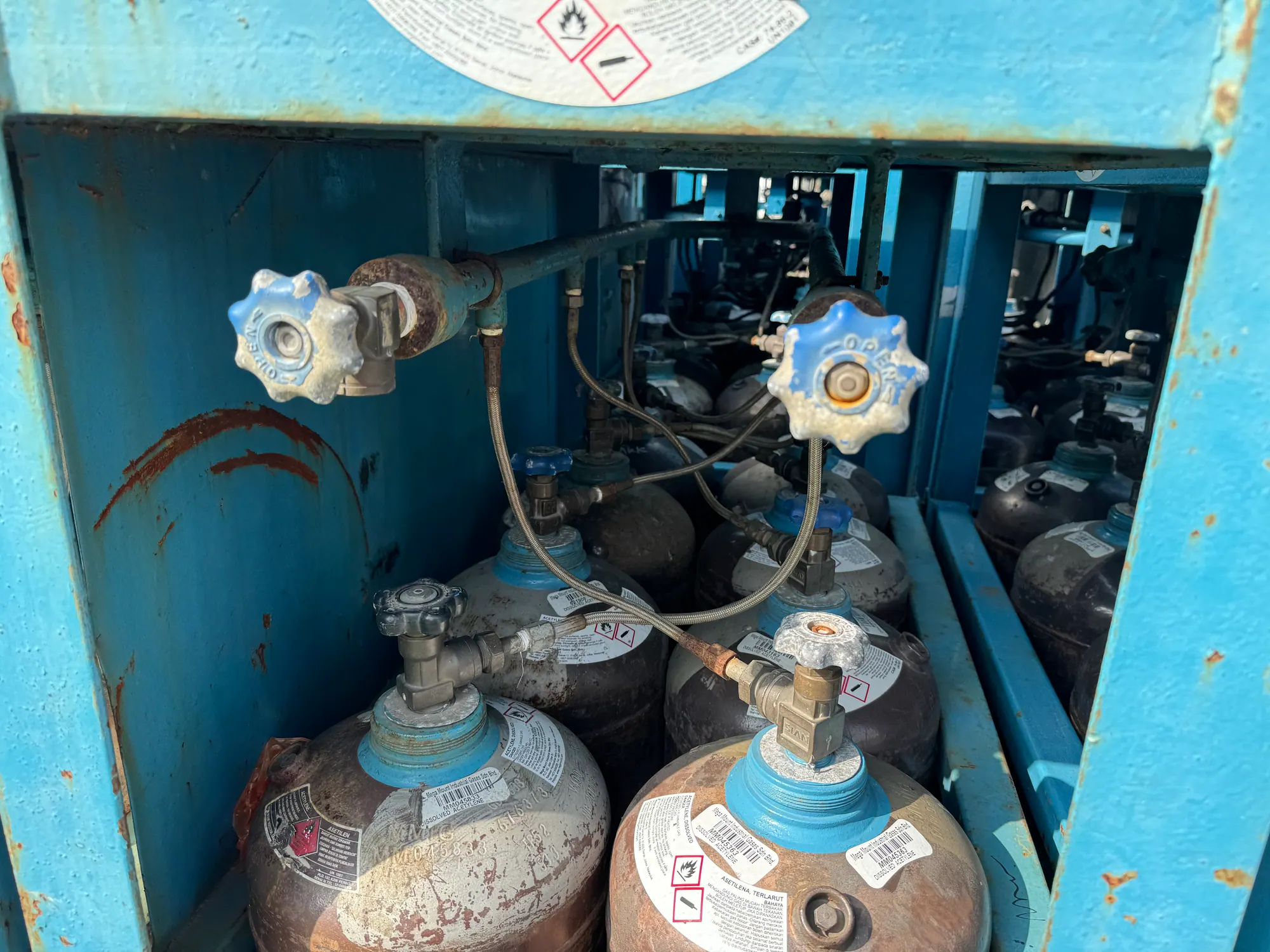
The correct response to a cold supply is to lower the draw per cylinder by coupling cylinders. Three cylinders on a simple three-way manifold with one regulator share the load, so each delivers a third of the flow and chills a third as fast. A permanent manifold with a non-return valve per cylinder and a flashback arrestor after the regulator is the right installation for any station that runs a heavy nozzle through the winter; the design rules are on the manifolds page.
Plan the day
Bring the cylinders to be used first into the shaded part of the workshop an hour before work, so they start at room temperature rather than yard temperature. Rotate: a cylinder that has been drawn hard for an hour rests while another takes the load. The C.P.I. 1968 code, written for European winters, recommended siting acetylene gasholders in a heated room or indoors in cold climates; the principle for cylinders is the same, without the heater.
Do not heat the cylinder
The C.P.I. 1968 operating rules say that unfreezing of pipes must only be carried out by hot water, avoiding all naked lights, but that rule is for pipework. No code in KIGL's reference set sanctions warming a dissolved acetylene cylinder by any means, and the C.P.I. requires cylinders to be kept away from radiators and other sources of heat. A heater pressed against the shell, a lamp under it, steam or a hot-water bath are all forms of heating. The safe answers are the two above: start the day with cylinders at workshop temperature, and lower the draw per cylinder.
Never a flame
The C.P.I. 1968 code states it as a prohibition: it is forbidden to heat the container with a flame. CGA G-1 repeats it: never apply a torch to a cylinder to raise pressure. A flame heats one spot of steel to hundreds of degrees while the rest stays cold; the acetone boils locally, the gas there comes out of solution at high pressure in a void, and a decomposition can start in the mass that no fusible plug will stop. Both codes also keep cylinders away from radiators and heat sources at all times, the C.P.I. adding even when the cylinder has been emptied of the acetylene that can practically be extracted, because an empty cylinder still holds acetone saturated with gas.
Rules that matter
What this means for you
- A cold cylinder is a full cylinder delivering slowly. Check contents by weight, not by gauge.
- Draw no more than one-seventh of contents per hour from any cylinder, and less in winter.
- Frost on the shell or soot in the flame means you are over-drawing: stop and share the load.
- Couple cylinders on a manifold for heavy nozzles and for every winter cutting station.
- Do not heat a cylinder by any means — no flame, heater, lamp, steam or hot-water bath. Lower the draw instead.
- Keep cylinders upright, closed and under cover, but never in a closed room, and bring the day's first cylinders into the workshop early.
KIGL supplies dissolved acetylene in north-east and eastern India. The winter rules are the same everywhere: plan for the solvent, respect the one-seventh rule, and keep every flame on the work.
Why an acetylene cylinder delivers less gas — frequently asked questions
Why does my acetylene cylinder seem to run out in winter when it still feels heavy?
It has not run out. Acetylene is held in solution in acetone, and acetone dissolves more acetylene as it cools: the C.P.I. 1968 solubility series gives a Bunsen coefficient of 26.6 at 15 °C against 14.4 at 40 °C. A cold cylinder therefore releases gas more slowly and shows a lower pressure. The gas is still there, which the weight proves; the cylinder is simply delivering it more slowly than your torch wants it.
Can I warm an acetylene cylinder with a torch or a heater to get more gas out?
No. The C.P.I. 1968 code says it is forbidden to heat the container with a flame, and CGA G-1 says never apply a torch to a cylinder to raise pressure. Local heating can start a decomposition in the porous mass that a fusible plug cannot stop. Keep cylinders away from radiators and other heat sources too, even when they are empty of usable gas.
Is it safe to stand an acetylene cylinder in warm water?
No code in KIGL's reference set sanctions warming a cylinder. The C.P.I. 1968 rule that frozen equipment may be thawed only with hot water, never a naked light, is written for pipes, not cylinders, and the same code keeps cylinders away from all sources of heat. Do not heat the cylinder: let it reach workshop temperature in the shade, reduce the draw and share the load across more cylinders on a manifold.
What does the one-seventh rule mean in practice?
CGA G-1 cl 6.2 limits withdrawal for welding and cutting to one-seventh of the cylinder's contents per hour, which KIGL also specifies. A cylinder holding 6 kg of acetylene, about 5.5 cubic metres, should supply no more than about 0.8 cubic metres per hour. A heavy cutting nozzle can want more than that, and in cold weather the cylinder cannot give even that, so the answer is two or three cylinders on a manifold.
Why does the cylinder get frosty near the bottom when I draw hard?
Taking acetylene out of solution absorbs heat, about 160 calories for every gram of gas, as the C.P.I. 1968 code gives it. Draw fast and the acetone cools faster than the room can warm the steel; the cylinder refrigerates itself, solubility rises, and the delivery falls further. Frost on the shell is the visible symptom of over-drawing. Stop, let it recover, and share the load across more cylinders.
Does cold weather push acetone into the hose?
Over-drawing does. When gas comes out of solution faster than the porous mass can release it cleanly, liquid acetone is entrained as droplets, the effect sometimes called acetone blowing. Cold weather makes a given demand into an over-draw, so the risk rises in winter. Acetone in the torch gives a sooty, unstable flame and attacks regulator seals; the cure is a lower draw per cylinder.
How should I store cylinders overnight in a cold yard?
Upright, closed, capped, and under cover from frost and wind but never in a closed room. Bring the cylinders to be used first into the shade of the workshop, not next to a furnace, an hour before work so they are at room temperature when the torch is lit. The C.P.I. 1968 code recommended gasholders in cold climates be kept in a heated room; the same logic, without the heater, applies to cylinders.
Does the problem exist in India at all?
Yes, on winter mornings in the north and north-east. The solubility change between 15 and 25 °C alone is from 26.6 to 20.9, about a quarter, which a cutting station set up in October will notice in December. Hill stations and pre-dawn starts on construction sites see it most. The remedy is planning: enough cylinders, a manifold for heavy nozzles, and the discipline never to reach for a flame.
References
- Bureau of Indian Standards. (2023). Acetylene — Code of Safety (IS 14814:2023, First Revision).
- C.P.I. (1968). Safety in the production and use of acetylene. Paris. [solubility of acetylene in acetone; cold-weather withdrawal; heating prohibition]
- Compressed Gas Association. (2009). Acetylene (CGA G-1).
- European Industrial Gases Association. (2025). Safe Filling of Acetylene Cylinders, Bundles and Battery Vehicles (EIGA Doc 26).
Enquiries
Request a quotation
State the gas or equipment, the quantity or capacity, and your location. KIGL will confirm the grade, the cylinder or plant size, and whether the location can be served from Noonmati, or through the agent network.