
Guide
Carbide lime sludge: how much there is what it still holds, and how to handle and dispose of it safely
A carbide-to-water acetylene generator leaves about 1.17 kg of dry lime residue per kg of carbide, as a slurry at pH 12.2–12.9. The sludge still holds dissolved acetylene, about 0.7 g per litre at 60 °C, so pits must be outdoors, open to the air and 9 m from the generator and boundary.
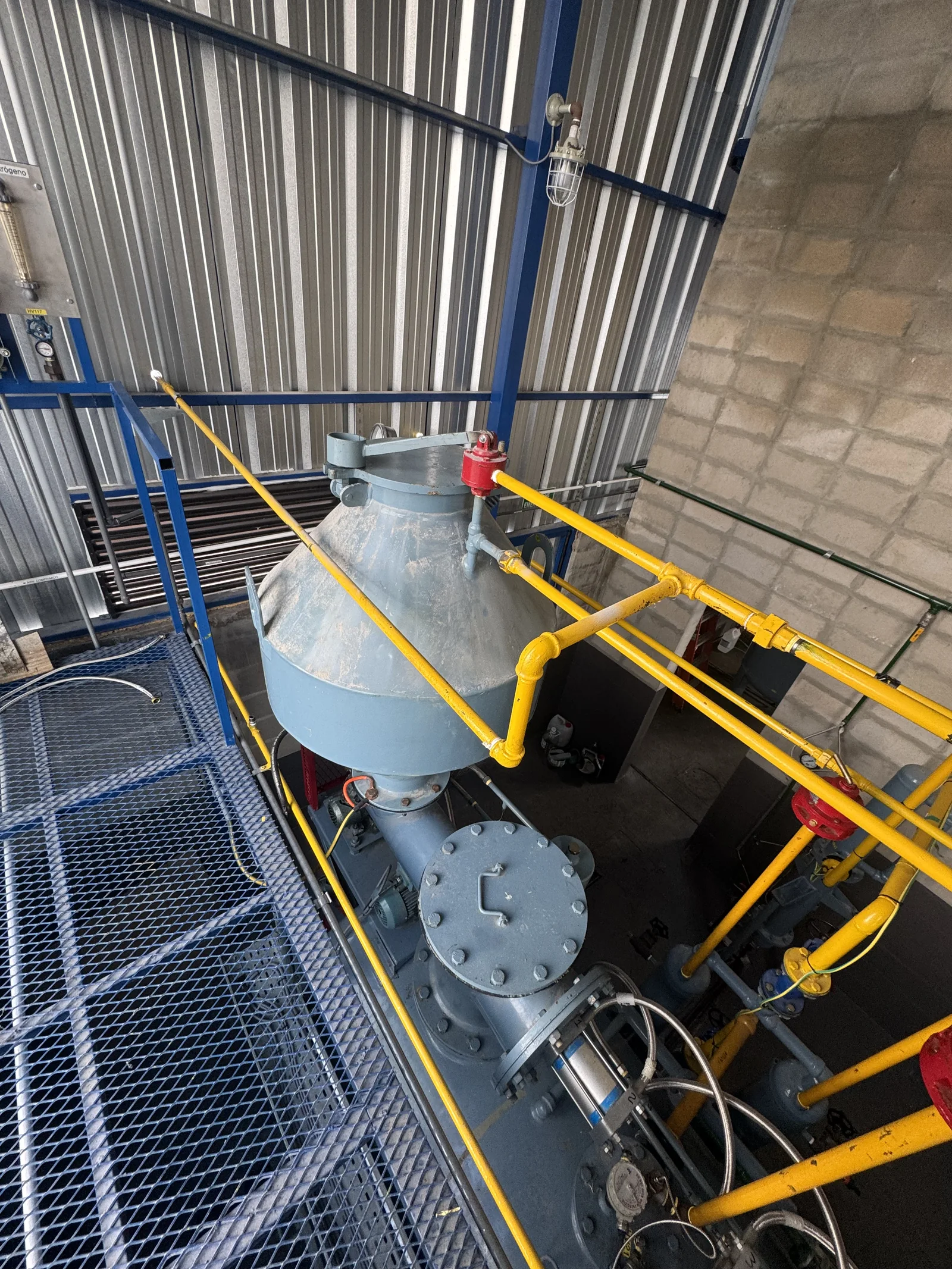
- Residue per kg of carbide
- About 1
- Dissolved acetylene in sludge
- 0.685 g/l at 60 °C and 0.438 g/l at 80 °C; 1 % of the make lost at 60 °C
- Slurry pH
- 12.6
- Pit distance
- Lime sludge drying pits 9 m from the boundary wall and from the acetylene generation unit
- Effluent liquor
- Typically 500 mg/l acetylene
For every tonne of carbide an acetylene plant gasifies, about 1.17 tonnes of dry calcium hydroxide leaves the generator, carrying with it most of the carbide's sulphur, a tenth of its phosphorus and dissolved acetylene, at a pH of 12.2–12.9. Nobody buys an acetylene plant for the lime, but the lime pit is part of the generator's hazard envelope and the by-product is the plant's largest effluent stream. This page sets out the quantities, what the sludge still holds, how the pit should be sited and run, and where Indian waste law currently stands.
How much, and what it is
The arithmetic starts from the generator reaction, CaC₂ + 2 H₂O → Ca(OH)₂ + C₂H₂, applied to a commercial carbide of 300 l/kg gas yield, about 82 % CaC₂ with 12 % free lime and 6 % inert impurities. The mass balance compiled by S. A. Miller (1965), checked against the page image, is:
| Per kg of 300 l/kg carbide | Quantity |
|---|---|
| Water consumed by the reaction | 499 g |
| Acetylene evolved | 12.8 mol, about 333 g |
| Calcium hydroxide formed, including hydrated free lime | 1,106 g |
| Unreacted impurities carried through | 60 g |
| Total dry residue | 1,166 g |
The dry residue is therefore about 95 % Ca(OH)₂ (1,106 of 1,166 g), with the balance being the carbide's silica, alumina, iron oxide, ferrosilicon, silicon carbide, free carbon and magnesia, carried through essentially unchanged. Older KIGL material quotes 1.27 tonnes per tonne; that figure came from a misread digit and 1.166 is the corrected value.
Two chemical facts about the residue follow from the impurity chemistry set out on the phosphine page. Under 3 % of the carbide's sulphur leaves as hydrogen sulphide, so over 97 % of it, about 4 g of S per kg of carbide, stays in the sludge as calcium sulphide; about 10 % of the phosphorus and most of the nitrogen, as ammonia, stay with it too. EIGA Doc 226 makes the same point from the operating side: ammonia, hydrogen sulphide and phosphine remain in solution in the lime slurry unless the pH changes significantly, and are recycled with return water or shipped off site with the lime. Ammonia is toxic to fish. Any buyer who acidifies the slurry, which is what a neutralisation customer does, will drive those gases out at the point of mixing.
As to physical form, EIGA Doc 143 gives the slurry from a wet generator at 25–30 % lime solids by weight, pumpable above about 65 % water, needing a mechanical digger at 60–65 % water, and reducible to a paste of 50 % water or less by filter press. EIGA Doc 123 gives 10–12 % solids from the wet process, 30–40 % after decanting and 50 % or more from a pond, with a filter press at 8–14 bar giving a cake at about 15 % moisture. Slurry density after simple decanting is about 1.2 and the pH is 12.6–12.8 (EIGA Doc 143 Table 1), independently confirmed at 12.2–12.9 across three Malaysian plants by Ramasamy, Agamuthu and Ibrahim (2002).
The sludge still makes gas
This is the part of carbide lime handling that the trade under-rates. Acetylene dissolves in lime slurry essentially as it does in water: the figures of Strizhevskii and Strebulaeva (1955), as compiled by S. A. Miller (1965), are 0.685 g per litre at 60 °C and 0.438 g per litre at 80 °C. The liquor leaves the generator saturated at generator temperature and gives the gas back as it cools and stands. The loss is quantified: dissolved acetylene in the sludge is about 1 % of a wet generator's make at 60 °C and 0.5–0.6 % at 75 °C (Hölemann et al., as compiled by S. A. Miller, 1965), which is 70–150 times the loss from a wet gasholder. Running the generator near the top of its temperature band nearly halves the largest single loss in the plant, and EIGA Doc 226 adds that at 70–85 °C in a well-run generator the lime pit emissions are insignificant. The temperature ceiling itself is discussed under generator overheating.
The second source of gas is aftergeneration. Carbide that gasifies too slowly, or lumps that became coated in lime before they finished reacting, carry on generating in the pit; the C.P.I. (1968) required settling basins to hold residues long enough for intact pieces of carbide coated in lime to decompose completely, and both the German regulations and the American IAA standard of that era carried clauses on acetylene evolved by the sludge after discharge. The same compilation states the hazard in one sentence: if the acetylene dissolved in generator slurry is allowed to evolve into a semi-confined space, an explosive mixture may form.
The effluent liquor typically carries 500 mg/l of acetylene, 150 mg/l of hydrogen sulphide and 0.8 mg/l of phosphine. A published treatment clears all three: acidify to pH 5 and bubble air through at 11 litres per hour per litre of liquor, which removes the acetylene in 60 minutes, the H₂S in 45 and the PH₃ in 30. That is a controlled stripping operation to be done outdoors with the off-gas vented safely, never in a tanker or a buyer's pit. Acidifying a material whose value is its alkalinity is self-defeating if the lime is to be sold. The simpler control is heat and time.
Rules that matter
The rules below are drawn from the C.P.I. (1968), EIGA Docs 226 and 237, the Gas Cylinders Rules 2016 licence conditions and the KIGL plant operation manual, and they agree with one another.
Siting and running the pit
- Discharge is never into a sewer. The KIGL manual sends slurry to a vented outdoor pit, where the sludge remains at least ten hours in not less than four times its bulk of water before anything passes to drains. The C.P.I. required the drainage pipes, over a sufficient part of their length, and the decanting trenches to be exposed to the open air, so that no explosive atmosphere can form in a closed container; where a pressure generator discharges by pipe to a tank or tank lorry, the same venting applies.
- The pit is outdoors, watertight and open to the atmosphere, both to prevent soil and groundwater contamination and to prevent the build-up of explosive acetylene mixtures (EIGA Doc 226 cl 9.2). It is sited so that gas evolving from it cannot drift into any building; the Indian licence conditions for a dissolved acetylene plant put lime sludge drying pits 9 m from the boundary wall and from the acetylene generation unit.
- Carbide dust is never put straight into the pit. EIGA Doc 226 cl 6.5 requires dust to be air-slaked or washed first and only the residue drained to the pit.
- Settling is managed, not left to itself. The 1965 compilation notes that slow settlement causes trouble but that fast settling can deposit lime that retards and even stops slurry flow from the generator; the generator discharge line and the pit inlet are cleaned on a schedule for this reason.
- Nothing with an ignition source goes near the pit. Acetylene evolving from standing sludge has the same 2.5–82 % flammable range as the gas in the plant, and tanker loading by vacuum pump releases it in quantity; EIGA Docs 143 and 226 require a flammable-zone-rated vacuum pump and a risk assessment for road-tanker loading.
- Lime water is never drained uncontrolled (EIGA Doc 226 cl 5.3): the sewage authority's permission and an agreed method are required, and decanted lime water is not used as cooling water because of its impurities. Clarified, acetylene-enriched water may be recycled to the generator, and the KIGL manuals recommend this.
- The pit is a lime hazard to people. At pH 12.6 the slurry is a severe eye hazard; goggles, gloves, boots and an eyewash station are the minimum at the pit and at any loading point.
Where Indian waste law stands
The question every State Pollution Control Board will eventually ask is whether carbide lime is a hazardous waste under the Hazardous and Other Wastes (Management and Transboundary Movement) Rules 2016. The position, as checked against the gazette text, has two parts.
Schedule I, the list of 38 processes generating hazardous waste, contains no entry for acetylene production, industrial gases, calcium carbide or lime, and the words do not appear anywhere in it. On the process route, carbide lime is not listed.
Schedule II is a different matter. Class C2 (Corrosive) captures a waste that is aqueous and has a pH less than or equal to 2 or greater than or equal to 12.5, together with a steel-corrosion limb of 6.35 mm per year at 55 °C; these are the US RCRA criteria transposed into Indian law. Carbide lime slurry sits at about 12.2–12.9 (12.6–12.8 in EIGA Doc 143). The route into hazardous-waste classification is therefore open on characteristics, not closed. Three things still help: the limb applies to an aqueous waste as presented, so a dewatered paste is a different material from a slurry; pH falls as the lime carbonates on standing in air; and a laboratory pH on the material as actually disposed of is determinative. The practical step is a NABL-accredited analysis of your own residue, fresh and pit-aged, for pH, sulphide, phosphate, ammoniacal nitrogen and the Schedule II metals, followed by a written question to the State Board with the analysis attached.
If the material is non-hazardous, it is managed as industrial solid waste under the plant's Consent to Operate, and selling it requires the Consent to recognise it as a by-product. If a Board treats it as hazardous, utilisation runs through the CPCB procedure under Rule 9 (December 2021), with one useful exception: co-processing in a cement plant needs no trial run where CPCB guidelines already exist. EIGA Doc 226 states that lime slurry should be considered a by-product and not a waste, on four conditions: it is intended for marketing rather than disposal, produced to a specification, supplied with a safety data sheet, and usable without further processing, with regular analysis to support the claim. Those four conditions are also the sensible internal standard for any Indian plant that wants the pit to stop being an effluent. What the lime can be used for is set out in uses of carbide lime.
Rules that matter
Rules to apply
- Budget 1.17 tonnes of dry lime per tonne of carbide, or about 4 tonnes of slurry at 25–30 % solids.
- Run the generator warm, within its ceiling: the acetylene the sludge carries out falls from about 1 % of the make at 60 °C to 0.5–0.6 % at 75 °C, but never exceed the generator's own temperature limit to gain it.
- Pit outdoors, open, watertight, 9 m from the generator and the boundary, no ignition sources, dust air-slaked before it goes in.
- Ten hours in four volumes of water before any discharge, and no discharge without the sewage authority's agreement.
- Get the pH and the Schedule II analysis done; it decides everything downstream.
The KIGL acetylene gas plant manuals specify the slurry discharge, pit and recirculation arrangements described here; the water side of the generator is covered under water-to-carbide ratio and the physics of acetylene in water under solubility in water and carbide sludge.
Carbide lime sludge — frequently asked questions
How much lime sludge does an acetylene plant produce?
About 1.17 kg of dry residue per kg of 300 l/kg carbide, on the mass balance compiled by S. A. Miller (1965): 1,106 g of calcium hydroxide plus 60 g of unreacted impurities. As discharged from a wet generator, it is a slurry of 25–30 % solids, so a plant using 1 tonne of carbide a day moves roughly 4 tonnes of wet slurry a day, and rather more if it is pumped out dilute.
Does carbide lime sludge still give off acetylene?
Yes, two ways. The liquor leaves the generator saturated with dissolved acetylene, 0.685 g/l at 60 °C, which comes out of solution as it cools and stands. And any lump of carbide coated in lime that escaped reaction continues to gasify in the pit. If that acetylene evolves into a semi-confined space an explosive mixture can form, which is why pits are outdoors and open.
Where should the lime pit be sited?
Outdoors, open to the atmosphere, watertight, and sited so that gas cannot drift into a building. The Gas Cylinders Rules 2016 licence conditions put lime sludge drying pits 9 m from the boundary wall and from the acetylene generation unit. EIGA Doc 226 adds that lime storage and loading areas must be watertight and open to the air.
Why does running the generator hotter reduce the loss?
Because acetylene is less soluble in hot slurry. Dissolved acetylene in the sludge is about 1 % of the plant's make at 60 °C but only 0.5–0.6 % at 75 °C, and EIGA Doc 226 notes that at 70–85 °C in a well-run generator the pit emissions are insignificant. Running near the top of the permitted temperature band is worth about half a per cent of output and reduces the pit hazard at the same time.
Is carbide lime a hazardous waste in India?
It is not listed by process in Schedule I of the Hazardous and Other Wastes Rules 2016, but Schedule II Class C2 classes an aqueous waste with pH of 12.5 or more as corrosive, and fresh slurry sits at about 12.2–12.9. The classification therefore turns on a laboratory pH of the material as actually disposed of, which falls as the lime carbonates. A NABL-accredited test on your own residue is the only way to settle it.
Can lime pit water be used for cooling or sent to the drain?
No to both. EIGA Doc 226 states that decanted lime water must not be used as cooling water because of its impurities, and that lime water must never be drained uncontrolled; its pH causes problems and the sewage authority's permission and an agreed method are needed. The KIGL manual holds sludge at least ten hours in not less than four times its bulk of water before any discharge.
What is in the sludge besides lime?
Over 97 % of the carbide's sulphur as calcium sulphide, about 10 % of its phosphorus, most of its nitrogen as ammonia, plus silica, alumina, iron, ferrosilicon and free carbon carried through unchanged. EIGA Doc 226 warns that ammonia, hydrogen sulphide and phosphine stay in solution and are shipped off site with the lime, and that ammonia is toxic to fish.
References
- CPCB procedure for utilisation of hazardous waste under Rule 9, December 2021 https://cpcb.nic.in/uploads/hwmd/SOP_December_2021.pdf
- European Industrial Gases Association. (n.d.). Best Available Techniques for Acetylene Production (EIGA Doc 226). https://www.eiga.eu/uploads/documents/DOC226.pdf
- European Industrial Gases Association. (n.d.). Guide to Carbide Lime Applications (EIGA Doc 143). https://www.eiga.eu/uploads/documents/DOC143.pdf
- Government of India. (2016). Gas Cylinders Rules, 2016 (G.S.R. 1081(E)). Petroleum and Explosives Safety Organisation. [PESO]
- Ramasamy, Agamuthu and Ibrahim, Carbide sludge management in acetylene producing plants, Waste Management & Research 20(6):536, 2002 https://www.researchgate.net/publication/10931458
Enquiries
Request a quotation
State the gas or equipment, the quantity or capacity, and your location. KIGL will confirm the grade, the cylinder or plant size, and whether the location can be served from Noonmati, or through the agent network.