
Guide
Oxygen technical data sheet: physical properties IS 309:2023 grades, cylinder data and liquid expansion
Oxygen (O₂, molar mass 31.999 g/mol) boils at −182.96 °C, has a gas density of 1.429 kg/m³ at 0 °C and is 1.105 times as heavy as air. Its critical point is −118.57 °C and 50.43 bar, so it is a permanent gas. IS 309:2023 sets three industrial grades, 99.0 to 99.95 %.
- Boiling point
- −182.96 °C
- Critical point
- −118.57 °C
- Gas density
- 1.429 kg/m³ at 0 °C
- Liquid expansion
- Liquid at 1
- Industrial grades
- IS 309:2023 Grade 1
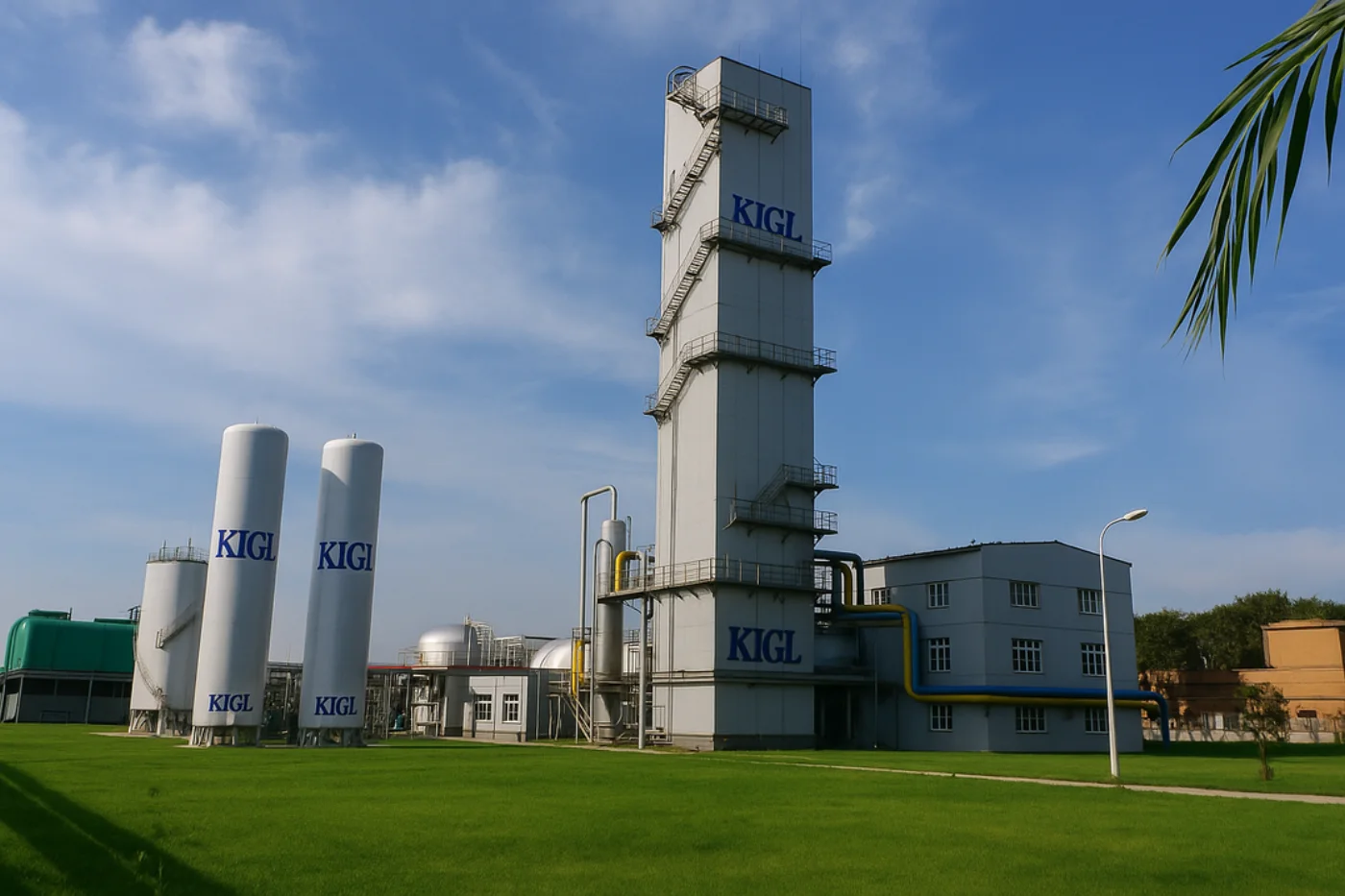
Oxygen is a permanent gas: its critical temperature of −118.57 °C is far below anything a cylinder sees, so it stays gaseous at any pressure at room temperature and is sold by pressure, not weight. The figures below are from the NIST Chemistry WebBook for the physical properties and from IS 309:2023, the Indian specification for compressed and liquid oxygen, for the grades. KIGL supplies industrial oxygen to IS 309 Grade 2 and medical oxygen to the Indian Pharmacopoeia.
Physical properties
| Property | Value | Source |
|---|---|---|
| Formula, molar mass | O₂, 31.999 g/mol | NIST |
| Boiling point at 1.013 bar | −182.96 °C (90.19 K) | NIST |
| Triple point | −218.79 °C (54.36 K), 1.46 mbar | NIST |
| Critical temperature | −118.57 °C (154.58 K) | NIST |
| Critical pressure | 50.43 bar | NIST |
| Critical density | 436 kg/m³ | NIST |
| Gas density, 0 °C, 1 atm | 1.429 kg/m³ | NIST |
| Gas density, 15 °C, 1 atm | 1.354 kg/m³ | NIST |
| Relative density to air | 1.105 | NIST |
| Liquid density at boiling point | 1,141 kg/m³ | NIST |
| Liquid to gas expansion | about 843 at 15 °C; about 860 at 21 °C | Computed from NIST densities |
| Latent heat of vaporisation | about 213 kJ/kg | NIST |
| Specific heat Cp, gas, 25 °C | about 0.918 kJ/kg·K | NIST |
| Ratio of specific heats Cp/Cv | 1.40 | NIST |
| Thermal conductivity, gas, 25 °C | about 0.0266 W/m·K | NIST |
| Viscosity, gas, 25 °C | about 20.6 µPa·s | NIST |
| Content of dry air | 20.95 % by volume | Standard atmosphere |
| UN number | 1072 compressed; 1073 refrigerated liquid | IS 4379:2021 Table 1 |
Two properties are unusual. Oxygen is paramagnetic, which is the basis of the paramagnetic and magneto-dynamic analysers that IS 309:2023 added as assay methods, harmonised with BS 4364. And liquid oxygen boils 13 K above liquid nitrogen, so air in contact with a surface cooled by liquid nitrogen condenses as an oxygen-enriched liquid. That is a fire hazard on uninsulated cryogenic pipework and the reason oxygen enrichment is a concern around nitrogen equipment as well as oxygen equipment.
The IS 309:2023 grades
IS 309 was revised in 2023 from one grade to three. "99.5 % to IS 309" is no longer a complete specification; the grade must be named.
| Characteristic | Grade 1 (N3.5) | Grade 2 (N2.5) | Grade 3 (N2.0) | Method |
|---|---|---|---|---|
| Oxygen, % v/v, min | 99.95 | 99.5 | 99.0 | A |
| Nitrogen, ppm, max | 100.0 | 100.0 | — | B-1 or B-6 |
| Water vapour, ppm, max | 1.5 | 2.0 | 67 | B-3, B-7 to B-10 |
| Carbon dioxide, ppm, max | 0.2 | 0.5 | 2.0 | B-1 to B-4 |
| Carbon monoxide, ppm, max | 0.2 | 0.5 | 3.0 | B-1 to B-3 |
| Hydrocarbons, ppm, max | 10.0 | 20.0 | 50.0 | B-1, B-2, B-3, B-5 |
Source: IS 309:2023 Table 1. Clause 4 assigns the uses: Grade 1 for calibration and where impurities must be minimised, Grade 2 as the laser-cutting assist gas for automotive and textile machinery and the grade to which liquid oxygen is aligned (with all measurements made in the gas phase), and Grade 3 for welding and other metallurgical operations. Note 1 exempts air-separation oxygen from routine CO, CO₂ and hydrocarbon testing except by agreement, and Note 2 makes method A-1 the referee. One internal inconsistency is worth knowing: Grade 1 is assayed at 99.95 % but its nitrogen limit of 100 ppm alone would imply about 99.99 %, so the grade label, the assay and the impurity table do not fully agree.
Sampling under Annex C is by lot, a lot being all cylinders charged at one time from one manifold: 5 cylinders from a lot of up to 50, rising to 25 from a lot of 301 or more, and the lot passes only if every sample passes. Contents are stated in cubic metres at 27 °C and 760 mm Hg (cl 6.2). Packing, marking and transport follow the Gas Cylinders Rules 2016 and, for liquid in tanks, the SMPV (Unfired) Rules 2016.
Medical oxygen
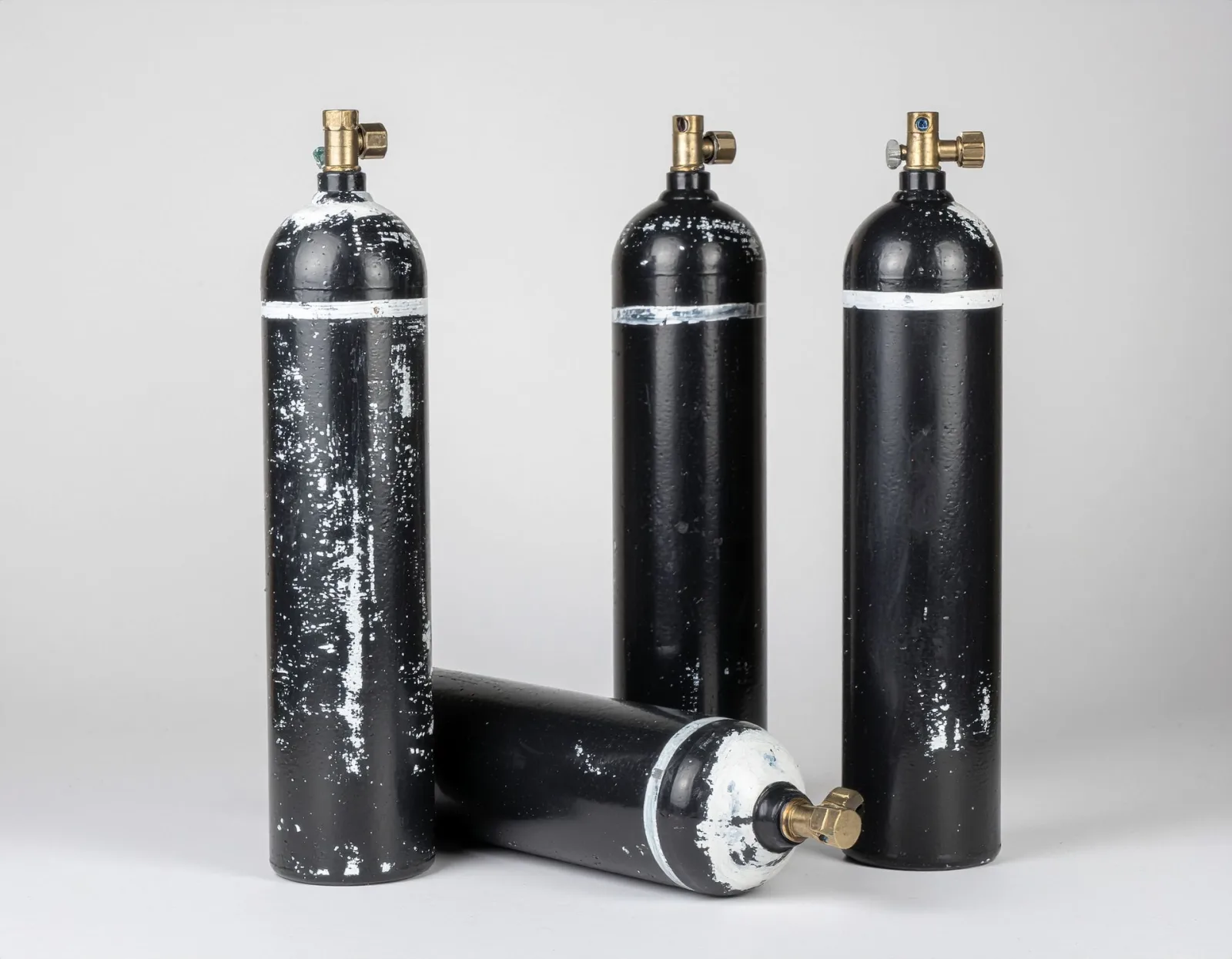
IS 309:2023 does not apply. Medical oxygen is a drug under the Indian Pharmacopoeia, which requires not less than 99.0 % v/v oxygen with carbon dioxide at 300 ppm and carbon monoxide at 5 ppm maximum. The difference matters at the cylinder: industrial oxygen is Graphite Black RAL 9011 throughout with no shoulder band (IS 4379:2021 Table 7); medical oxygen is black with a white RAL 9003 shoulder (IS 3933:2021 Table 1). The full comparison is on industrial vs medical oxygen.
Cylinder and pressure data
Oxygen cylinders are seamless steel to IS 7285 (Part 1):2018 or (Part 2):2017, valves to IS 3224:2021 with a right-hand outlet thread, and the filling pressure is fixed at 15 °C with the developed pressure checked at 65 °C under IS 8775:1978. Oxygen holds slightly more than an ideal gas at cylinder pressure because its compressibility factor is below 1, about 0.95 at 150 bar and 15 °C.
| Water capacity | Fill pressure at 15 °C | Ideal content, 15 °C | Approximate real content, 15 °C | Same at 27 °C (IS 309 basis) |
|---|---|---|---|---|
| 46.7 L | 150 bar | 6.96 m³ | about 7.4 m³ | about 7.7 m³ |
| 46.7 L | 200 bar | 9.26 m³ | about 9.8 m³ | about 10.2 m³ |
| 10 L | 150 bar | 1.49 m³ | about 1.6 m³ | about 1.6 m³ |
These are worked examples, not a KIGL size list; the method is on gas cylinder sizes and contents in India. Pressure rises about 0.4 % per °C, so a 150 bar fill at 15 °C reads about 176 bar at 50 °C (NIST). Bulk users take liquid oxygen in vacuum-insulated tanks licensed under the SMPV (Unfired) Rules, vaporised on site into an oxygen pipeline.
Rules that matter
Oxygen is not flammable; it is an oxidiser. It lowers the ignition temperature and ignition energy of fuels, widens flammable ranges and speeds burning. Acetylene, for example, is flammable from 2.5 to 82 % in air but over a far wider range in oxygen. The consequences for handling:
Chemical and fire properties
- No oil or grease on valves, regulators or fittings; GCR 2016 Rule 9 puts this on every cylinder label.
- Adiabatic compression of oxygen in a regulator or hose opened too fast can heat a contaminant to ignition; open cylinder valves slowly.
- Materials in high-pressure oxygen service are chosen for their ignition resistance; IS/ISO 11114-3 covers autogenous ignition testing.
- Pipework must be cleaned for oxygen service; see oxygen pipeline cleanliness.
- An atmosphere above 23.5 % oxygen is treated as enriched by EIGA; clothing that has absorbed oxygen burns violently.
The hazards and first aid are on oxygen safety data explained and the oxygen safety data sheet; applications by grade are on uses of oxygen gas, and the Indian standards are set out on oxygen standards.
Rules that matter
What to put on a purchase order
- Product: oxygen, compressed, to IS 309:2023 Grade 2 (N2.5), or the grade the process needs.
- Contents basis: m³ at 27 °C and 760 mm Hg per IS 309 cl 6.2, or state another basis explicitly.
- Cylinder: water capacity, filling pressure at 15 °C, valve outlet, Graphite Black throughout.
- Certificate: assay by method A-1 or A-2 with the impurity panel for the grade, and the lot sampling per Annex C.
- For medical use: Indian Pharmacopoeia grade under drug licence, white shoulder, batch record — never industrial oxygen.
Oxygen technical data sheet — frequently asked questions
What is the boiling point of oxygen?
−182.96 °C (90.19 K) at atmospheric pressure, according to the NIST Chemistry WebBook. Liquid oxygen is pale blue, paramagnetic and denser than water at 1,141 kg/m³. It freezes at −218.79 °C. Because its boiling point is 13 K above that of nitrogen, liquid oxygen can condense out of air on any surface cooled with liquid nitrogen, which is a fire hazard around cryogenic equipment.
Is oxygen heavier than air?
Slightly. Its relative density is 1.105, so released oxygen at ambient temperature tends to linger at low level and in poorly ventilated spaces rather than rising away. Cold oxygen vapour from a liquid spill is much denser still and flows along the ground. An enriched atmosphere can persist in clothing for some time after the source is shut.
What is the specific gravity of oxygen?
As a gas, oxygen has a specific gravity (relative density to air) of 1.105, from a density of 1.429 kg/m³ at 0 °C and 1 atm, so it is slightly heavier than air. Liquid oxygen at its boiling point has a density of 1,141 kg/m³, which makes it denser than water. Both figures are from the NIST Chemistry WebBook.
What is the expansion ratio of liquid oxygen?
About 1 to 860 at 21 °C and 1 atm, and about 1 to 843 at 15 °C, computed from the liquid density of 1,141 kg/m³ at the boiling point and the gas density at ambient. One litre of liquid oxygen therefore gives roughly 0.85 m³ of gas, which is why a small liquid spill in a closed room produces a large volume of enriched atmosphere.
What purity is industrial oxygen in India?
IS 309:2023 has three grades: Grade 1 (N3.5) at 99.95 % minimum for calibration and impurity-sensitive work, Grade 2 (N2.5) at 99.5 % for laser cutting and liquid oxygen, and Grade 3 (N2.0) at 99.0 % for welding and metallurgy. KIGL's industrial oxygen is supplied to Grade 2. Quote the grade, not just the percentage.
Does IS 309 cover medical oxygen?
No. IS 309:2023 clause 1 excludes aviation oxygen and oxygen for medical or inhalation purposes. Medical oxygen is governed by the Indian Pharmacopoeia monograph, not less than 99.0 % v/v with carbon dioxide at 300 ppm and carbon monoxide at 5 ppm maximum, filled under a drug licence. Its cylinders are black with a white shoulder under IS 3933:2021.
Why does IS 309 not test air-separation oxygen for CO and hydrocarbons?
Note 1 to IS 309:2023 Table 1 says oxygen from air separation shall not normally contain carbon monoxide, carbon dioxide or hydrocarbons, because the cryogenic process removes them, so for that product they are tested only by agreement between buyer and seller. Oxygen made by other routes must be tested for them. Note 2 makes method A-1 the referee in any purity dispute.
How is oxygen purity measured?
IS 309:2023 Annex A gives two assay methods; for Grades 2 and 3 either may be used but A-1 is the referee, and instrument resolution must be 0.1 % for Grades 2 and 3 and 0.01 % for Grade 1. Impurities are measured by gas chromatography, cavity ring-down spectroscopy, infrared or spectral analysers, and water vapour by phosphorus pentoxide absorption at 10 litres per hour for 4 to 5 hours.
References
- Bureau of Indian Standards. (2021). and IS 3933:2021 cylinder colour identification (IS 4379:2021, Second Revision).
- Bureau of Indian Standards. (2023). Oxygen, compressed gas and liquid — Specification (IS 309:2023, Fifth Revision).
- EIGA — oxygen pipeline, cleaning and enrichment documents
- Government of India. (2016). Gas Cylinders Rules, 2016 (G.S.R. 1081(E)). Petroleum and Explosives Safety Organisation. [and SMPV (Unfired) Rules 2016]
- Linstrom, P. J., & Mallard, W. G. (Eds.). (n.d.). NIST Chemistry WebBook (NIST Standard Reference Database 69). National Institute of Standards and Technology. [oxygen thermophysical properties] https://webbook.nist.gov/cgi/cbook.cgi?ID=C7782447
Enquiries
Request a quotation
State the gas or equipment, the quantity or capacity, and your location. KIGL will confirm the grade, the cylinder or plant size, and whether the location can be served from Noonmati, or through the agent network.