
Guide
PSA nitrogen: why purity not flow, decides what your plant costs
A PSA nitrogen plant separates air over a carbon molecular sieve that holds oxygen back. Raising the delivered purity from 95 % to 99.999 % can multiply the plant size, the air demand and the energy per cubic metre several times over. Specify the purity the process needs, not the highest available.
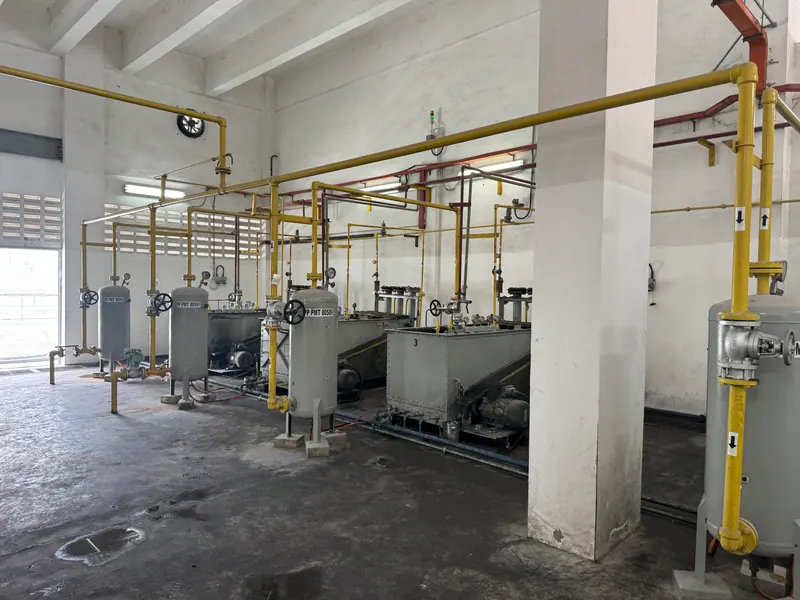
- Separating medium
- Carbon molecular sieve
- Feedstock
- Compressed air
- Dominant cost driver
- Delivered purity
- Dominant running cost
- Electricity for the air compressor
- Typical low-purity duty
- Tank blanketing
The counter-intuitive part
Most equipment costs scale with how much it makes. Ask for twice the flow and you get roughly twice the plant.
PSA nitrogen does not behave that way. Flow scales roughly as you would expect — but purity does not. Adding nines to the delivered purity can multiply the plant size, the air demand and the energy per cubic metre several times over, at the same flow.
Which means the most expensive decision on a PSA nitrogen project is usually made in a single line of the specification, often without much thought, months before anyone looks at a price.
What the nines actually mean
The grade names hide how large the steps are. Put the oxygen limits beside them and the cost curve becomes obvious.
IS 1747 grades nitrogen on purity, and oxygen is the impurity it caps. Going from the ordinary cylinder grade to the top analytical grades is not a refinement. It is a reduction in permitted oxygen of more than a thousandfold, from thousands of parts per million down to single figures.
That is the whole story of PSA nitrogen economics in one line. You are not buying a slightly better gas; you are buying the removal of almost all of what was left. And the sieve does not care that the remaining oxygen is only a trace; the last molecules are the hardest to hold back.
Worth knowing too: only the lowest of those grades is specified as a gas. The higher ones are specified as liquid, because that is how that purity is normally produced and delivered. A PSA plant aiming at the top of the range is competing with a liquid supply chain, not with cylinders.
Why the last fraction is so expensive
The plant works by passing compressed air over a carbon molecular sieve that holds oxygen back and lets nitrogen through, the mirror image of the zeolite sieve in a PSA oxygen plant.
Removing most of the oxygen is comparatively easy. Removing the last of it is not. To go from 99 % to 99.999 % you must:
- hold the gas against the sieve considerably longer
- vent more product during regeneration
- compress much more air for each cubic metre delivered
Every one of those raises the electricity bill and the size of the machine, for the same output. The third is the one that dominates: the ratio of air compressed to nitrogen delivered is the number that sets your running cost, and purity is what sets that ratio.
Matching purity to duty
| Duty | Purity needed |
|---|---|
| Tank blanketing, general purging | Usually well below 99 % |
| Tyre and pneumatic inflation | Low |
| Food packaging | Higher |
| Laser cutting | Higher — oxide-free edge is the point |
| Electronics, analytical, semiconductor | Top of the range |
Establish the highest purity any single application genuinely requires, then ask a harder question: should that one application be served from the plant at all?
Laser cutting is the case worth thinking hardest about, because the requirement is real rather than conventional. The reason for cutting with nitrogen is that nothing reacts at the kerf; oxygen carried in with the nitrogen reacts instead, and the bright edge you were paying for comes back discoloured. So the purity is not a specification someone copied. It is the product.
The mixed-demand trap
A single plant serving several duties gets sized for the strictest of them. So the cheap, high-volume work ends up subsidising the expensive, low-volume work, and the plant runs at a purity most of its output does not need.
Where a small part of the load needs much higher purity, it is frequently cheaper to run the plant at the lower purity and supply that one application from cylinders. That combination is worth pricing before committing to a plant sized for the exception.
The arithmetic is usually stark once someone does it. A blanketing and purging load that would be served comfortably by a modest plant, plus one laser at the top of the range, can end up specifying a machine two or three times the size, to serve a demand that a handful of cylinders a month would cover.
PSA or membrane?
Membrane systems are simpler, more compact and tolerant of intermittent operation, but generally reach lower purity and cost more per cubic metre at scale.
PSA is the usual choice for continuous duty and higher purity.
The decision follows the same three variables as everything else here: flow, purity, and how continuous the demand is. Intermittency is the one people weigh too lightly. A PSA plant is happiest running steadily, and a duty that stops and starts wastes the gas in the vessel at every changeover and works the valves harder for no output.
What it costs to run
Electricity for the air compressor, by a wide margin, and that scales with how much air you must compress per cubic metre of product, which is set by the purity.
So purity and running cost are not two conversations. They are the same one, and it is worth having before the specification is written rather than after the plant is installed.
One consequence worth stating plainly: because the cost is overwhelmingly electricity, a PSA business case is partly an electricity tariff calculation, and it should be redone when the tariff moves rather than treated as settled at purchase.
The wider make-or-buy method is on cylinders or on-site generation.
Sources
PSA nitrogen — frequently asked questions
Why does purity cost so much more than flow?
Because the last fraction of oxygen is the hardest to remove. Getting from air to 95 % nitrogen is comparatively easy; going from 99 % to 99.999 % means holding gas against the sieve far longer, venting far more of it, and compressing much more air for each cubic metre delivered. Doubling flow roughly doubles the plant. Adding nines can multiply it.
What purity do I actually need?
Tank blanketing and general purging are usually satisfied well below 99 %. Food packaging and laser cutting need considerably more. Electronics and analytical work need the top of the range. The right approach is to establish the highest purity any single application genuinely requires, and question whether that application should be served from cylinders instead.
Can one plant serve mixed purity demands?
It can, but it will be sized for the strictest one — so the cheap, high-volume duties end up subsidised by the expensive, low-volume one. Where a small part of the load needs much higher purity, it is often cheaper to run the plant at the lower purity and supply that one application from cylinders.
What is the difference between PSA and membrane nitrogen?
Membrane systems are simpler, more compact and tolerant of intermittent operation, but generally reach lower purity and cost more per cubic metre at scale. PSA is the usual choice for continuous duty and higher purity. Which is right depends on flow, purity and how continuous the demand is.
What determines running cost?
Electricity for the air compressor, by a wide margin — and it scales with how much air you must compress per cubic metre of product, which is itself set by the purity. This is why purity and running cost are the same conversation rather than two separate ones.
Should I generate or buy cylinders?
Steady, continuous, moderate-purity demand favours generation. Intermittent demand or very high purity in modest volume favours cylinders. Because purity drives plant cost so strongly, a high-purity requirement pushes the crossover a long way out — sometimes past the point where generation ever makes sense.
Enquiries
Request a quotation
State the gas or equipment, the quantity or capacity, and your location. KIGL will confirm the grade, the cylinder or plant size, and whether the location can be served from Noonmati, or through our agent network.