
Guide
PSA VPSA or cryogenic air separation: choosing an oxygen gas plant by purity, scale, liquid output and energy
A cryogenic air separation plant distils liquefied air into 99.5 % or purer oxygen, nitrogen and argon, as gas or liquid, and suits outputs above about 5,000 Nm³/h. PSA and VPSA plants adsorb nitrogen on zeolite at ambient temperature and give 90 to 96 % oxygen gas only, suiting hospitals and smaller factories.
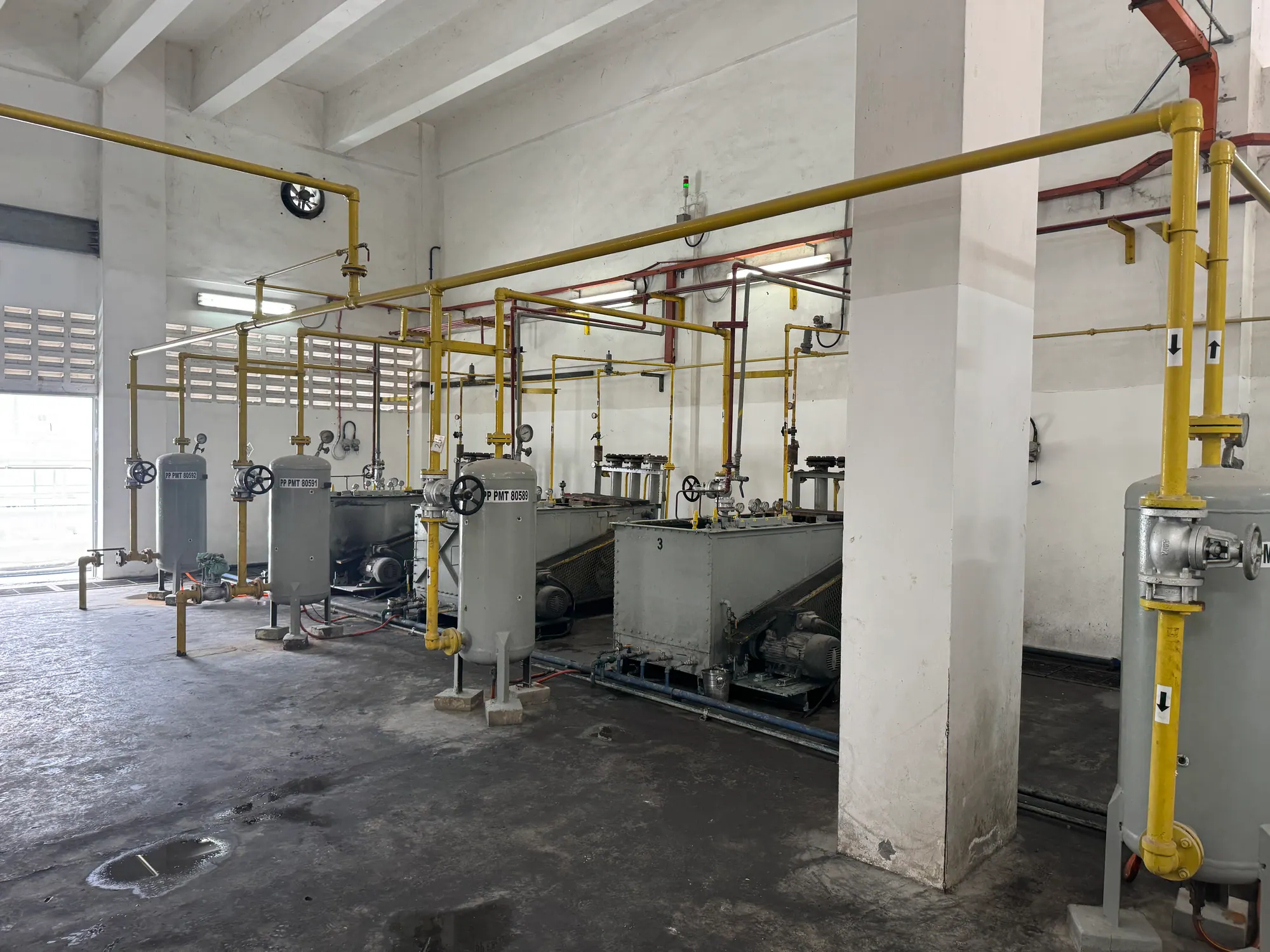
- Cryogenic scale
- Cryogenic air separation units are applied for oxygen production above about 5
- Cryogenic energy
- More than 200 kWh of electricity per tonne of oxygen
- Adsorption energy
- Calculated as low as 140 kWh per tonne of 95 % oxygen for VPSA; real applications almost three times higher
- PSA medical grade
- Oxygen 93: 90 to 96 % oxygen
- VPSA purity
- Gaseous oxygen at 90 to 93 %
There are three ways to build an oxygen gas plant, and they are not competitors across the whole range. A cryogenic air separation unit (ASU) is the only route to liquid oxygen, to oxygen purer than about 96 %, and to argon. Pressure swing adsorption (PSA) and its larger cousin vacuum pressure swing adsorption (VPSA) make oxygen gas at 90 to 96 % at ambient temperature, and are the practical choice for hospitals and most factories that make their own. This page compares the three on purity, scale, liquid output and energy, using named sources, and sets out where each one fits. How each process works is on how oxygen is made.
ASU vs PSA vs VPSA at a glance
| Feature | Cryogenic air separation (ASU) | PSA | VPSA |
|---|---|---|---|
| Principle | Liquefy air and distil it in a column | Zeolite adsorbs nitrogen at pressure; desorbs at atmospheric | Zeolite adsorbs near atmospheric; desorbs under vacuum |
| Oxygen purity | 99.5 % and above; IS 309:2023 Grade 1 is 99.95 % | 90 to 96 % (Oxygen 93) | 90 to 93 % (Leeds 2024) |
| Balance of product | Trace argon and nitrogen | Mostly argon, some nitrogen | Mostly argon, some nitrogen |
| Typical scale | Above about 5,000 Nm³/h (Variny et al. 2021) | Smallest plants: hospitals, workshops, small furnaces | Between PSA and cryogenic |
| Liquid output | Yes, with extra refrigeration | No | No |
| Co-products | Nitrogen and argon, gas or liquid | None | None |
| Electricity per tonne of oxygen | More than 200 kWh/t, about 0.29 kWh/Nm³ (Variny et al. 2021) | Higher than VPSA and large ASU per tonne; no named-source figure | Calculated as low as 140 kWh/t at 95 %, real plants almost three times higher (Variny et al. 2021) |
| Start-up | Slow: the cold box must be cooled down | Fast | Fast |
| Feed preparation | Compression, molecular-sieve removal of water, CO₂ and hydrocarbons | Compressed, dried, filtered air | Blower air, filtered |
A conversion helps when comparing quotes. One tonne of oxygen a day is about 29.2 Nm³/h of gas at 0 °C, from the NIST density of 1.429 kg/m³. On that basis, Variny's 5,000 Nm³/h threshold is about 170 tonnes a day.
Why the purities differ
The purity gap is physics, not engineering quality. A distillation column separates by boiling point, and given enough stages it can separate oxygen from argon as well as from nitrogen. A zeolite separates by how strongly it holds each molecule, and it holds argon about as weakly as oxygen. Argon is 0.934 % of air, so if a PSA plant removed every molecule of nitrogen, its product would still be only about 95.7 % oxygen. That is why medical PSA oxygen is specified as Oxygen 93, 90 to 96 %, in the WHO International Pharmacopoeia (11th edition, 2022), rather than against the higher-purity monograph for liquid-derived oxygen. A PSA plant offered at 99 % or above is not describing pressure swing adsorption on zeolite. The mechanism is explained further on how PSA oxygen generation works.
For most uses the gap does not matter. Furnace enrichment, glass and metal melting, effluent treatment, ozone generation and hospital supply all run on 90 to 96 % oxygen. Where it does matter, IS 309:2023 sets the industrial grades: Grade 3 (N2.0) at 99.0 %, Grade 2 (N2.5) at 99.5 % and Grade 1 (N3.5) at 99.95 %. No adsorption plant reaches any of them.
Energy per Nm³: what the sources say
Energy is the main running cost of every oxygen plant, because the oxygen itself is free. The numbers in the literature are not directly comparable unless the purity, delivery pressure and product state are the same.
| Source | Technology | Figure | Basis and caution |
|---|---|---|---|
| Variny et al. 2021 | Cryogenic ASU | More than 200 kWh per tonne of oxygen | Large gaseous oxygen plant; the paper cites a theoretical minimum of about 51 kWh/t |
| Variny et al. 2021 | VPSA | As low as 140 kWh per tonne of 95 % oxygen (calculated) | The paper notes real applications are almost three times higher |
| Leeds, Carollo Engineers 2024 | Cryogenic | About 750 kWh per ton | Water-industry comparison; ton not defined; likely includes liquid production and delivery |
| Leeds, Carollo Engineers 2024 | VPSA | About 615 kWh per ton | Same comparison |
Two conclusions survive the differences. First, large cryogenic plants and VPSA are in the same range per tonne of gaseous oxygen; neither is dramatically cheaper to run at its best scale. Second, liquid oxygen costs more energy than gas, because it has to be liquefied, and it then has to be transported. For a buyer, the useful question to every supplier is the same: kilowatt-hours per Nm³ of product, at a stated purity and delivery pressure, measured at the plant's actual operating point rather than its design point.
When each plant makes sense
Choose a cryogenic ASU when demand is large and steady, at the scale of a steelworks, a refinery or a merchant liquid plant; when purity above about 96 % is required on site; when argon or nitrogen is wanted as well; or when liquid product is part of the business. An ASU is a long-term asset, slow to start and stop, and is normally run continuously by a gas company.
Choose VPSA when demand is large for an adsorption plant, purity of 90 to 93 % is acceptable, and power cost dominates the decision. VPSA is common for furnace enrichment, pulp and paper, and water treatment.
Choose PSA when demand is small to moderate, the site needs to be independent of deliveries, and 90 to 96 % purity is acceptable. Hospitals, small foundries, glass works, aquaculture and ozone systems are the typical users. A PSA plant starts quickly and follows demand.
Choose bulk liquid or cylinders instead when demand is intermittent, too small to justify a plant, or needs higher purity than adsorption gives. The method for that decision is on cylinder supply or on-site generation, and the hospital case is treated on liquid medical oxygen in India.
Whatever the primary source, a plant producing gas only needs a back-up. A PSA plant has no stored liquid reserve, so it is paired with a cylinder manifold or a liquid tank for maintenance and breakdowns.
Oxygen and nitrogen from one plant?
Only an ASU makes both from the same machine. Adsorption plants use different sieves for each gas: zeolite for oxygen, which holds nitrogen, and carbon molecular sieve for nitrogen, which holds oxygen. A site that needs both from adsorption installs a PSA oxygen plant and a PSA nitrogen plant side by side, each with its own adsorber vessels and its own purity and pressure duty.
What KIGL builds
KIGL builds PSA oxygen and PSA nitrogen plants, gas pipelines and medical gas pipeline systems, and fills oxygen, nitrogen and other gases in cylinders at its own PESO-approved works at Noonmati, Guwahati, and Howrah, Kolkata. KIGL also operates an air separation plant and supplies liquid oxygen and liquid nitrogen. For a site sizing an on-site plant, the PSA oxygen plant page sets out what KIGL supplies.
PSA — frequently asked questions
What is the difference between an air separation plant and a PSA plant?
An air separation plant, or ASU, cools air until it liquefies and distils it, so it can make oxygen above 99.5 %, nitrogen and argon, as gas or as liquid. A PSA plant works at room temperature, pushing compressed air through zeolite that holds back nitrogen, and makes only oxygen gas at 90 to 96 %. An ASU is a large industrial installation; a PSA plant fits in a hospital plant room.
What is a VPSA oxygen plant?
Vacuum pressure swing adsorption. It uses the same zeolite as PSA but swings between near atmospheric pressure, supplied by a blower, and vacuum, drawn by a vacuum pump, instead of between high pressure and atmospheric. That avoids compressing all the feed air to several bar and suits larger adsorption plants. A 2024 water-industry comparison put VPSA product at 90 to 93 % oxygen.
Which oxygen plant uses the least electricity?
At large scale, cryogenic separation and VPSA are close. Variny and co-authors (2021) report cryogenic units above 200 kWh per tonne of oxygen, and VPSA calculated at 140 kWh per tonne of 95 % oxygen but nearly three times that in real plants. Small PSA units use more per tonne than either. Always compare quotes in kWh per Nm³ at the same purity and delivery pressure.
Can a PSA plant make liquid oxygen?
No. PSA and VPSA produce gas at ambient temperature only. Liquid oxygen needs the low temperatures of a cryogenic plant, and making liquid takes extra refrigeration even there. A site that needs a stored reserve alongside a PSA plant keeps cylinders or a liquid tank filled from a cryogenic producer, which is also how hospital back-up supply is normally arranged.
At what size does a cryogenic oxygen plant make sense?
Generally at large, steady demand. Variny et al. (2021) place cryogenic units at production above about 5,000 Nm³/h, roughly 170 tonnes a day, the scale of a steelworks or a merchant liquid plant. Below that, adsorption plants or bulk liquid delivered by tanker are usually the better fit, unless high purity, argon or liquid product is needed on site.
Can one plant make both oxygen and nitrogen?
A cryogenic ASU can, because it separates air into all its main components at once, and most produce oxygen, nitrogen and argon together. Adsorption plants cannot: PSA oxygen uses zeolite that holds nitrogen, while PSA nitrogen uses carbon molecular sieve that holds oxygen. A site needing both from adsorption installs two separate plants.
References
- Bureau of Indian Standards. (2023). Oxygen, compressed gas and liquid — Specification (IS 309:2023, Fifth Revision).
- Leeds A., Comparison of Oxygen Sources for Ozone Generation, Carollo Engineers, PNWS-AWWA, May 2024 https://pnws-awwa.org/wp-content/uploads/2024/06/Comparison-of-Oxygen-Sources-for-Ozone-Generation.pdf
- Linstrom, P. J., & Mallard, W. G. (Eds.). (n.d.). NIST Chemistry WebBook (NIST Standard Reference Database 69). National Institute of Standards and Technology. [oxygen gas density] https://webbook.nist.gov/cgi/cbook.cgi?ID=C7782447
- The Global Fund, technical briefing note on PSA oxygen purity (WHO International Pharmacopoeia, 11th ed., 2022)
- Variny M. et al., Cutting oxygen production-related greenhouse gas emissions by improved compression heat management in a cryogenic air separation unit, Int. J. Environ. Res. Public Health 2021, 18, 10370 https://mdpi-res.com/d_attachment/ijerph/ijerph-18-10370/article_deploy/ijerph-18-10370.pdf
Enquiries
Request a quotation
State the gas or equipment, the quantity or capacity, and your location. KIGL will confirm the grade, the cylinder or plant size, and whether the location can be served from Noonmati, or through the agent network.