
Guide
Acetylene supply across the North-East: what the geography does to it
Acetylene is filled at KIGL's Guwahati works, where we have made it since 1947, and supplied across Assam and the North-East through an agent network beyond the delivery radius. Distance, monsoon and hill roads make cylinder stock a planning question rather than a purchasing one: hold buffer for two weeks, not for two days.
- Where KIGL fills acetylene
- Guwahati works
- Supply beyond the delivery radius
- Through a network of appointed agents
- Manufacturing since
- 1947
- Cylinder standard
- IS 7312
- Why cascades matter here
- Fewer deliveries for the same consumption
Why this is a real question here and not elsewhere
In most of India, acetylene supply is a purchasing decision. You order, it arrives, you use it.
Across Assam and the North-East it is a planning decision, and the reason is the gas itself.
Acetylene cannot be stored in bulk on your site. There is no equivalent of a liquid oxygen tank. It arrives in cylinders, each holding a limited quantity, and each cylinder can only give up about one-seventh of its contents per hour without pulling acetone out with the gas — the reason for that is on why acetylene is dissolved in acetone.
So your consumption is capped by what is physically standing in your yard. Distance from a filling works is not an inconvenience; it is a constraint on how much work you can do.
Where the gas comes from
KIGL fills dissolved acetylene at its Guwahati works, in Assam, and has manufactured acetylene since 1947. Beyond that works' delivery radius, cylinder gas reaches customers through a network of appointed agents.
The Kolkata works manufactures equipment — acetylene plants, flashback arrestors, flame arrestors and safety valves — rather than filling cylinders.
Plan stock around the worst window, not the normal one
The common mistake is holding stock sized to the usual delivery interval.
Size it instead to the worst interval your route actually experiences: monsoon, a landslide, a closed road, a festival week, a bridge under repair. For most North-East locations, two weeks of cover is a more realistic starting point than two days.
This costs cylinder rental and yard space. It costs considerably less than a fabrication shop standing idle because the gas did not arrive.
Cascades are worth more here than elsewhere
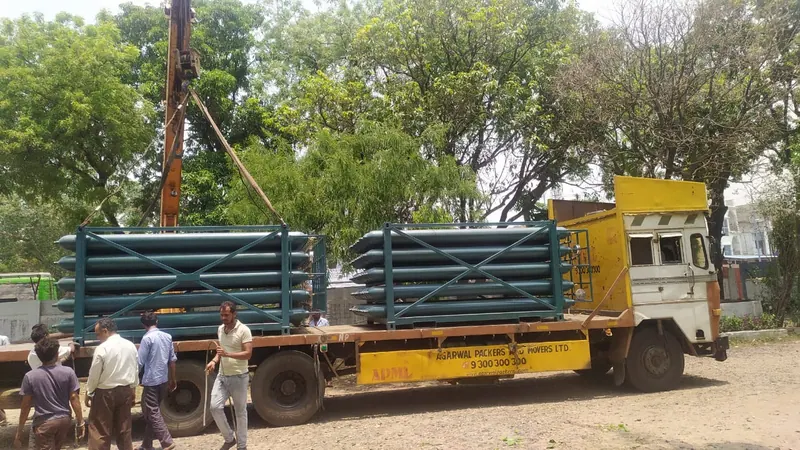
A cascade — several cylinders manifolded together — does two things:
- Lets you draw a higher continuous rate without exceeding the one-seventh limit on any single cylinder
- Holds more gas per delivery
The second is the one that matters when the road is your constraint. Same consumption, fewer deliveries, less exposure to a route being closed.
We size cascades against measured draw-off rather than total monthly consumption, because the draw-off rate is what determines whether the arrangement works at the torch.
When generation starts to make sense
Remoteness raises the value of removing delivery dependency, so the crossover between buying cylinders and generating on site sits closer here than it would in a city.
It does not remove the arithmetic. Steady consumption, purity, and whether you can actually run and maintain a plant all still decide it; the method is on cylinders or on-site generation.
But if you are running a fabrication operation several hundred kilometres from a filling works, it is worth costing rather than assuming. KIGL builds the plants as well as filling the cylinders, which means we can price both sides of that question honestly.
Rules that matter
What to ask for
- Your real draw-off rate, not your monthly total — it decides cylinder count and cascade size
- Buffer stock sized to the worst delivery window on your route
- A conversation in April, not in July
Tell us where you are, what you consume and how the road behaves, and we will tell you what to hold.
Acetylene supply across — frequently asked questions
Why does geography matter for acetylene specifically?
Because acetylene cannot be stored in bulk on your site the way a liquefied gas can. It arrives in cylinders, each holding a limited quantity, and each cylinder can only give up about a seventh of its contents per hour. So the further you are from a filling works, the more your consumption becomes a logistics problem rather than a purchasing one.
How much buffer stock should I hold?
More than you would in a city with a filling works down the road. Plan around the worst delivery window your route actually experiences — monsoon, a landslide, a closed road, a festival — rather than the normal one. Two weeks of cover is a more realistic starting point than two days for most North-East locations.
Why use a cascade rather than single cylinders?
Two reasons, and the second matters more here. A cascade lets you draw a higher continuous rate without exceeding the one-seventh limit on any single cylinder. And it holds more gas per delivery, so the same consumption needs fewer deliveries — which is exactly what you want when the road is the constraint.
Does KIGL fill acetylene anywhere other than Guwahati?
No. Acetylene is filled at the Guwahati works. Beyond that works' delivery radius, cylinder gas reaches customers through a network of appointed agents. The Kolkata works manufactures equipment — acetylene plants, flashback arrestors, flame arrestors and safety valves, rather than filling cylinders.
What happens to delivery during monsoon?
Roads across the region are affected to different degrees and for different lengths of time, and a route that is reliable for ten months can be interrupted in the other two. The practical answer is not a promise from a supplier but stock held before it starts, and a conversation about it in April rather than in July.
Is on-site generation worth considering here?
More often than in a city, because the value of removing delivery dependency is higher. The arithmetic still has to work on steady consumption, purity and whether you can run a plant — but remoteness pushes the crossover closer than it would be elsewhere. It is worth costing rather than assuming.
Enquiries
Request a quotation
State the gas or equipment, the quantity or capacity, and your location. KIGL will confirm the grade, the cylinder or plant size, and whether the location can be served from Noonmati, or through our agent network.