
Guide
What carbon dioxide is used for and why it is sold by weight
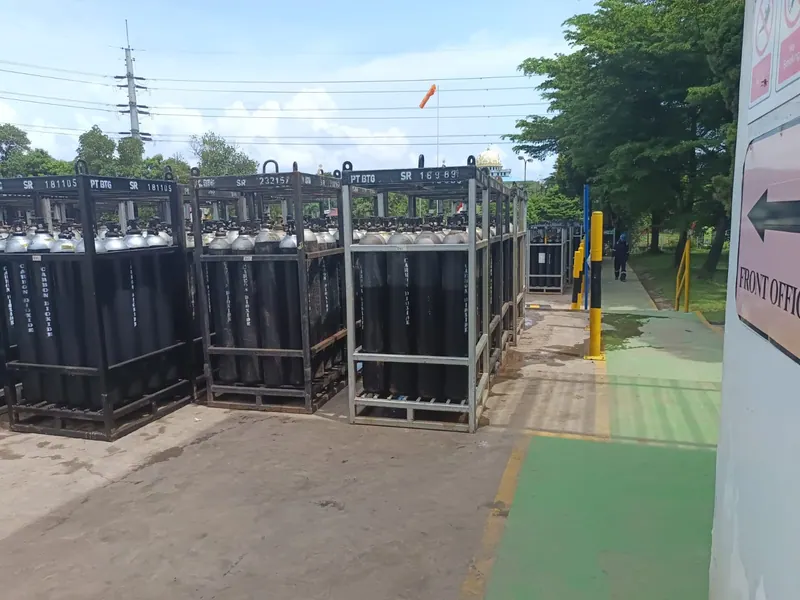
Carbon dioxide is used as a MIG welding shield, for beverage carbonation, food chilling and freezing, pH control in water treatment, and in fire suppression. KIGL fills it to IS 307 at ≥99.0 %. Cylinders are charged and sold by weight, because the contents are liquid and a pressure gauge tells you nothing.
- Specification
- IS 307
- Cylinder colour
- Black body with white band
- Valve standard
- IS 3078
- Contents measured by
- Weight
- Critical temperature
- 31 °C
A liquid, not a compressed gas
The single most useful fact about a carbon dioxide cylinder is that it is not full of gas. It holds liquid carbon dioxide with vapour above it, held there by its own vapour pressure.
Everything odd about handling CO2 follows from that.
The gauge lies
The pressure you read is the vapour pressure of the liquid, and that stays roughly constant as long as any liquid remains. A CO2 cylinder reads nearly full until it is nearly empty. Contents are determined by weighing, which is why CO2 is charged and sold by weight rather than by cubic metre.
The cylinder gets cold
Drawing gas boils liquid, and boiling absorbs heat. Draw too fast and the cylinder frosts over, vapour pressure falls, and flow drops away — the cylinder appears to run out while still substantially full. If you need a high continuous rate, manifold cylinders rather than pushing one harder.
31 °C is a real limit
That is the critical temperature of carbon dioxide: above it the liquid phase cannot exist at any pressure, the contents become a single dense phase, and cylinder pressure climbs sharply. Thirty-one degrees is not an unusual afternoon in Guwahati or Kolkata. Keep CO2 cylinders out of direct sun, away from heat sources, and never in a closed vehicle in summer.
What it is used for
MIG and MAG welding
Carbon dioxide gives deep penetration on steel at low cost, at the price of a harsher arc and significant spatter. Most steel work therefore runs on an argon–CO2 mixture rather than pure CO2 — but on thick material where penetration dominates, straight CO2 still earns its place.
Beverage carbonation
The fizz in every carbonated drink and the gas pushing beer through a line. This needs a food-grade product, which is a different specification from industrial CO2 even where the headline purity looks similar.
Food chilling and freezing
Expanded to solid CO2 (dry ice) or injected as liquid, for chilling in transit, freezing tunnels and mixing.
Water and effluent treatment
Dissolved in water, carbon dioxide forms carbonic acid — a controllable, non-hazardous way to bring pH down without handling mineral acid.
Inerting and fire suppression
Displacing oxygen to prevent or extinguish combustion.
Greenhouse enrichment
Raising CO2 concentration to increase plant growth rates.
Rules that matter
Nitrogen and argon kill by displacing oxygen and giving no warning at all. Carbon dioxide is worse in one specific way: it is physiologically active long before it displaces enough oxygen to matter.
Rising CO2 in the air you breathe causes rapid breathing, headache, dizziness and confusion. The confusion is the dangerous part — judgement fails at exactly the moment good judgement is required to leave.
It is also substantially heavier than air, so it flows downhill and collects in pits, cellars, drains, tank bottoms and cold rooms, where it can sit for a long time.
The hazard that is different from the other inert gases
- Ventilate at floor level, not at the ceiling
- Treat cellars, pits and cold rooms where CO2 is used as confined spaces
- Fit CO2 monitoring where cylinders are used in enclosed areas, particularly in beverage cellars
- Never store cylinders in a basement without ventilation
Full hazard data is in the carbon dioxide safety data sheet.
What carbon dioxide is used — frequently asked questions
Why is a CO2 cylinder sold by weight rather than volume?
Because the contents are liquid, not compressed gas. A CO2 cylinder holds liquid carbon dioxide with vapour above it, and the pressure you read is the vapour pressure of that liquid — which stays roughly constant while liquid remains, whatever the level. The gauge reads almost full until it is nearly empty, so contents are determined by weighing.
What happens above 31 degrees C?
Thirty-one degrees is the critical temperature of carbon dioxide. Above it the liquid phase cannot exist at any pressure, so the contents become a single dense supercritical phase and cylinder pressure rises sharply. That is not an unusual temperature in an Indian summer, which is why CO2 cylinders must be kept out of direct sun and away from heat.
Why does CO2 spatter in MIG welding?
Because carbon dioxide dissociates at arc temperature, cooling the arc and making droplet transfer coarser and less regular. You get deep penetration and a lot of spatter. Most steel MIG work therefore uses an argon–CO2 mixture rather than pure carbon dioxide.
Is carbon dioxide dangerous?
Yes, in two distinct ways. It is an asphyxiant that displaces air, and it is heavier than air so it collects in pits, cellars, tank bottoms and drains. Unlike nitrogen it is also physiologically active well before it displaces enough oxygen to matter — rising CO2 causes rapid breathing, headache and confusion, which impairs judgement exactly when clear thinking is needed.
Why does the cylinder get cold in use?
Because drawing gas boils the liquid inside, and boiling absorbs heat. Draw too fast and the cylinder frosts, the vapour pressure falls, and the flow drops off — the cylinder appears to run out while still substantially full. Where a high continuous rate is needed, manifold cylinders rather than pushing one harder.
What purity do I need for beverage use?
Beverage and food applications need a food-grade specification, which is a different product from industrial CO2 even where the assay looks similar — it is about the impurities that are controlled and the traceability behind them. Never assume industrial grade is acceptable for anything a person will consume.
Enquiries
Request a quotation
State the gas or equipment, the quantity or capacity, and your location. KIGL will confirm the grade, the cylinder or plant size, and whether the location can be served from Noonmati, or through our agent network.