
Guide
What nitrogen is used for: purging blanketing, cutting and cooling
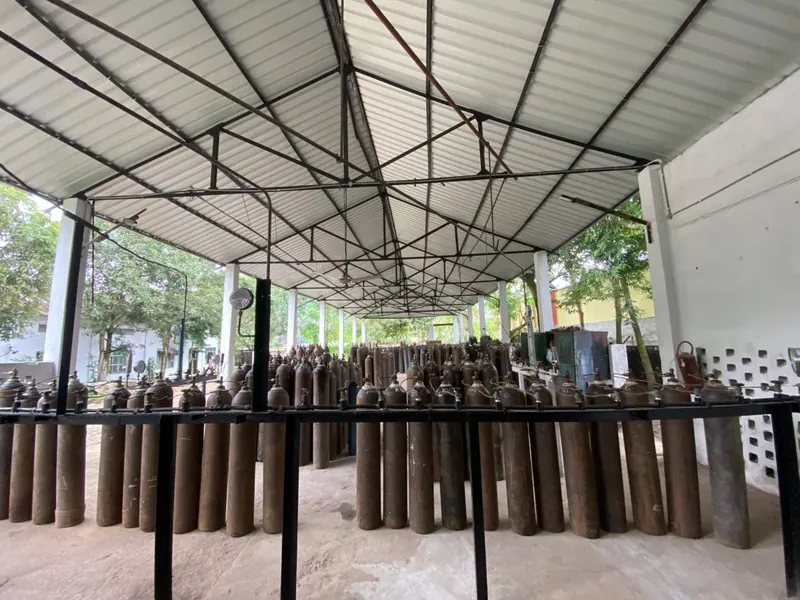
Nitrogen makes up 78 % of air and is almost completely unreactive at ordinary temperatures, so it is used wherever oxygen must be excluded: purging vessels and pipelines, blanketing tanks, laser cutting, food packaging and pressure testing. KIGL fills it to IS 1747 at ≥99.5 % in cylinders and cascades.
- Specification
- IS 1747
- Industrial purity
- ≥99.5 % N₂
- Proportion of the atmosphere
- 78 %
- Cylinder colour
- French grey body with black band
- Shielding gas standard
- EN ISO 14175
One property, many jobs
Nitrogen is 78 % of the air you are breathing and is almost completely unreactive at ordinary temperatures. That inertness is the entire product. Everything below is a use of nitrogen's refusal to participate.
Which is worth saying plainly, because it changes how you buy it. With most gases you are paying for something the gas does. With nitrogen you are paying for something it does not do, and the practical consequence is that the specification you need is defined almost entirely by what you will tolerate coming along with it. Oxygen is the impurity that matters in nearly every application below, and it is the one the standard controls.
Which grade you are actually buying
IS 1747 sets four grades on purity alone, named N 2.5 up to N 5.5. The one point that decides most purchasing conversations: only N 2.5, the lowest, is specified as a gas. The three high-purity grades above it are specified as liquid, because that is how that purity is produced and delivered.
So asking for a very high grade "in cylinders" is asking for something the standard does not contemplate. What would actually arrive is decanted liquid, with the handling, boil-off and vessel requirements that implies. KIGL's cylinder nitrogen is N 2.5 at ≥ 99.5 %, with oxygen held below 5 000 ppm, and oxygen is the only impurity the standard caps at this grade; the tighter limits on hydrogen, carbon dioxide, hydrocarbons, carbon monoxide and moisture begin at the liquid-sourced grades.
One thing to check when you compare quotations: IS 1747 requires cylinder contents to be measured at 27 °C and 760 mm Hg and expressed in cubic metres. That is not the same reference condition as NTP, and a supplier quoting on a different basis is not directly comparable. A price difference that looks like a discount is sometimes a measurement difference.
Purging
Sweeping oxygen out of a vessel, pipeline or reactor before maintenance or start-up. No oxygen means no combustion, whatever flammable residue is present.
This is the largest single industrial use, and it is where the rule that matters most lives: acetylene equipment is purged with nitrogen, never with air. Acetylene is flammable in air from 2.5 % right up to 82 %, so an air purge does not dilute the hazard; it walks the equipment straight through the middle of the flammable range on the way. That is why a nitrogen supply sits beside every acetylene plant, including ours.
Purging is also where quantity gets underestimated. A purge is not one vessel-volume of gas: gas mixes rather than pushing the old atmosphere out in a clean front, so several volume changes are normally needed before a test confirms the space is clear. The test is what ends the purge, not the clock and not the cylinder gauge.
Blanketing
A low-pressure nitrogen layer held over a liquid in a storage tank, so air never touches the surface. It prevents oxidation, keeps moisture out, and holds the vapour space outside its flammable range. Standard practice on solvents, edible oils, chemicals and fuels.
Blanketing is a continuous, low-flow duty rather than a burst one, and that changes the supply question completely. A tank that breathes with the day's temperature swing and with every fill and draw consumes a modest amount of gas constantly, for years. It is one of the clearest cases where steady demand eventually outruns cylinder delivery. See the crossover method at the end.
Laser cutting
Cutting with oxygen is faster and cheaper, because the oxygen reacts and adds heat to the cut. But it leaves an oxidised edge that usually needs cleaning before painting or welding.
Nitrogen contributes no heat, so the cut is slower and uses more gas, and the edge comes off bright and oxide-free. On stainless and aluminium, where the finish is often the point, that trade is worth making.
The catch is purity, and it catches people out. Nitrogen cutting works because nothing reacts at the kerf, so oxygen carried in with the nitrogen reacts instead, and the discoloured edge you were paying to avoid comes back. If the finish is the reason you chose nitrogen, the oxygen content of the gas is not a detail, it is the specification.
Food and packaging
Displacing oxygen in a sealed pack slows spoilage and rancidity without adding anything to the food. This is modified-atmosphere packaging, and it is why a crisp packet is inflated.
Food contact is its own question, separate from the chemistry. A gas being pure enough is not the same as a gas being handled under food-appropriate controls, and the certification is what a food auditor will ask for. Ask for it explicitly rather than inferring it from a purity figure.
Pressure testing and pneumatics
Nitrogen is used to pressure-test systems that must not be tested with air — because air brings oxygen and moisture — and to charge accumulators, dampers and suspension systems.
Oxygen systems are the important case. An oxygen line has been cleaned for oxygen service at considerable trouble, and testing it with compressed air undoes that in one step: shop air carries compressor oil in aerosol form, and oil in an oxygen system is the specific hazard the cleaning existed to prevent. Test an oxygen line with nitrogen.
Rules that matter
Nitrogen is non-toxic, non-flammable and completely unremarkable, which is precisely why it kills people.
It displaces air with no smell, taste, colour or warning at all. There is no gasp reflex, because that reflex responds to carbon dioxide building up, not to oxygen running out — and in a nitrogen-filled space the carbon dioxide is being washed away with every breath. A person walking into a purged vessel can lose consciousness in a few breaths, without ever feeling short of air. The second fatality is then the person who goes in to help, which is why this is the classic multiple-casualty confined-space accident.
The hazard nobody sees coming
- Treat any purged vessel as unsafe until it has been tested and cleared, not until it has been "left open for a while"
- Never enter a confined space after nitrogen work without a permit, a gas test and a watcher outside who does not follow you in
- Ventilate at the point of use. Nitrogen is very close to the density of air, so it neither rises out of a pit nor sinks out of a headspace — it simply stays where it was released
Full hazard data is in the nitrogen safety data sheet.
Cylinders or an on-site plant?
Beyond a certain steady consumption, generating nitrogen on site with a PSA plant costs less than taking delivery of cylinders.
The crossover depends on how much you use, how continuously, and at what purity, and the purity requirement usually decides it before the flow does. PSA nitrogen gets progressively more expensive as the specification tightens, because the last fraction of oxygen is the hardest to remove; a plant sized for a modest purity is a different machine from one sized for a demanding one. Work out the purity you genuinely need first, then the flow. There is a method for that decision on cylinder supply or on-site generation, and the purity side specifically on choosing PSA nitrogen purity.
What nitrogen is used — frequently asked questions
Why is nitrogen used for purging?
Because it displaces oxygen without reacting with anything it meets. Purging a vessel or pipeline with nitrogen removes the oxygen needed to support combustion, so flammable residues cannot ignite during maintenance or start-up. It is the standard purge medium precisely because it does nothing else.
Why must acetylene equipment never be purged with air?
Because acetylene forms a flammable mixture with air across a very wide range, so purging with air can create an explosive atmosphere inside the very equipment you are trying to make safe. Nitrogen displaces the acetylene without forming a combustible mixture. This is a requirement, not a preference.
What is blanketing?
Holding a low-pressure nitrogen layer above a liquid in a storage tank so that air never reaches the surface. It stops oxidation, prevents moisture pick-up, and keeps the vapour space outside its flammable range. Common on solvents, edible oils, chemicals and fuels.
Why does laser cutting use nitrogen?
To produce an oxide-free cut edge. Cutting with oxygen is faster and cheaper because the oxygen reacts and contributes heat, but it leaves an oxidised edge that often needs cleaning before painting or welding. Nitrogen is inert, so the edge comes off bright — which matters on stainless and aluminium.
Is nitrogen dangerous?
It is non-toxic and non-flammable, and that is exactly what makes it dangerous indoors. It displaces air with no smell, taste, colour or warning of any kind. A person entering a nitrogen-filled space can lose consciousness before understanding anything is wrong. Confined space entry after nitrogen work is a procedure, not a judgement call.
What purity do I need?
It depends entirely on the job. Purging and pressure testing tolerate ordinary industrial grade. Laser cutting and food packaging need higher purity, and electronics or analytical work higher still, because at those levels residual oxygen and moisture are the whole point. Tell us the application and we will specify against it rather than against a price list.
Enquiries
Request a quotation
State the gas or equipment, the quantity or capacity, and your location. KIGL will confirm the grade, the cylinder or plant size, and whether the location can be served from Noonmati, or through our agent network.