
Guide
Choosing a shielding gas: argon carbon dioxide or a mixture
Pure argon gives a stable arc and a clean bead but shallow penetration on steel. Carbon dioxide penetrates deeply and costs less but spatters. Most steel MIG therefore runs on a mixture, and KIGL fills argon to IS 5760 at ≥99.99 %. Metal, thickness and transfer mode set the ratio.
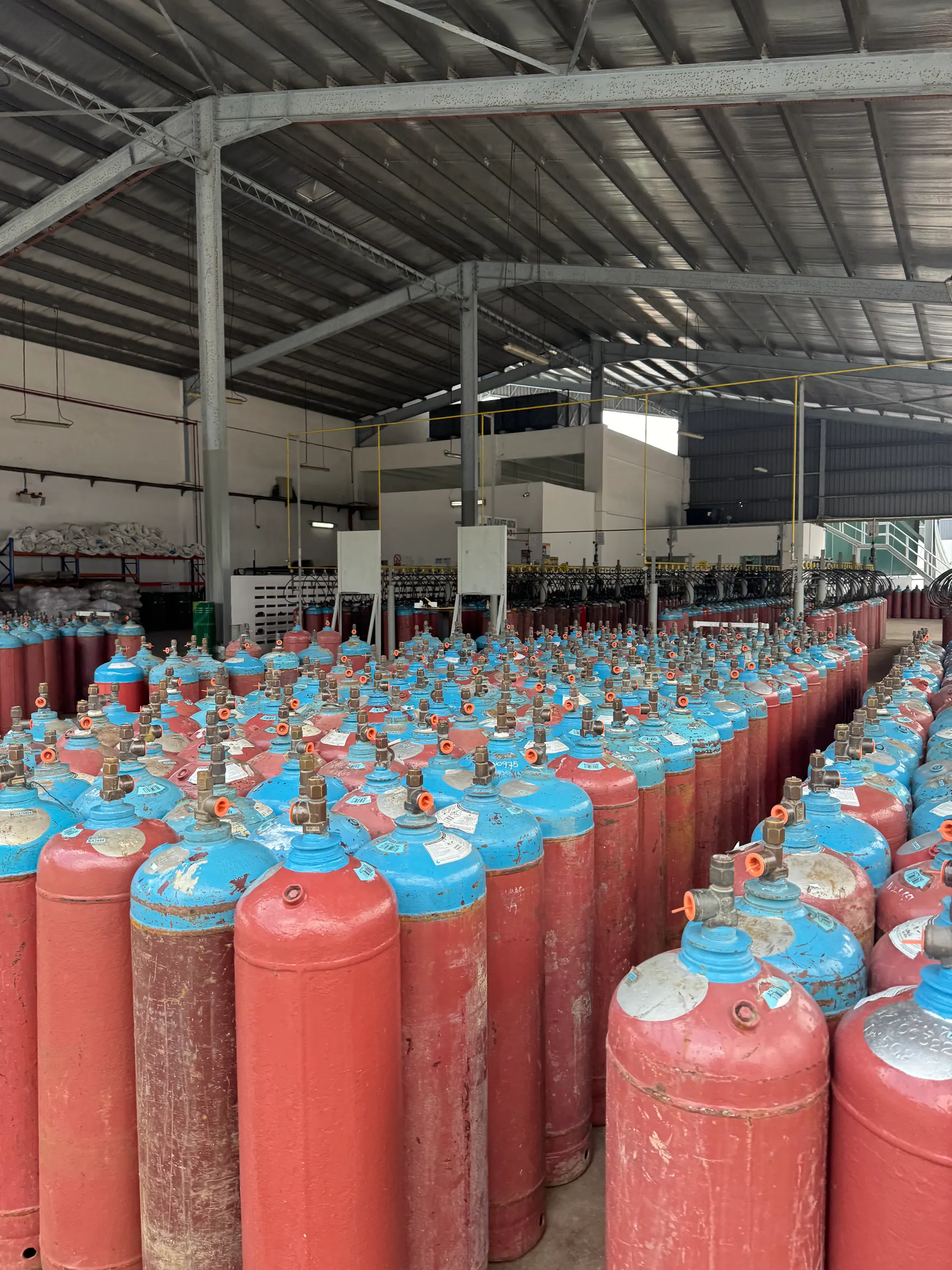
- Argon specification
- IS 5760
- Argon welding purity
- ≥99.99 % Ar
- Carbon dioxide specification
- IS 307
- Shielding gas classification
- EN ISO 14175
- Argon cylinder colour
- Peacock blue
Rules that matter
The most useful thing to understand about shielding gas is that it is not something the weld consumes, like wire. It is the atmosphere the weld is made in.
Whatever the gas carries with it ends up in the pool:
The gas is the atmosphere, not a consumable
- oxygen — oxide inclusions, dull and discoloured beads
- nitrogen — porosity, and lost toughness in the finished joint
- moisture — porosity again, and hydrogen exactly where it is least wanted
On carbon steel a slightly poor gas may pass unnoticed. On stainless and aluminium it shows immediately, in the colour of the bead and the behaviour of the arc. Welders usually spot a bad cylinder before any instrument does.
That is why cheap argon is rarely cheap. The saving is counted in rupees per cylinder and the cost in rejected welds.
What each gas does
| Pure argon | Carbon dioxide | |
|---|---|---|
| Arc stability | High | Lower |
| Transfer | Stable spray, clean bead | Harsher, more spatter |
| Penetration on steel | Shallow, narrow | Deep |
| Bead appearance | Clean | Requires cleaning |
| Cost | Higher | Lower |
| Right for | Aluminium, TIG, stainless | Thick steel where penetration rules |
Argon is monatomic and inert. It gives a smooth, predictable arc and a tidy bead, but on carbon steel the penetration profile is narrow and shallow, and the arc can wander at the weld toes.
Carbon dioxide dissociates at arc temperature. That cools the arc and coarsens droplet transfer, which is where the spatter comes from — but it also drives penetration deep. On thick material that is exactly what is wanted.
Which is why most steel runs on a mixture
Adding carbon dioxide to argon buys penetration without giving up all of argon's stability. Higher argon favours spray transfer, a stable arc and a clean bead; higher carbon dioxide favours penetration and costs less.
There is no single correct ratio, because the right answer depends on:
- Parent metal — carbon steel, stainless, aluminium
- Thickness — how much penetration the joint actually needs
- Transfer mode — dip or spray, which sets how much argon you need
Tell us those three and the gas can be specified against the work rather than picked off a price list. See gas mixtures.
The special cases
Aluminium is normally welded under pure argon. On thick section, helium is sometimes added to raise heat input, because helium carries more energy into the joint — at a price, and helium is scarce.
Stainless usually runs under argon-rich mixtures with a small addition. Too much carbon dioxide raises the carbon content of the weld metal, which is the opposite of what stainless is for.
TIG, on almost any metal, uses argon or argon–helium. There is no carbon dioxide in TIG shielding.
The hazard people forget
Argon, carbon dioxide and shielding mixtures are all heavier than air, non-toxic and completely odourless. They collect in pits, trenches, tank bottoms and any low confined space, and they displace air with no warning of any kind.
A welder working in a tank or a pit with gas flowing is in a slowly changing atmosphere they cannot detect. Ventilate at the low point, not the high one, and treat confined-space entry after welding as a procedure rather than a judgement call.
Full hazard data is in the argon safety data sheet.
Choosing — frequently asked questions
What does the shielding gas actually do?
It replaces the air around the arc and the molten pool. Oxygen, nitrogen and moisture from the atmosphere dissolve into liquid weld metal and reappear as porosity, oxide inclusions, lost toughness and discoloured beads. The gas is not a consumable that gets used up — it is the atmosphere the weld is made in.
Why is pure argon not used for steel MIG?
Because argon alone gives shallow, narrow penetration on carbon steel, and the arc tends to wander at the toes of the weld. Adding carbon dioxide or a little oxygen makes the arc column more conductive and the penetration profile far more useful. Pure argon is correct for aluminium and for TIG on most metals.
Why does CO2 spatter?
Because at arc temperature carbon dioxide dissociates, which cools the arc and makes droplet transfer coarser and less regular. You get deep penetration and a lot of spatter, with the cost of cleaning it off usually undoing the saving on the gas. It is still the right choice on thick material where penetration dominates.
What mixture should I use on mild steel?
That depends on thickness and transfer mode rather than on a single right answer. Higher argon content favours spray transfer, a stable arc and a clean bead; higher CO2 favours penetration and costs less. Tell us the parent metal, the thickness and whether you are running dip or spray, and the gas can be specified against the work.
Does shielding gas purity matter?
Yes, more than most buyers expect. In shielded-arc welding anything the gas carries ends up in the weld pool: oxygen gives oxide inclusions and dull beads, nitrogen gives porosity and lost toughness, moisture gives porosity and hydrogen where it is least wanted. On carbon steel a slightly poor gas may pass unnoticed. On stainless and aluminium it shows immediately.
Which gas for aluminium and for stainless?
Aluminium is normally welded under pure argon, sometimes with helium added to raise heat input on thick section. Stainless is usually welded under argon-rich mixtures with a small addition, since too much carbon dioxide raises the carbon content of the weld metal. Both are cases where gas quality shows in the finished bead.
Enquiries
Request a quotation
State the gas or equipment, the quantity or capacity, and your location. KIGL will confirm the grade, the cylinder or plant size, and whether the location can be served from Noonmati, or through our agent network.