
Guide
What is argon gas used for? TIG and MIG shielding stainless steelmaking, lighting, laboratory and more
Argon gas is used mainly as an inert shield: 99.99 % argon for TIG and MIG welding, argon stirring and argon-oxygen decarburisation in stainless steelmaking, filling for lamps and double glazing, and 99.999 % argon as carrier and plasma gas in GC and ICP instruments. It is 0.934 % of air.
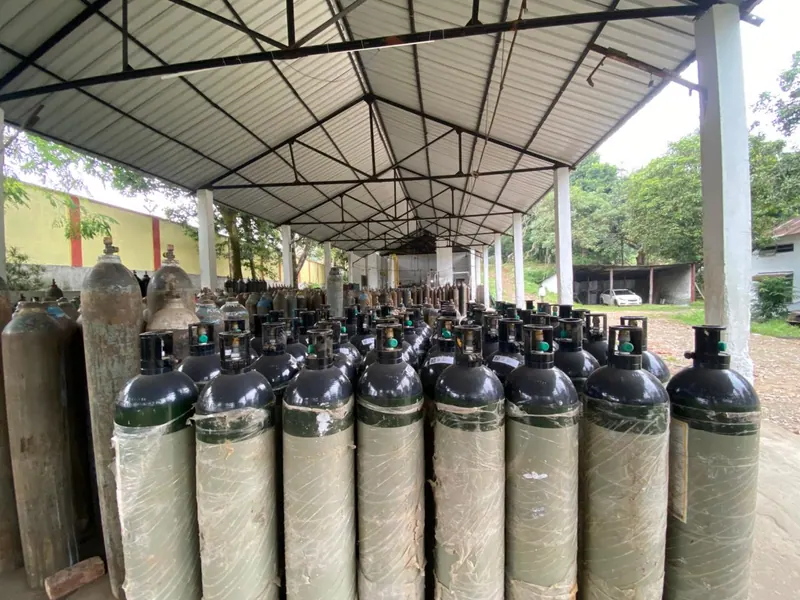
- Share of air
- 0.934 % by volume
- Density
- 1.784 kg/m³ at 0 °C and 1 atm; relative density 1.38 to air
- Welding-grade purity
- ISO 14175 Group I1 argon: minimum 99.99 % purity; instrument grades 99.999 %
- Ionisation energy
- 15.76 eV for argon against 24.59 eV for helium
- Indian standard
- IS 5760 Argon
Argon is the industrial inert gas. Nitrogen is cheaper and far more plentiful, but nitrogen reacts with molten metals, with titanium even in the solid state and with lithium and magnesium at modest temperatures. Argon, a noble gas with a full outer electron shell, reacts with nothing under any industrial condition. That is why it shields the arc in TIG and MIG welding, blankets molten steel and aluminium, fills lamps and glazing units, and carries samples through chromatographs. It makes up 0.934 % of the atmosphere, more than carbon dioxide, and every tonne comes out of a cryogenic air separation unit as a by-product of oxygen and nitrogen production.
Arc welding: the dominant use
Gas tungsten arc welding (TIG) and gas metal arc welding (MIG/MAG) account for most of the argon sold in cylinders in India. The shielding gas has three jobs: to keep oxygen and nitrogen in the air away from the molten pool and the hot electrode, to carry the arc, and to shape the bead. Argon does the first because it is inert, the second because its ionisation energy of 15.76 eV is low enough for the arc to strike and hold stably at low currents, and the third because at 1.38 times the density of air it stays over the pool rather than drifting away. Helium, with an ionisation energy of 24.59 eV and a density one tenth that of air, gives a hotter, broader arc but needs a higher open-circuit voltage and a higher flow rate, which is why helium is blended into argon for thick aluminium and copper rather than used alone.
| Process | Shielding gas | Typical purity | Why |
|---|---|---|---|
| TIG on carbon and stainless steel | Argon | 99.99 % | Stable arc, clean weld, no reaction with chromium |
| TIG on aluminium, magnesium | Argon, or argon + 25–75 % helium | 99.99 % | Argon's cathodic cleaning removes oxide; helium adds heat on thick sections |
| TIG on titanium, zirconium | Argon, with trailing and backing shields | 99.998 % or better | Oxygen above a few ppm embrittles and discolours the weld |
| MIG on carbon steel | Argon + 5–25 % CO₂, or argon + 1–5 % O₂ | 99.99 % argon base | Active addition stabilises the arc and wets the bead |
| MIG on stainless steel | Argon + 2 % O₂, or argon + 1–2 % CO₂ | 99.99 % argon base | Minimal oxidation of chromium |
| MIG on aluminium | Argon or argon-helium | 99.99 % | No active gas tolerated |
| Root purging of stainless and titanium pipe | Argon | 99.99 % | Prevents sugaring on the inside of the joint |
ISO 14175, the welding-gas classification standard, sets 99.99 % as the minimum purity for Group I1 argon and classifies the mixtures above as Group M (mixed, mildly active). The choice between them is covered on choosing a shielding gas, and the argon-based mixtures KIGL supplies are on the gas mixtures page. Note that under IS 4379:2021 Table 12 an argon-CO₂ mixture cylinder is peacock blue with a light Brunswick green band, and an argon-oxygen mixture is peacock blue with a graphite black band, so a mixed cylinder is distinguishable from pure argon at a glance.
Plasma cutting and plasma arc welding use argon, argon-hydrogen or argon-nitrogen as the plasma gas, and laser welding of reactive alloys commonly uses argon as the shield.
Steelmaking and foundry
The argon-oxygen decarburisation (AOD) process, introduced by Union Carbide in the late 1960s, is now the route for most of the world's stainless steel. Carbon is removed from a chromium-bearing melt by blowing oxygen, and the problem is that oxygen also burns chromium. Diluting the oxygen with argon lowers the partial pressure of the carbon monoxide produced, which shifts the equilibrium so that carbon oxidises preferentially and chromium stays in the metal. The argon fraction of the blow is raised as the carbon falls, so that very low carbon is reached with little chromium lost to the slag. Vacuum-oxygen decarburisation does the same job under reduced pressure with less argon.
Ordinary steelmaking uses argon too: bubbled through porous plugs in the ladle bottom to stir the bath, float inclusions and even out temperature and composition before casting; as a shroud around the pouring stream between ladle and tundish and between tundish and mould so that the stream does not pick up nitrogen and oxygen from the air; and as the carrier gas for powder injection in desulphurisation. Aluminium foundries bubble argon, or argon-chlorine, through the melt to strip dissolved hydrogen that would otherwise cause porosity in castings. Titanium and zirconium sponge are produced by the Kroll process under argon, and their ingots are melted by vacuum arc or plasma under argon because both metals burn in nitrogen.
Heat treatment, lighting and glazing
Bright annealing of stainless strip and wire, sintering of powder-metal parts and brazing in continuous furnaces all need an atmosphere that neither oxidises nor carburises the work. Nitrogen-hydrogen mixtures do most of this job cheaply, but where even trace nitriding is a problem, as with titanium, some stainless grades and certain magnetic alloys, argon or argon-hydrogen is the atmosphere.
Incandescent lamps are filled with argon, or argon-nitrogen, at slightly below atmospheric pressure: the gas slows tungsten evaporation from the filament, which lets the filament run hotter and brighter for the same life. Fluorescent tubes use argon with mercury vapour as the starting gas; "neon" signs that glow blue or lavender are argon-filled; and argon-ion lasers emit the blue-green lines used in medicine and in older lithography.
Sealed insulating glass units are filled with argon because its thermal conductivity, about 0.018 W/m·K at room temperature against about 0.026 for air, cuts conductive heat loss across the cavity by roughly a third. Krypton is better still but costs far more. The purity needed here is modest; the fill must simply be dry and leak-free.
Laboratory and analytical argon
Inductively coupled plasma spectrometers (ICP-OES and ICP-MS) run a plasma torch on argon, consuming 15 to 20 litres per minute while operating, and gas chromatographs use argon or argon-methane as carrier gas for electron-capture detectors. Glove boxes for air-sensitive chemistry, battery electrode fabrication and semiconductor handling are kept under argon at a few parts per million of oxygen and water. These uses specify 99.999 % (grade 5.0) or 99.9995 % argon, with oxygen, moisture and hydrocarbons each below 1 to 2 ppm, and they are the reason a supplier carries a high-purity grade alongside welding grade. KIGL argon is offered in both; the properties, impurity limits and cylinder pressures are on the argon technical data page.
Rules that matter
Other uses worth knowing
- Fire suppression: IG-01 is pure argon and IG-55 is 50/50 argon-nitrogen, used to flood electrical and archive rooms where water or chemical agents would do more damage than the fire.
- Wine and food: argon blankets opened wine, edible oils and pharmaceutical liquids against oxidation, and is a permitted packaging gas.
- Additive manufacturing: laser powder-bed fusion of titanium, aluminium and nickel alloys runs in an argon-filled chamber at a few hundred ppm oxygen.
- Semiconductors: argon is the sputtering gas for depositing metal films and the ambient for crystal growth of silicon.
- Diving and medicine: argon is used as a dry-suit inflation gas for its insulation and, in cryosurgery, as the expanding gas in Joule-Thomson probes.
- Electrical: argon-filled Geiger-Müller tubes, thyratrons and high-voltage switchgear.
Safety: the one thing argon does
Argon is non-toxic and non-flammable, and it has no smell, colour or taste. Its hazard is displacement of oxygen, and its density makes that worse than for nitrogen: a leak or a purge vent fills pits, trenches, the bottom of tanks and the inside of a vessel being welded from the floor upwards, and a welder bending into a purged pipe or leaning into a tank can lose consciousness in seconds with no sensation of breathlessness beforehand. The controls are the same as for any inert gas and are set out on argon safety data explained and inert gas confined space entry: oxygen monitoring, forced ventilation of welding bays, purge gas vented outside, and no entry into a purged space without a permit and a gas test. The argon safety data sheet carries the transport and first-aid detail.
Standards and what KIGL publishes
The Indian specification is IS 5760, Argon, compressed and liquid. The 1998 second revision (reaffirmed February 2021, one amendment) and a 2026 third revision are both listed by the Bureau of Indian Standards, but KIGL has not reviewed the text of either edition, so KIGL publishes its two argon grades as its own specifications rather than claiming an IS grade it cannot check. The cylinder colour, peacock blue shade 103, comes from IS 4379:2021 Table 7, and the UN number for compressed argon is 1006 (refrigerated liquid argon is UN 1951). The Indian position on argon standards is set out on argon standards.
What is argon gas used — frequently asked questions
Why is argon used for TIG welding instead of nitrogen or CO₂?
Because it is genuinely inert. Nitrogen reacts with molten steel, titanium and aluminium to form nitrides; CO₂ dissociates in the arc and oxidises the weld pool. Argon does neither, and its low ionisation energy of 15.76 eV lets the arc strike easily and run stably at low current, which matters for thin sheet and root passes. Its high density also keeps the shield in place over the pool.
What purity of argon do I need for welding?
99.99 % (grade 4.0) with moisture and oxygen in the low parts-per-million range is the working standard; ISO 14175 sets 99.99 % as the minimum for Group I1 argon. Titanium, zirconium and some nickel alloys are specified at 99.998 % or better because their welds discolour and embrittle from oxygen that steel tolerates without visible effect.
What is the difference between argon and argon-CO₂ mixtures for MIG?
Pure argon on steel gives an unstable arc and a high, narrow bead. Adding 5 to 25 % CO₂ or 1 to 5 % oxygen makes the arc smoother, wets the bead and gives better penetration on carbon steel; 75/25 argon-CO₂ is the common Indian shop mixture. Aluminium, copper and stainless are still welded with pure argon or argon-helium. Mixtures carry their own cylinder band under IS 4379:2021 Table 12.
How is argon used in making stainless steel?
In the argon-oxygen decarburisation (AOD) converter. Blowing a mixture of argon and oxygen through the melt lowers the partial pressure of carbon monoxide, so carbon can be removed to very low levels without oxidising the chromium that makes the steel stainless. Argon is also bubbled through ladles to stir and homogenise ordinary steel, and used as a shroud to keep air off the stream during continuous casting.
Why is argon used in light bulbs and double glazing?
In incandescent lamps an argon fill slows evaporation of the tungsten filament and suppresses arcing, extending life compared with a vacuum. In sealed double-glazed units argon's thermal conductivity, about 0.018 W/m·K against 0.026 for air, cuts heat conduction across the cavity by roughly a third. Both uses need only ordinary purity but good dryness.
Is argon dangerous?
Argon is non-toxic and non-flammable, but it is a simple asphyxiant 1.38 times denser than air. A leak or a purge discharge collects at floor level in pits, tanks and vessels being welded, and it gives no warning: there is no smell and no sensation of breathlessness before collapse. Oxygen monitoring and forced ventilation in welding bays and confined spaces are the controls.
How much argon is in a cylinder?
A 46.7 litre water-capacity cylinder at 150 bar holds about 7.0 m³ on an ideal-gas basis at 15 °C; argon's compressibility at that pressure adds a few per cent to the real content. The same cylinder at 200 bar holds about 9.3 m³. Bulk users take liquid argon in vacuum-insulated tanks and vaporise it on site.
References
- Bureau of Indian Standards. (2021). cylinder colours (IS 4379:2021, Second Revision).
- EIGA — inert gas and asphyxiation safety documents
- International Organization for Standardization. (2008). Welding consumables — Gases and gas mixtures for fusion welding and allied processes (ISO 14175:2008).
- IS 5760 Argon, compressed and liquid — Specification
- Linstrom, P. J., & Mallard, W. G. (Eds.). (n.d.). NIST Chemistry WebBook (NIST Standard Reference Database 69). National Institute of Standards and Technology. [argon thermophysical properties] https://webbook.nist.gov/cgi/cbook.cgi?ID=C7440371
Enquiries
Request a quotation
State the gas or equipment, the quantity or capacity, and your location. KIGL will confirm the grade, the cylinder or plant size, and whether the location can be served from Noonmati, or through the agent network.