
Guide
Is acetylene lighter than air? What a specific gravity of 0.906 means for ventilation and leak detection
Acetylene is slightly lighter than air: 1.08959 g/l at 20 °C and 1 atm against about 1.204 g/l for air, a specific gravity of about 0.905 (0.906 at 15 °C in IS 14814). A leak neither reliably rises nor sinks, so acetylene rooms need vents and detectors at both floor and ceiling.
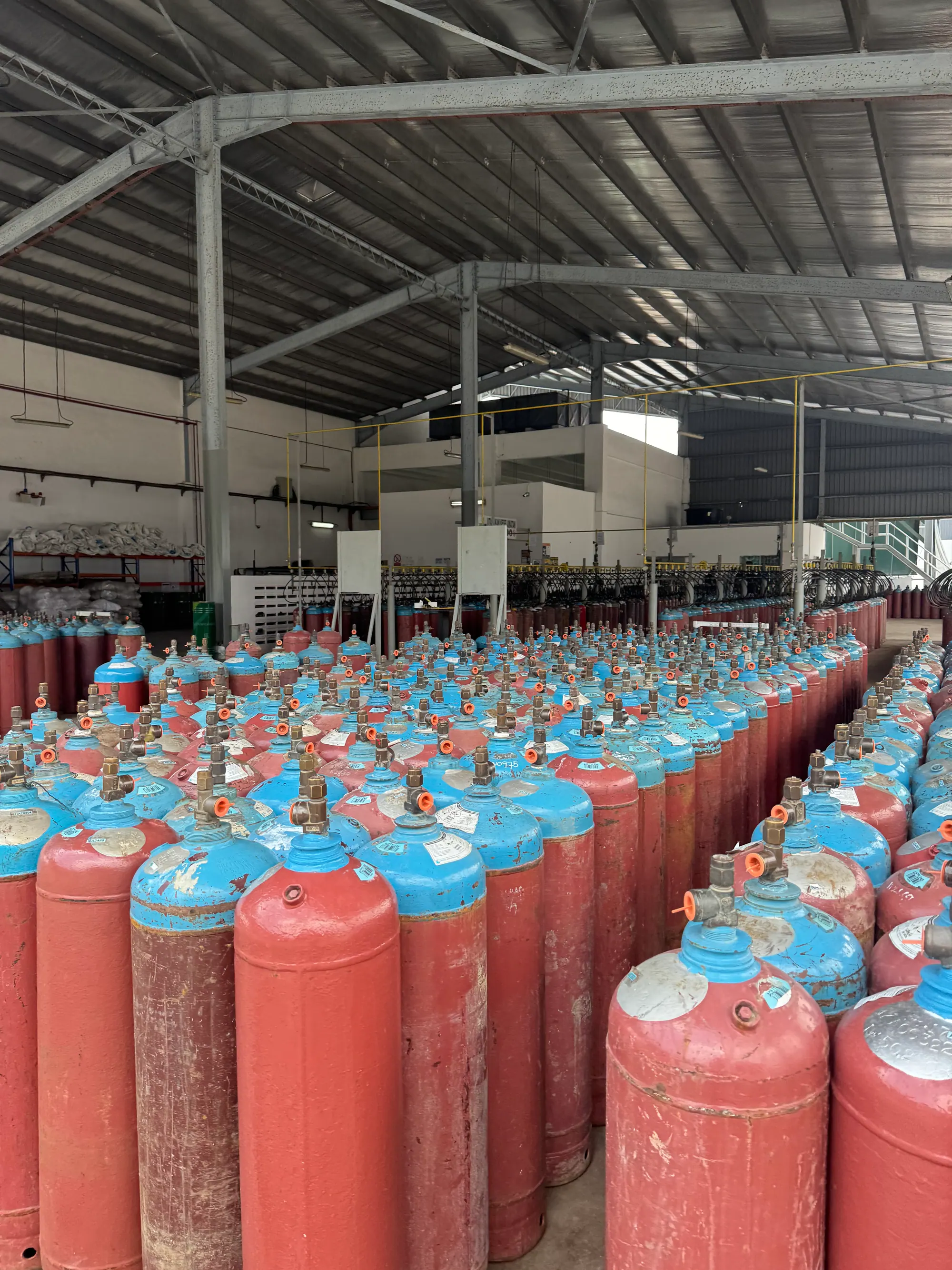
- Density of acetylene
- 1.17167 g/l at 0 °C; 1.08959 g/l at 20 °C; 1.01858 g/l at 40 °C
- Specific gravity (air = 1)
- 0.906 real gas; the ideal-gas molar-mass ratio 26.038/28.966 would give 0.899
- IS 14814 wording
- vapour density 0.91
- Ventilation rule
- non-closing ventilation openings at floor level and in the ceiling where mechanical ventilation is not used
- Lower explosive limit
- 2.5 % v/v in air
Acetylene is lighter than air, but only just. At 20 °C and 1 atm it weighs 1.08959 g/l against about 1.204 g/l for dry air, a specific gravity of about 0.905 (0.906 at 15 °C in IS 14814). That 9 % margin is the whole answer to the question, and the practical consequence is the opposite of what the bare word "lighter" suggests: a gas this close to neutral buoyancy does not go anywhere in particular, so an acetylene room has to be ventilated as if the gas could be at any height.
This page sets out the measured densities, the three ways the specific gravity gets quoted, and what the near-neutral figure means for ventilation, detector placement and leak behaviour in a plant, a store or a workshop.
Rules that matter
The reference densities are those of Bottomley, Reeves and Seitlow (published in Nature and J. Appl. Chem.), the series S. A. Miller adopted in 1965 after discarding the older and discordant determinations. Air is the standard dry-air value.
| Temperature | Acetylene at 1 atm, g/l | Dry air at 1 atm, g/l | Ratio |
|---|---|---|---|
| 0 °C | 1.17167 | 1.2929 | 0.906 |
| 15 °C | 1.10898 | 1.2256 | 0.906 (IS 14814:2023 cl 4.3.9) |
| 20 °C | 1.08959 | 1.2041 | 0.905 |
| 30 °C | 1.05284 | 1.1644 | 0.904 |
| 40 °C | 1.01858 | 1.1272 | 0.904 |
The ratio hardly moves with temperature because both gases expand at almost the same rate; the mean coefficient of thermal expansion of acetylene at 1 atm over 0–40 °C is 0.003758 per °C.
Three versions of the specific gravity circulate, and it helps to know which is which:
What the measurements say
- 0.899 is the ideal-gas value, the molar-mass ratio 26.038 ÷ 28.966. It is what you get from a periodic table.
- 0.906 is the real-gas value from the measured densities. Acetylene is 0.85 % denser than an ideal gas at NTP (molar volume 22.223 litres against 22.413), which lifts the ratio. IS 14814:2023 cl 4.3.9 prints 0.906 at 15 °C and 1 atm.
- 0.91 is IS 14814:2023 cl 4.3.8's rounded vapour density, with the comment "slightly lighter than air".
KIGL's older literature carried 0.908 and 0.91; the figure to use is 0.906, and the full property set is on the acetylene technical data sheet.
How acetylene compares with other fuel gases
On molar mass alone (ideal-gas ratios, molecular weights from the NIST WebBook) the common fuel and shielding gases fall into three clear groups, and acetylene sits awkwardly between two of them.
| Gas | Molecular weight | Relative density (air = 1) | Behaviour of a leak |
|---|---|---|---|
| Hydrogen | 2.016 | 0.07 | Rises fast; vents and detectors high |
| Methane (natural gas) | 16.04 | 0.55 | Rises; detectors high |
| Acetylene | 26.038 | 0.899 (ideal); 0.906 as a real gas | Near neutral; mixes; vents and detectors high and low |
| Nitrogen | 28.01 | 0.97 | Neutral |
| Propane | 44.10 | 1.52 | Sinks; collects in pits and drains |
| Butane | 58.12 | 2.01 | Sinks |
| Acetone vapour | 58.08 | 2.0 | Sinks — relevant to near-empty cylinders |
Hydrogen and acetylene share the lowest minimum ignition energy of any common combustible (about 2 × 10⁻⁵ J, Fenn, Ind. Eng. Chem. 1951) and the same explosion group (IIC), but their buoyancy is a factor of thirteen apart. A ventilation scheme copied from a hydrogen installation, with high-level vents only, is wrong for acetylene; so is one copied from an LPG store.
Rules that matter
A gas with a relative density of 0.07 has a buoyancy force per unit volume of 93 % of its displaced air weight; it rises in a coherent plume and a high vent takes it away. A gas at 1.5 sinks and pools. A gas at 0.906 has a buoyancy force of only about 9 % of the displaced air weight, which is comparable to the density difference produced by a few degrees of temperature or by the momentum of a jet from a small leak. In practice:
Why near-neutral buoyancy is harder to design for than either extreme
- A leak from a flange or valve stem is a jet; it travels in the direction of the leak and mixes with the room air long before buoyancy sorts it out.
- Warm gas is lighter. Gas leaving a carbide-to-water generator is at 60–70 °C and saturated with water vapour, and it will rise until it cools.
- Cold gas is heavier. A cylinder drawn hard self-refrigerates (dissolving acetylene in acetone releases 684–757 kJ per kg, and withdrawing it absorbs the same), and gas issuing at 0 °C has a density of 1.17 g/l, close to that of room air at 20 °C.
- Gas from a nearly empty cylinder is not pure acetylene. From the partial-pressure data of Hölemann and Hasselmann, at 20 °C and 1 atm about 23 % of the gas leaving the valve is acetone vapour (molecular weight 58). A simple molar average gives a mixture of molecular weight 33, denser than air. This is KIGL's arithmetic rather than a published figure, but the direction is unambiguous: a cylinder leaking at low residual pressure, or a cylinder being blown down, can lay a heavier-than-air layer along the floor.
The C.P.I. handbook made the same point in the language of 1968 by requiring openings at both levels, and IS 14814:2023 requires good ventilation to remove any explosive mixture as rapidly as possible. Neither assumes the gas will find the vent by itself.
Rules that matter
For dissolved acetylene plant buildings the C.P.I. (Paris, 1968, Ch. V) sets out numbered rules that are still the basis of good practice, and their logic is the buoyancy figure above:
The ventilation rules that follow
- Premises must be well ventilated, by mechanical means if necessary. Where mechanical ventilation is not used, there must be non-closing ventilation openings both at floor level and in the ceiling.
- Doors should open outwards and be of light construction so that fresh air can enter at the lower part.
- Buildings in which acetylene is compressed must have a single floor; a light roof is desirable.
- Generator rooms must be ventilated very thoroughly so that acetylene that may be liberated does not accumulate, and isolated from workshops and offices.
- Relief and over-production pipes must discharge outside the building, in the open air, at a place involving no risk, and must be arranged so that they cannot choke.
The Indian overlay is in IS 14814:2023 and the Gas Cylinders Rules 2016: flameproof electrical fittings to IS/IEC 60079-1 in filling and storage premises, no storage of acetylene and oxygen cylinders together, and ventilation to remove any explosive mixture rapidly. Site layout and the PESO separation distances are covered in plant layout and safety distances, and cylinder store rules in storage rules for acetylene cylinders in India.
Rules that matter
Because the gas can be anywhere, the question is not "high or low" but "where will it be first". A workable layout for an acetylene area:
Detector placement
- One sensor at high level near the most likely leak source (compressor, filling rack, generator top) for warm or momentum-driven releases.
- One sensor at breathing-zone height on the downwind side of the room, which is where mixed gas accumulates and also where people are.
- A low-level sensor near cylinder storage, blow-down points and any pit or trench, for acetone-laden or cold gas.
Infra-red detection at the 13.7 µm band (the ν₅ bending vibration) reads acetylene below 0.003 % v/v, about 30 ppm (an Anal. Chem. 1956 study compiled by S. A. Miller, 1965); the 3 µm band needs 0.03–0.1 %. Catalytic sensors work but must be rated for a Group IIC gas. Whatever the sensor, calibrate it on acetylene in air rather than in nitrogen or carbon dioxide: pressure broadening by 1 atm of air raises the infra-red absorbance of the 7.4 µm band by 310–440 %, and broadening by CO₂ raises it by 410–500 %, so an analyser set up in the wrong background gas reads badly wrong. Practical leak-finding is covered in acetylene leak detection.
The smell test, and its limits
The C.P.I. (1968) records that anyone with a normal sense of smell can detect acetylene in mixtures more dilute than the lower flammability limit, which it gave as 2.3 %; IS 14814:2023 gives the LEL as 2.5 % v/v and attributes commercial acetylene's garlic odour to its impurities. So a smell is a warning that arrives before an explosive atmosphere does. Two cautions keep that fact from being misused. Smell fatigues within minutes and gives no number. And the physiological thresholds in IS 14814:2023 (slight intoxication at 10 %, unconsciousness in 7 minutes at 33 %) begin well above the 2.5 % lower explosive limit, so in a leak the explosion hazard governs first; in an unventilated space the gas is also a simple asphyxiant with a TLV of 2,500 ppm and no antidote. Health data are on the acetylene SDS.
Rules that matter
Rules to apply
- Treat acetylene as neutrally buoyant for design purposes: ventilate and detect at both floor and ceiling level.
- Never assume a leak has risen out of harm's way; the jet, the temperature and the acetone content decide where it goes.
- Expect heavier-than-air gas near low-pressure cylinders, blow-down points and sludge pits.
- Keep the real-gas specific gravity, 0.906, on datasheets and SDSs, with its temperature.
- Pair the number with the IS 14814:2023 ventilation and flameproof requirements, which are what an inspector will check, and with KIGL's dissolved acetylene product pages for cylinder-specific guidance.
Is acetylene lighter than air? What — frequently asked questions
Does acetylene rise or sink when it leaks?
Mostly it mixes. With a specific gravity of 0.906 the buoyancy force on a leaking plume is less than a tenth of that on hydrogen (0.07) and far less than the sinking tendency of LPG (about 1.5). Draughts, temperature differences and the momentum of the leak dominate, so acetylene can be found at any height in a room. Design for both.
Why do acetylene plants have vents at floor level and in the ceiling?
Because the gas is near-neutrally buoyant. The C.P.I. handbook of 1968 requires non-closing ventilation openings both at floor level and in the ceiling of dissolved acetylene plant buildings where mechanical ventilation is not fitted, and doors of light construction that let fresh air enter at the bottom. IS 14814:2023 requires good ventilation to remove any explosive mixture as rapidly as possible.
Where should an acetylene gas detector be mounted?
Not only high up, as for hydrogen, and not only low down, as for LPG. Because acetylene's density is within 10 % of air, a sensible layout covers both the ceiling and the breathing zone, with the high sensor close to the likely leak source. Infra-red detection at the 13.7 µm band reads below 30 ppm (an Anal. Chem. 1956 study, as compiled by S. A. Miller).
Is the gas coming out of an almost-empty acetylene cylinder lighter than air?
Often not. At 20 °C and 1 atm about 23 % of the gas leaving the valve is acetone vapour, from the partial-pressure data of Hölemann and Hasselmann. Acetone has a molecular weight of 58, so that mixture averages about 33 and is denser than air. Leaks from nearly empty cylinders can therefore collect low down.
Is acetylene heavier than natural gas or hydrogen?
Yes. On molar mass alone methane is 0.55 and hydrogen 0.07 relative to air, against acetylene's 0.906. Propane and butane are 1.5 and 2.0 and sink. Acetylene is the one common fuel gas that sits almost exactly at the density of air, which is why its venting rules borrow from both camps.
Can I smell acetylene before it reaches an explosive concentration?
Usually. The C.P.I. (1968) states that anyone with a normal sense of smell detects the stench of acetylene in mixtures more dilute than 2.3 %, the lower flammability limit it used; IS 14814:2023 notes the garlic odour from impurities. Smell is a warning, not a measurement, and the 10 % level at which IS 14814 records the first intoxicating effect is reached long after the LEL.
Does temperature change whether acetylene floats?
Yes, through the density of both gases. Warm, steam-saturated gas leaving a generator at 60–70 °C is appreciably lighter than room air and rises; cold gas drawn fast from a self-refrigerating cylinder is denser. The mean thermal expansion coefficient of acetylene at 1 atm over 0–40 °C is 0.003758 per °C, close to that of air.
References
- Bureau of Indian Standards. (2023). Acetylene — Code of Safety (IS 14814:2023, First Revision).
- C.P.I. (1968). Safety in the production and use of acetylene. Paris. [successor bodies: EIGA, IIW]
- Linstrom, P. J., & Mallard, W. G. (Eds.). (n.d.). NIST Chemistry WebBook (NIST Standard Reference Database 69). National Institute of Standards and Technology. [molar masses and gas-phase data] https://webbook.nist.gov/chemistry/
- Petroleum and Explosives Safety Organisation. (n.d.). Gas Cylinders Rules 2016. Government of India.
Enquiries
Request a quotation
State the gas or equipment, the quantity or capacity, and your location. KIGL will confirm the grade, the cylinder or plant size, and whether the location can be served from Noonmati, or through the agent network.