
Guide
Helium: why it is scarce where it cannot be replaced, and how to waste less
Helium is the second lightest element, chemically inert, and liquefies at 4 K — properties nothing else combines. India imports essentially all of it, so price and availability move with global supply. Knowing which of your uses genuinely need helium, and which do not, is the only real cost control.
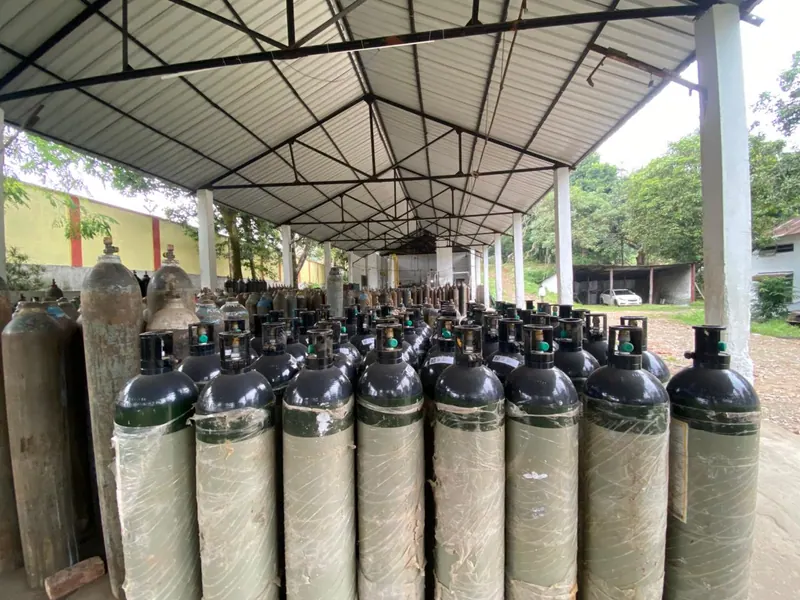
- Boiling point
- About 4 K
- Chemical behaviour
- Inert
- Indian supply
- Essentially all imported
- Cylinder colour
- Middle brown
- Principal hazard
- Asphyxiation
Helium is not like the other gases on your rack
Nitrogen is 78 % of the air. Oxygen is 21 %. Argon is 0.93 % and can be distilled out of the atmosphere indefinitely.
Helium cannot. It is produced from a small number of natural gas fields, India imports essentially all of it, and — uniquely among the gases you buy — once released it escapes the atmosphere altogether. It does not come back. That is why the price behaves the way it does, and why availability sometimes has nothing to do with your supplier.
What only helium can do
Cryogenics below 20 K
Helium liquefies at about 4 K (−269 °C), the lowest of any element, and it is the only route to the temperatures superconducting magnets need. MRI scanners, NMR instruments and superconducting research run on liquid helium because there is no alternative at any price.
Leak detection
A helium atom is very small, moves quickly, and is present in ordinary air at a negligible concentration. That combination makes helium mass-spectrometer leak testing far more sensitive than anything using another gas — you can distinguish your tracer from the background almost perfectly.
Lifting where flammability is unacceptable
Hydrogen lifts better and burns; helium does not burn.
In these three roles, nothing substitutes.
What does not actually need helium
This is where the money is.
Much welding
Helium carries more energy into the joint than argon, giving a hotter and broader arc, which genuinely helps on thick aluminium and copper. But a great deal of helium is used in welding out of habit rather than necessity. Argon, or an argon-rich mixture, does the job at a fraction of the cost on most work — see choosing a shielding gas.
Most purging and pressure testing
Nitrogen is the standard choice and costs a small fraction as much. Helium is warranted only where you are also leak-testing.
Blanketing
Nitrogen again, almost always.
If helium is being used somewhere because that is how the procedure has always read, that procedure is worth re-reading.
Using less of what you do need
- Fix leaks. Helium finds every one, which is exactly why it is used as a tracer. A system that leaks helium is losing the most expensive gas on site through the smallest holes.
- Set flow to the job, not to the top of the gauge. Over-flowing a shielding gas does not improve the weld; on helium it simply costs more.
- Shut it off between operations. On most sites the single largest saving is gas flowing while nothing is being made.
- Consider recovery where volume justifies it, particularly in laboratory and cryogenic use.
- Review the application list annually. Helium creeps into procedures and rarely leaves them.
The hazard
Helium is non-toxic and non-flammable, and that is precisely the problem. It displaces air with no smell, taste, colour or warning.
Unlike argon and carbon dioxide, which pool low, helium rises — so ventilation and detection belong at the highest point of the space, and trapped pockets form in roof voids and the tops of enclosures rather than in pits.
Full hazard data is in the helium safety data sheet.
Helium — frequently asked questions
Why is helium so expensive?
Because it is genuinely finite in a way most industrial gases are not. Helium is produced from a small number of natural gas fields, India imports essentially all of it, and once released it leaves the atmosphere altogether rather than being recoverable. Price and availability therefore move with global supply rather than with local demand.
Where can helium not be replaced?
Cryogenics below the temperature any other coolant can reach — MRI magnets and superconducting work — and leak detection, where its small atom and low background concentration make it uniquely sensitive. In those roles nothing substitutes for it at any price.
Where can helium be replaced?
More often than people assume. Argon does much of what helium does in welding at a fraction of the cost, though with lower heat input. Nitrogen replaces helium in many purging, pressure-testing and blanketing duties. If helium is being used because that is how it has always been done, it is worth re-examining.
Why is helium used in welding at all?
Because it carries more energy into the joint than argon, giving a hotter, broader arc. That matters on thick aluminium and copper, where argon alone struggles to get enough heat in. It is usually blended with argon rather than used pure, precisely because of cost.
Is helium dangerous?
It is non-toxic and non-flammable, which is what makes it dangerous in an enclosed space. It displaces air with no smell, taste or warning. Because it rises, it collects at ceiling level, so ventilation and detection should be high rather than low — the opposite of argon or carbon dioxide.
How can we use less?
Fix leaks first, because helium's small atom finds every one. Then check flow rates are set to what the job needs rather than to the top of the gauge, shut down flow between operations, and consider recovery where volumes justify it. Most sites find their largest saving is simply turning it off when nothing is being made.
Enquiries
Request a quotation
State the gas or equipment, the quantity or capacity, and your location. KIGL will confirm the grade, the cylinder or plant size, and whether the location can be served from Noonmati, or through our agent network.