
Guide
Writing an emergency response plan for an acetylene plant: stop the gas vent the high-pressure side, deal with hot cylinders, and inspect before restart
An acetylene plant emergency plan starts by stopping the compressors and generators to cut gas to the high-pressure system, venting it through quick-opening valves near the exits, and cooling exposed cylinders with water from a distance. EIGA Doc 123 sizes deluge at 10 l/m² per minute with 12 hours' supply for a hot-cylinder incident.
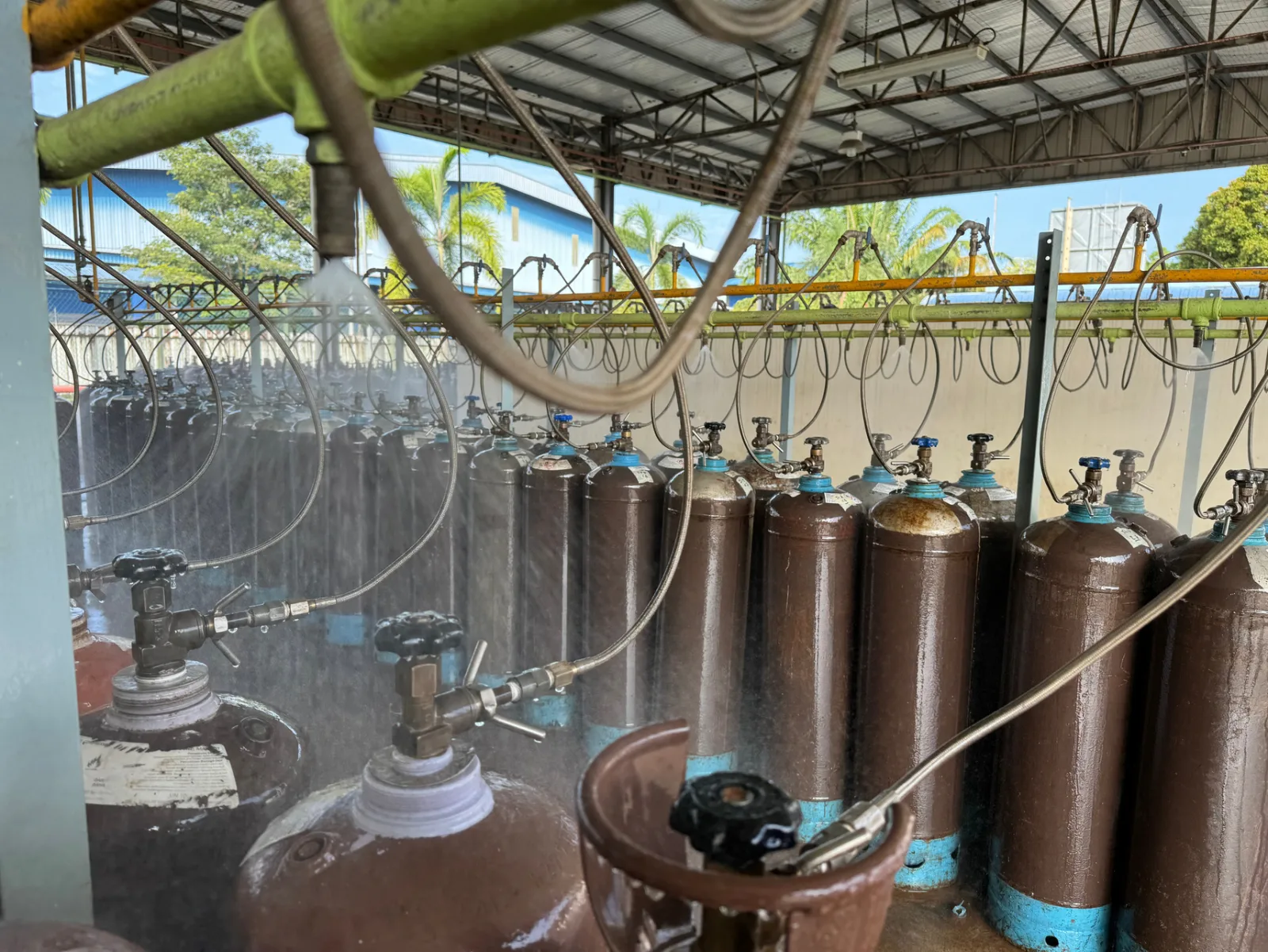
- First action
- Stop the compressors and generators as soon as possible to halt the supply of acetylene to the high-pressure system
- Depressurisation
- Quick-opening discharge valves
- Deluge
- 10 l/m² per minute; 90 minutes' supply normally and 12 hours for a hot-cylinder incident; tested every 3 months
- Hot cylinder — Dutch rule
- Shut the valve
- Extinguishers
- Dry chemical powder at strategic locations; CO₂ extinguishers not used on flammable-gas fires because of static
An acetylene plant holds a gas that can burn without air, compressed to more than twenty atmospheres on its filling side, beside a store of calcium carbide that makes more gas when wet. Its emergency plan cannot be a generic fire plan. It has to say, in order, how the supply of acetylene is stopped, how the high-pressure system is emptied, what is done with a cylinder that is heating, which extinguishing media go where, and what must happen before the plant runs again. This page sets out those elements from the codes that define them — the C.P.I. code of 1968, EIGA Doc 123, NFPA 51A, IS 14814 and the Gas Cylinders Rules 2016 — and from the engineering lessons of incidents KIGL has investigated.
The principle: stop the gas, then fight the fire
NFPA 51A-1984, the US charging-plant standard (international practice, not Indian law), opens its fire chapter with the doctrine in one paragraph: the major fire hazard is acetylene escaping from equipment, piping or cylinder fittings; it may or may not ignite; in either case every attempt consistent with personnel safety is made to shut off or remove the source; fire is not normally extinguished in any other way; and cylinders exposed to fire are kept cool with water so that their safety devices do not release more gas. An acetylene flame put out while gas still escapes leaves an expanding cloud with a 2.5 percent lower explosive limit (IS 14814:2023) and an ignition energy of about 0.02 mJ (EIGA Doc 123). The plan is built round that sequence.
Rules that matter
The C.P.I. code Safety in the Production and Use of Acetylene (Paris, 1968) required staff in the high-pressure part of a plant to be trained to know exactly what to do on a leak, an explosion or a fire, and singled out one action: stop the compressors and generators as soon as possible to halt the supply of acetylene to the high-pressure system. Every other step depends on it. In practice that means:
Step 1 — stop the compressors and generators
- an emergency stop for all compressors, generators and feed motors, reachable from the exits and from outside the building — NFPA 51A requires a readily accessible emergency electrical shutdown switch;
- carbide feed stopped and hoppers isolated;
- the generator held at positive pressure and not allowed to draw a vacuum, which would pull air in; the standing rule should be that on any abnormal pressure, temperature or smell of gas the plant is shut down and purged with nitrogen before the cause is investigated.
Step 2 — depressurise the high-pressure system
The same code required means to lower the pressure in the high-pressure circuit rapidly when needed, and recommended quick-opening discharge valves installed at several places, preferably near the exit doors of the halls, with outlet pipes ending in the open air where the gas cannot form an explosive mixture or cause damage if it ignites, and where the outlet cannot be obstructed, especially by ice. The siting near the exits is the point: the operator opens the vent on the way out. Filling-manifold cylinder valves are closed last at the end of charging and first in an emergency only where it is safe to reach them; NFPA 51A notes that cylinder valves are opened first and closed last in normal charging. The physics of why emptying the system matters is on the acetylene decomposition page.
Step 3 — alarm, evacuation and outside help
The C.P.I. code required devices to warn the works staff of fire and standing orders for calling the fire brigade and other public services; it also required staff to know what to do "in the course of the first few minutes preceding the arrival of aid from outside". The plan should name the alarm, the assembly point upwind and outside the 15 m plant boundary, the person who calls the fire service and what they tell it — that the site holds dissolved acetylene cylinders and calcium carbide, and that water must not be used on the carbide store. A written emergency procedure and periodic fire drills are required by NFPA 51A, and EIGA Doc 123 asks for a drill at least annually.
Step 4 — fire services and extinguishing media
| Area | Medium | Not to be used | Source |
|---|---|---|---|
| Filling, compressor, manifold areas | Deluge or water spray; hose with spray and jet nozzles; dry chemical powder | CO₂ extinguishers on gas fires (static) | GCR 2016 Form E Part B; NFPA 51A ch 9 |
| Cylinder storage | Water spray to cool; dry powder | — | IS 14814:2023 cl 9.2 |
| Carbide store and generator hopper | Dry powder, dry sand | Water, water spray, soda-acid, pressurised-water extinguishers | IS 14814:2023 cl 9.2 |
| Electrical panels | CO₂ or dry powder | Water jet | general practice |
EIGA Doc 123 clause 7.3 sizes the deluge at 10 l/m² per minute, with 90 minutes' supply normally and 12 hours for a hot-cylinder incident, and requires a test every three months. Hydrants go outside the buildings with adequate pressure and delivery (C.P.I. 1968); hose stations and deluge valves are placed so they can be worked from outdoors or at an exit (NFPA 51A). Form E requires dry chemical powder extinguishers at strategic locations and states that carbon dioxide extinguishers are not to be used on flammable-gas fires because they generate static; IS 14814 clause 9.2 allows CO₂ on an acetylene flame. The safe reading is dry powder for gas fires and CO₂ for electrical equipment. Carbon tetrachloride is never used; it forms phosgene in a flame.
Step 5 — the hot cylinder
A DA cylinder that has been in a fire, has had a flashback into it, or has a top that feels warm may have decomposition running inside it. The published advice divides on the valve, and the plan must choose; all sources agree on sustained water cooling, which the Indian filling-licence conditions require.
| Source | Procedure |
|---|---|
| Dutch Factory Inspector, Instruction Leaflet on Dissolved Acetylene, 1950 | Shut the valve tight; take the cylinder into the open; immerse or spray with water from a distance for four to five hours; if this cannot be done, evacuate |
| British Oxygen Company, as compiled by S. A. Miller (1965) | With the valve closed, take the cylinder into the open; remove the regulator; open the valve fully for the fastest possible venting; cool with water if feasible |
| Gas Cylinders Rules 2016, Form E Part B item 9 (Indian licence condition) | Spray of cooling water over a hot cylinder is continued for a sustained period until the cylinder is cool; the condition does not say whether the valve is kept shut or opened |
| S. A. Miller (1965), own judgement | Advise full venting when decomposition is obviously in progress, even before the safety devices operate; slow or discontinuous venting is more hazardous than either full release or none |
The reasoning behind Miller's caution is the data he compiled: of five decomposing cylinders without safety devices, two burst — one with its valve kept closed, one vented only sporadically. A partly blocked valve, or a leak beside a closed valve, produces exactly the slow venting he warned against. Whichever procedure the site adopts, the plan should say so, and should say that if the chosen procedure is producing slow venting, the operator changes to the other — and that if neither is possible, the area is cleared. A cylinder cooled under water spray is not safe until it stays cool with the water off; EIGA's 12-hour deluge supply is consistent with blow-down times of 8 to 10 hours for a large full cylinder. Under Rule 24(2) of the Gas Cylinders Rules 2016, a DA cylinder damaged by fire is condemned and destroyed. Cylinder-level guidance for customers is on the acetylene cylinder fire page.
Step 6 — the generator and carbide
A generator that overheats, a hopper that ignites or a carbide drum that heats are plant-specific emergencies the plan must cover; Form E requires written procedures for carbide storage and transport, carbide fires, lime spillage and hot cylinders. The common thread in the generator incidents KIGL has investigated across several operators is that each began in the screw feed or hopper, and in most the ignition source was tramp metal or stone in the carbide rubbing at a running clearance of a few millimetres. In those events the wet flashback arrestors and relief valves contained the decomposition where the arrestors had water in them, and did not where they had been allowed to run dry. The emergency response is to stop the feed, vent the generator to its safe vent, admit nitrogen, keep water away from carbide, and leave the hopper closed until it has cooled.
Step 7 — after the event
The C.P.I. code set a deliberately low trigger: after an accident in which an explosion has occurred, or is believed to have occurred, in any part of the installation, the installation is carefully inspected and tested before it is put into service again. That means soot checks in generator, arrestors and pipelines — soot is the signature of decomposition — relief-valve inspection, arrestor strip-down, pressure testing with nitrogen, and a documented restart authorisation. Rule 67 of the Gas Cylinders Rules 2016 requires notice of an accident to the Chief Controller by fax or e-mail, with a letter of particulars within twelve hours.
Rules that matter
What the plan must contain
- Emergency stops for compressors, generators and feed, reachable from exits.
- Quick-opening high-pressure vents near exits, with outlets that cannot block.
- Alarm, assembly point, fire-service call script naming acetylene and carbide.
- Deluge sized to EIGA's 10 l/m² per minute and 12 hours for hot cylinders, tested quarterly.
- Dry powder at strategic points; no water on carbide; CO₂ reserved for electrics.
- The site's hot-cylinder procedure, with the slow-venting warning.
- Inspection, nitrogen testing, PESO notification and written authority before restart.
Training to this plan is set out on the operator training syllabus page, and KIGL supplies plant-specific emergency procedures with its acetylene gas plants.
Writing an emergency response plan — frequently asked questions
What is the first thing to do in an acetylene plant emergency?
Stop the compressors and generators. The C.P.I. code of 1968 made this the point staff in the high-pressure part must know above all: cutting the supply of acetylene into the high-pressure system stops the event from being fed. Then depressurise that system through the quick-opening discharge valves, raise the alarm, call the fire service and move people out of the compressor and filling areas.
Should a heated acetylene cylinder be kept closed or vented?
Published practice differs. The Dutch Factory Inspector's 1950 leaflet says shut the valve, take the cylinder outside and cool it with water from a distance for four to five hours, or evacuate. The British Oxygen Company recommended taking it outside, removing the regulator and opening the valve fully, with water cooling if feasible. S. A. Miller (1965) favoured full venting when decomposition is obviously in progress, and warned that slow venting is the worst case.
Why is slow venting of a hot acetylene cylinder dangerous?
Because it keeps a gas phase in the cylinder and keeps stripping acetylene out of the acetone without relieving the pressure. As compiled by S. A. Miller (1965), of five decomposing cylinders without safety devices, two burst — one with the valve closed and one vented only sporadically. A valve that is partly blocked, or a leak alongside a closed valve, creates this case, which is why the plan must say which procedure the site follows.
Which fire extinguishers should an acetylene plant have?
Dry chemical powder extinguishers at strategic locations, as Form E of the Gas Cylinders Rules 2016 requires, with a deluge system. Form E says CO₂ extinguishers are not to be used on flammable-gas fires because of static; IS 14814 mentions CO₂ on an acetylene flame, but the licence condition prefers dry powder, with water spray to cool cylinders. On calcium carbide, no water, no water-based extinguisher and no soda-acid: dry powder or dry sand only.
How much water does an acetylene plant deluge system need?
EIGA Doc 123 specifies a deluge density of 10 l/m² per minute, a supply for 90 minutes in normal cases and for 12 hours for a hot-cylinder incident, tested every three months, with a fire drill at least annually. The 12-hour figure is consistent with how long large cylinders take to blow down: Doc 123 gives 8 to 10 hours for a large full cylinder.
Should an acetylene leak fire be extinguished?
Generally not, unless the source can be shut off. NFPA 51A-1984 states the doctrine: the major hazard is escaping gas, every attempt consistent with safety is made to shut off or remove the source, and fire is not normally extinguished in any other way, because a gas that keeps escaping after the flame is out can re-ignite explosively. Exposed cylinders are kept cool with water meanwhile.
Can the plant restart straight after an incident?
No. The C.P.I. code required that after an explosion has occurred, or is believed to have occurred, in any part of the installation, it is carefully inspected and tested before going back into service. Under Rule 67 of the Gas Cylinders Rules 2016 the Chief Controller must be notified, with particulars within twelve hours, and fire-damaged DA cylinders are condemned under Rule 24(2).
References
- Bureau of Indian Standards. (2023). Acetylene — Code of Safety (IS 14814:2023, First Revision).
- European Industrial Gases Association. (n.d.). Code of Practice — Acetylene (EIGA Doc 123).
- Government of India. (2016). Gas Cylinders Rules, 2016 (G.S.R. 1081(E)). Petroleum and Explosives Safety Organisation. [Form E Part B and Rules 24 and 67]
- Petroleum and Explosives Safety Organisation. (n.d.). Petroleum and Explosives Safety Organisation. Government of India.
Enquiries
Request a quotation
State the gas or equipment, the quantity or capacity, and your location. KIGL will confirm the grade, the cylinder or plant size, and whether the location can be served from Noonmati, or through the agent network.